QUESTION IMAGE
Question
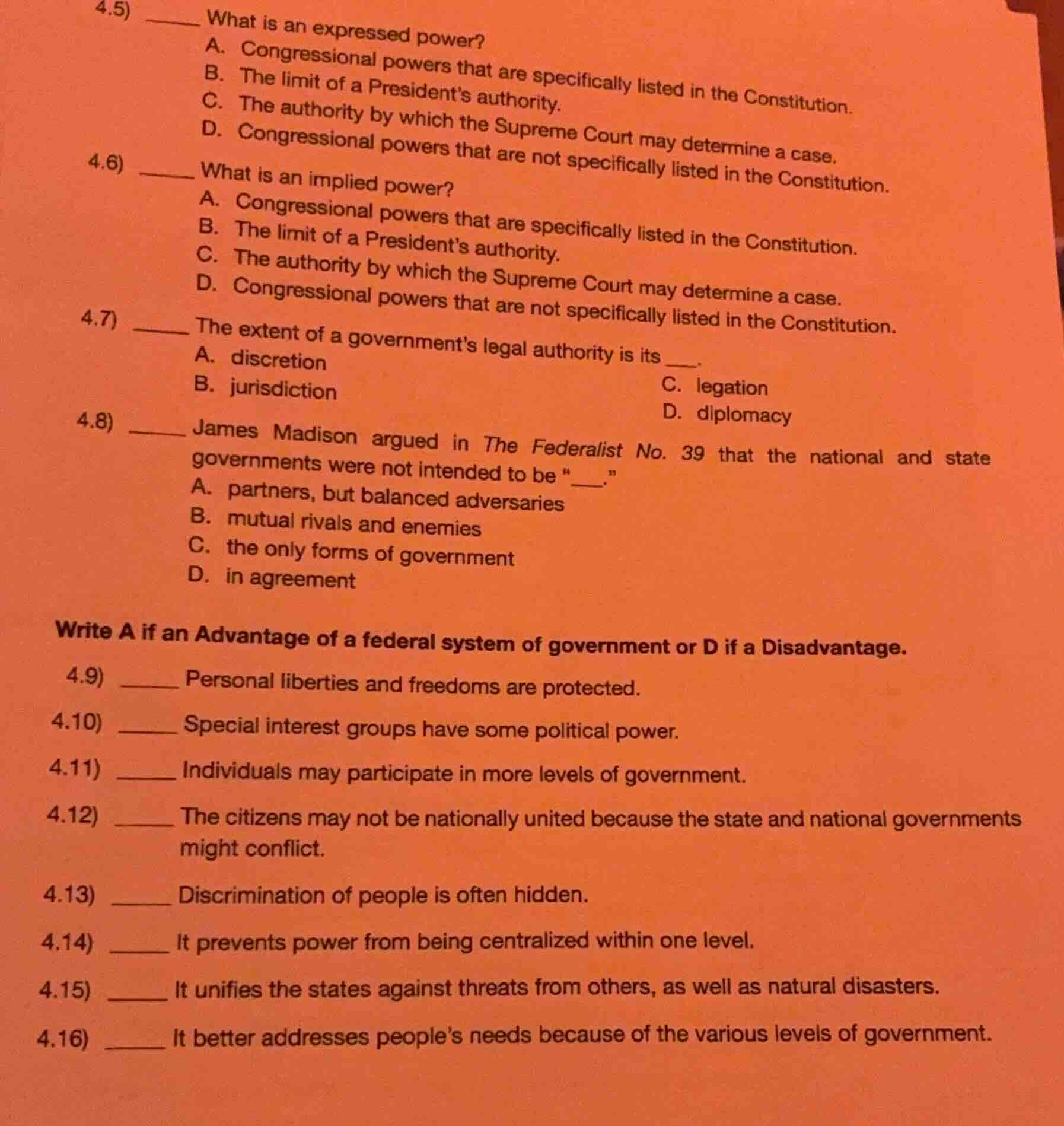
4.5) ____ what is an expressed power?
a. congressional powers that are specifically listed in the constitution.
b. the limit of a president’s authority.
c. the authority by which the supreme court may determine a case.
d. congressional powers that are not specifically listed in the constitution.
4.6) ____ what is an implied power?
a. congressional powers that are specifically listed in the constitution.
b. the limit of a president’s authority.
c. the authority by which the supreme court may determine a case.
d. congressional powers that are not specifically listed in the constitution.
4.7) __ the extent of a government’s legal authority is its _.
a. discretion c. legation
b. jurisdiction d. diplomacy
4.8) __ james madison argued in the federalist no. 39 that the national and state governments were not intended to be “_.”
a. partners, but balanced adversaries
b. mutual rivals and enemies
c. the only forms of government
d. in agreement
write a if an advantage of a federal system of government or d if a disadvantage.
4.9) ____ personal liberties and freedoms are protected.
4.10) ____ special interest groups have some political power.
4.11) ____ individuals may participate in more levels of government.
4.12) ____ the citizens may not be nationally united because the state and national governments might conflict.
4.13) ____ discrimination of people is often hidden.
4.14) ____ it prevents power from being centralized within one level.
4.15) ____ it unifies the states against threats from others, as well as natural disasters.
4.16) ____ it better addresses people’s needs because of the various levels of government.
4.5) Expressed powers are explicitly named in the U.S. Constitution for Congress.
4.6) Implied powers are not written out but are inferred for Congress to carry out expressed powers.
4.7) Jurisdiction defines the legal scope of a government's authority.
4.8) In Federalist No. 39, Madison framed national and state governments as balanced, not fully aligned or adversarial.
4.9) Protecting liberties is a core benefit of federalism.
4.10) Special interest groups gaining power can undermine broader public interests, a disadvantage.
4.11) Multi-level participation increases civic engagement, an advantage.
4.12) Inter-governmental conflict can split national unity, a disadvantage.
4.13) Federalism can let local governments hide discriminatory practices, a disadvantage.
4.14) Decentralizing power prevents authoritarian concentration, an advantage.
4.15) Unifying states for collective action is a key federalism strength, an advantage.
4.16) Localized government can meet community needs better, an advantage.

Snap & solve any problem in the app
Get step-by-step solutions on Sovi AI
Photo-based solutions with guided steps
Explore more problems and detailed explanations
4.5) A. Congressional powers that are specifically listed in the Constitution.
4.6) D. Congressional powers that are not specifically listed in the Constitution.
4.7) B. jurisdiction
4.8) A. partners, but balanced adversaries
4.9) A
4.10) D
4.11) A
4.12) D
4.13) D
4.14) A
4.15) A
4.16) A