QUESTION IMAGE
Question
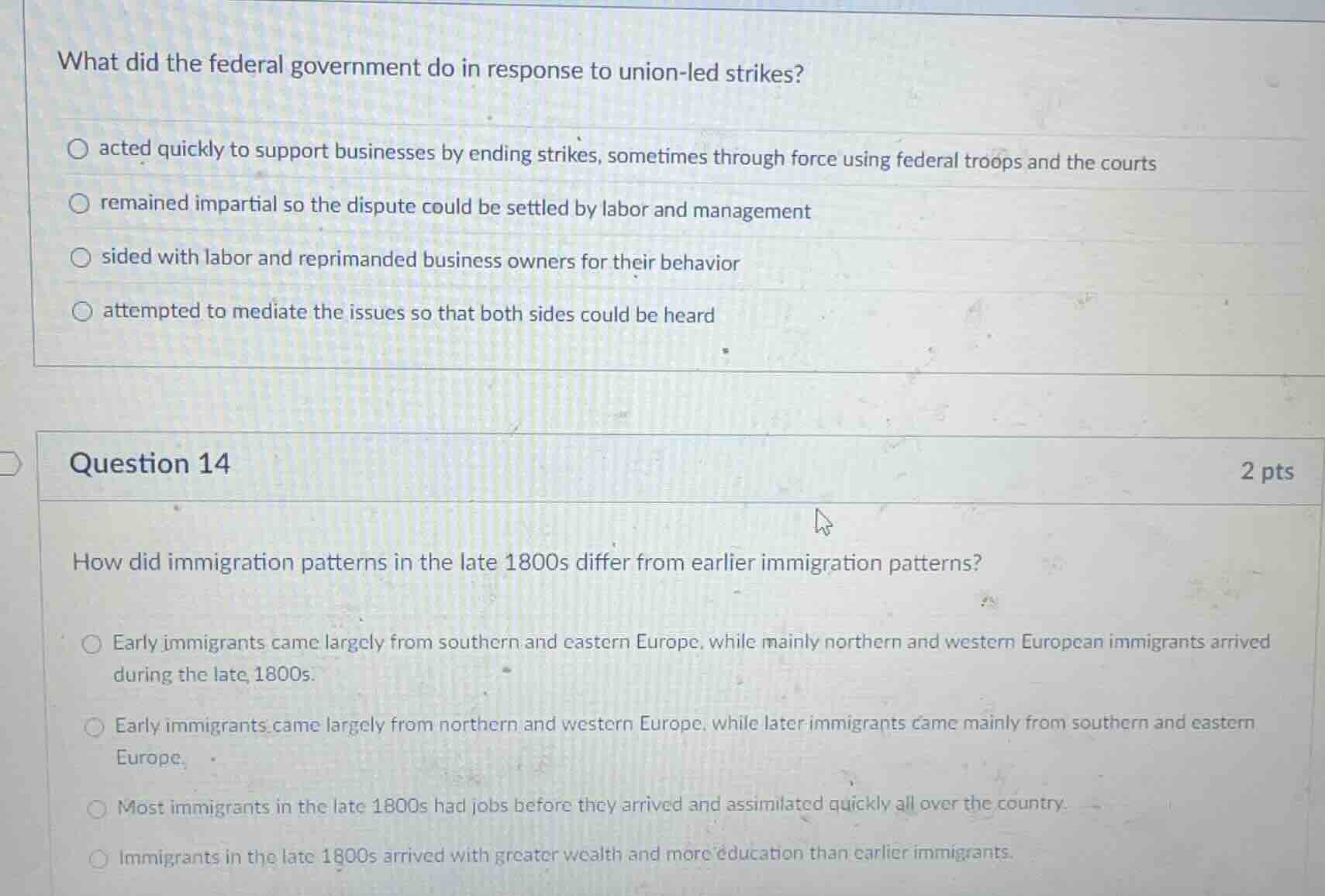
what did the federal government do in response to union - led strikes?
acted quickly to support businesses by ending strikes, sometimes through force using federal troops and the courts
remained impartial so the dispute could be settled by labor and management
sided with labor and reprimanded business owners for their behavior
attempted to mediate the issues so that both sides could be heard
question 14
2 pts
how did immigration patterns in the late 1800s differ from earlier immigration patterns?
early immigrants came largely from southern and eastern europe, while mainly northern and western european immigrants arrived during the late 1800s.
early immigrants came largely from northern and western europe, while later immigrants came mainly from southern and eastern europe.
most immigrants in the late 1800s had jobs before they arrived and assimilated quickly all over the country.
immigrants in the late 1800s arrived with greater wealth and more education than earlier immigrants.
For the first question: In the late 19th and early 20th centuries, the U.S. federal government typically took a pro-business stance during union strikes, using federal troops and court actions to end strikes and protect business interests.
For the second question: Before the late 1800s, most U.S. immigrants came from northern and western Europe. In the late 1800s, the majority shifted to southern and eastern Europe, with these new immigrants often having less wealth and facing more assimilation challenges.

Snap & solve any problem in the app
Get step-by-step solutions on Sovi AI
Photo-based solutions with guided steps
Explore more problems and detailed explanations
- acted quickly to support businesses by ending strikes, sometimes through force using federal troops and the courts
- Early immigrants came largely from northern and western Europe, while later immigrants came mainly from southern and eastern Europe.