QUESTION IMAGE
Question
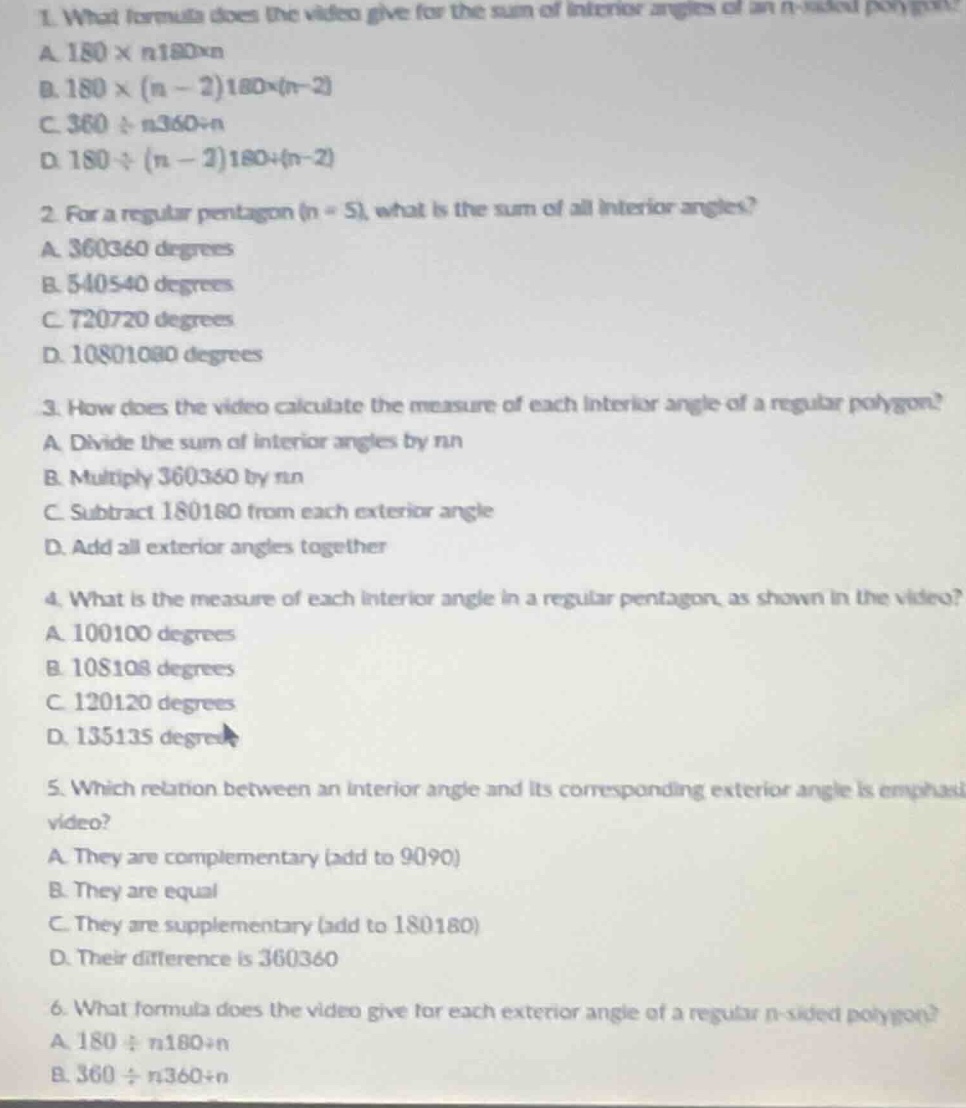
- what formula does the video give for the sum of interior angles of an n - sided polygon?
a. $180\times n$
b. $180\times(n - 2)$
c. $360\div n$
d. $180\div(n - 2)$
- for a regular pentagon ($n = 5$), what is the sum of all interior angles?
a. 360 degrees
b. 540 degrees
c. 720 degrees
d. 1080 degrees
- how does the video calculate the measure of each interior angle of a regular polygon?
a. divide the sum of interior angles by $n$
b. multiply 360 by $n$
c. subtract 180 from each exterior angle
d. add all exterior angles together
- what is the measure of each interior angle in a regular pentagon, as shown in the video?
a. 100 degrees
b. 108 degrees
c. 120 degrees
d. 135 degrees
- which relation between an interior angle and its corresponding exterior angle is emphasized in the video?
a. they are complementary (add to 90)
b. they are equal
c. they are supplementary (add to 180)
d. their difference is 360
- what formula does the video give for each exterior angle of a regular n - sided polygon?
a. $180\div n$
b. $360\div n$
Question 1
The formula for the sum of interior angles of an \( n \)-sided polygon is a well - known result in geometry. We can derive it by dividing the polygon into \( (n - 2) \) triangles. Since the sum of the interior angles of a triangle is \( 180^{\circ} \), the sum of the interior angles of an \( n \)-sided polygon is \( 180\times(n - 2) \).
Step 1: Recall the formula for the sum of interior angles
We know that the sum of interior angles of an \( n \)-sided polygon is given by \( S=180\times(n - 2) \).
Step 2: Substitute \( n = 5 \) (for a pentagon)
Substitute \( n = 5 \) into the formula: \( S=180\times(5 - 2)=180\times3 = 540 \) degrees.
In a regular polygon, all interior angles are equal. So, to find the measure of each interior angle, we take the sum of all interior angles (which we know from the formula \( 180\times(n - 2) \)) and divide it by the number of sides \( n \). Option B is incorrect because \( 360\times n \) has no relation to the measure of interior angles of a regular polygon. Option C is incorrect as the relation between interior and exterior angles is supplementary (they add up to \( 180^{\circ} \)), not subtracting 180 from the exterior angle to get the interior angle. Option D is incorrect because adding all exterior angles together gives \( 360^{\circ} \) for any polygon, not the measure of an interior angle.

Snap & solve any problem in the app
Get step-by-step solutions on Sovi AI
Photo-based solutions with guided steps
Explore more problems and detailed explanations
B. \( 180\times(n - 2) \)