QUESTION IMAGE
Question
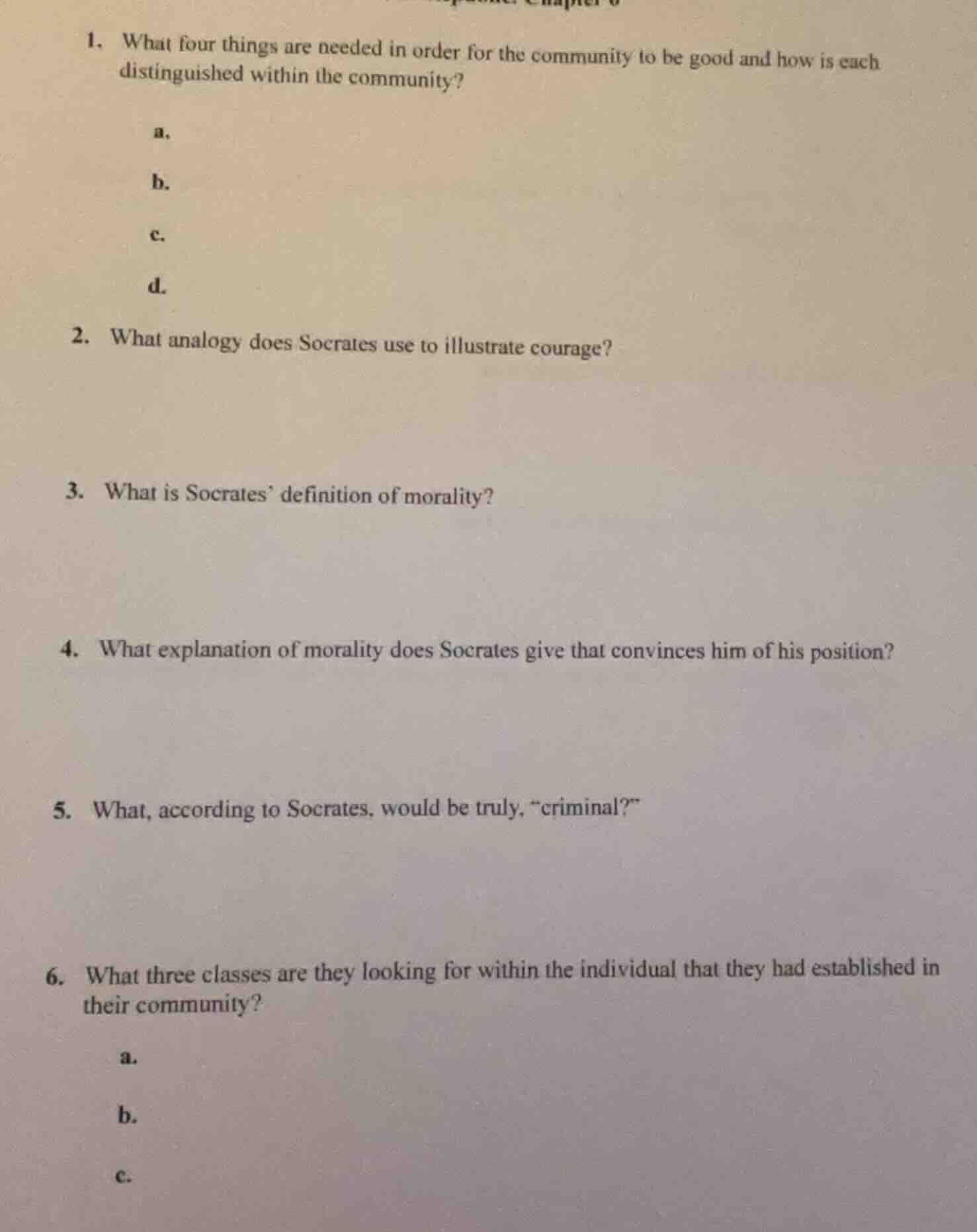
- what four things are needed in order for the community to be good and how is each distinguished within the community?
a.
b.
c.
d.
- what analogy does socrates use to illustrate courage?
- what is socrates definition of morality?
- what explanation of morality does socrates give that convinces him of his position?
- what, according to socrates, would be truly, \criminal?\
- what three classes are they looking for within the individual that they had established in their community?
a.
b.
c.
All questions refer to Plato's Republic, where Socrates outlines his political and ethical theories.
- The four virtues come from the class structure of the ideal city.
- Socrates uses a military-focused comparison for courage.
- His definition ties morality to internal order.
- He uses the city-soul analogy to confirm his view.
- True criminality stems from internal disorder.
- The individual's parts mirror the city's classes.

Snap & solve any problem in the app
Get step-by-step solutions on Sovi AI
Photo-based solutions with guided steps
Explore more problems and detailed explanations
1.
a. Wisdom: Held by the ruling guardian class; their knowledge of what is best for the entire community distinguishes them.
b. Courage: Held by the auxiliary (warrior) class; their ability to uphold beliefs about what is to be feared in service of the city distinguishes them.
c. Moderation: Shared across all classes; it is the agreement about who should rule and be ruled, creating harmony between the classes.
d. Justice: The principle that each class performs only its own proper function without interfering in the roles of others.
- Socrates uses the analogy of a city's auxiliaries (warriors) being like well-trained guard dogs: they are fierce toward threats to the city but gentle toward those within it, illustrating that courage is the preservation of the belief about what is truly dangerous, taught by the rulers.
- Socrates defines morality (justice) as having each part of the soul (or each class in the city) performing its own proper function without interfering with the others, maintaining internal order and harmony.
- Socrates uses the analogy between the just city and the just individual: he first defines justice in the city as each class fulfilling its role, then argues that the individual soul has three corresponding parts (rational, spirited, appetitive), and justice in the individual is each part fulfilling its proper role, with reason ruling. This parallel convinces him of his position.
- According to Socrates, a true "criminal" is someone whose appetitive part of the soul rules over the rational and spirited parts, leading them to act against their own good and the good of the community, breaking the internal order that defines morality.
6.
a. Rational part: Corresponding to the ruling guardian class, focused on wisdom and good judgment.
b. Spirited part: Corresponding to the auxiliary class, focused on courage and upholding the rational part's directives.
c. Appetitive part: Corresponding to the producer class, focused on basic desires like food, wealth, and comfort.