QUESTION IMAGE
Question
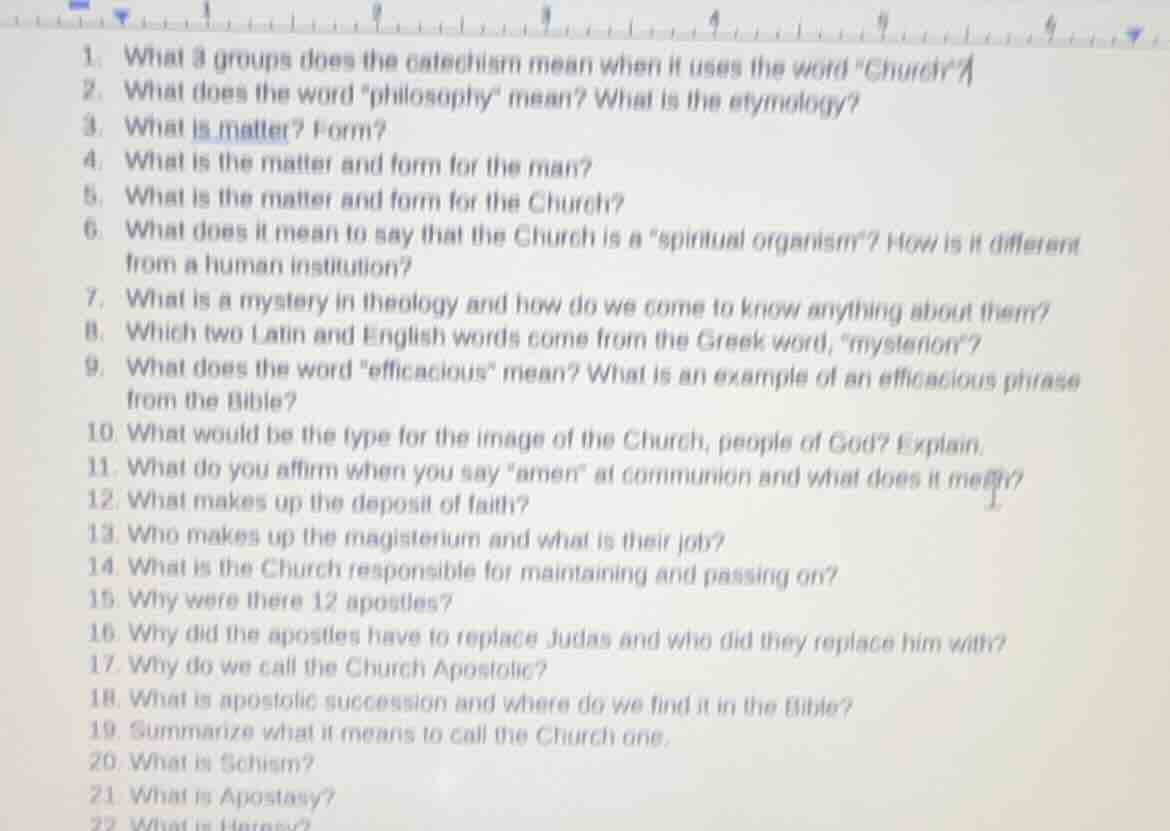
- what 3 groups does the catechism mean when it uses the word \church\?
- what does the word \philosophy\ mean? what is the etymology?
- what is matter? form?
- what is the matter and form for the man?
- what is the matter and form for the church?
- what does it mean to say that the church is a \spiritual organism\? how is it different from a human institution?
- what is a mystery in theology and how do we come to know anything about them?
- which two latin and english words come from the greek word, \mysterion\?
- what does the word \efficacious\ mean? what is an example of an efficacious phrase from the bible?
- what would be the type for the image of the church, people of god? explain.
- what do you affirm when you say \amen\ at communion and what does it mean?
- what makes up the deposit of faith?
- who makes up the magisterium and what is their job?
- what is the church responsible for maintaining and passing on?
- why were there 12 apostles?
- why did the apostles have to replace judas and who did they replace him with?
- why do we call the church apostolic?
- what is apostolic succession and where do we find it in the bible?
- summarize what it means to call the church one.
- what is schism?
- what is apostasy?
- what is heresy?
Brief Explanations
- The Catechism refers to the Church as the Triple Munera: the Church as the People of God, the Body of Christ, and the Temple of the Holy Spirit.
- Philosophy comes from the Greek philosophia, meaning "love of wisdom" (philo = love, sophia = wisdom). It is the study of fundamental questions about existence, knowledge, values, reason, mind, and language.
- In Thomistic (Aristotelian) theology, matter is the potential, material component of a thing; form is the actualizing principle that gives it its specific nature.
- For humans: matter is the physical body; form is the rational soul, which gives humans their unique intellectual and moral nature.
- For the Church: matter is the baptized faithful and the sacraments; form is the hierarchical structure (pope, bishops, priests) and the presence of the Holy Spirit.
- A "spiritual organism" means the Church is a living, unified body animated by the Holy Spirit, not just a human-made organization. Unlike a human institution (which is a structured group for a temporal goal), the Church exists to unite people to God and each other spiritually, with Christ as its head.
- In theology, a mystery is a truth about God or divine reality that surpasses human reason but is revealed by God. We come to know them through divine revelation (Scripture and Tradition) and the guidance of the Holy Spirit.
- From the Greek mysterion: Latin mysterium and English mystery.
- Efficacious means "effective, producing the intended result." An example from Scripture is Jesus' words at the Last Supper: "This is my blood of the covenant, which is poured out for many for the forgiveness of sins" (Matthew 26:28), which effects the forgiveness of sins when celebrated in the Eucharist.
- "People of God" is a covenantal image: it frames the Church as a chosen community bound to God by a sacred promise, called to live out God's will, analogous to the Israelites in the Old Testament.
- Saying "amen" at communion affirms your faith in the real presence of Christ in the Eucharist and your unity with the Church. It comes from Hebrew āmēn, meaning "truly, so be it."
- The deposit of faith is the full content of divine revelation, consisting of Sacred Scripture (the Bible) and Sacred Tradition (the living transmission of the Gospel through the Church).
- The magisterium is the teaching authority of the Church, made up of the Pope and the college of bishops in union with him. Their job is to guard, interpret, and teach the deposit of faith authentically.
- The Church is responsible for maintaining and passing on the deposit of faith (Scripture and Tradition), celebrating the sacraments, and bearing witness to the Gospel in the world.
- Jesus chose 12 apostles to correspond to the 12 tribes of Israel, symbolizing the new, universal People of God that the Church would form.
- Judas was replaced to maintain the 12-apostle structure (representing the 12 tribes). The apostles replaced him with Matthias (Acts 1:26).
- The Church is called "Apostolic" because it is built on the foundation of the apostles (Ephesians 2:20), and its teaching authority (magisterium) traces back to apostolic succession.
- Apostolic succession is the unbroken line of bishops tracing their ordination back to the apostles, ensuring the Church's continuity with apostolic teaching and authority. It is referenced in Acts 1:21-26 (choosing Matthias) and 1 Timothy 3:1-7 (qualifications for bishops).
- Calling the Church "one" means it is unified in faith, worship…

Snap & solve any problem in the app
Get step-by-step solutions on Sovi AI
Photo-based solutions with guided steps
Explore more problems and detailed explanations
- The People of God, the Body of Christ, the Temple of the Holy Spirit
- "Love of wisdom"; from Greek philosophia (philo = love, sophia = wisdom)
- Matter = potential material; Form = actualizing nature
- Matter = human body; Form = rational soul
- Matter = baptized faithful/sacraments; Form = hierarchy/Holy Spirit
- Living spiritual body (not human institution); Christ as head
- Revealed divine truth beyond reason; known via Scripture/Tradition
- Latin mysterium, English mystery
- Effective; Example: "This is my blood..." (Matthew 26:28)
- Covenantal image: chosen, unified community of God
- Affirms faith in Eucharist; "Truly, so be it"
- Sacred Scripture and Sacred Tradition
- Pope + bishops in union; guard/teach the faith
- Deposit of faith, sacraments, Gospel witness
- Correlate to 12 tribes of Israel (new People of God)
- To keep 12-apostle structure; replaced with Matthias
- Built on apostles, apostolic succession of bishops
- Unbroken bishop line from apostles; Acts 1:21-26, 1 Tim 3:1-7
- Unified in faith, worship, governance under Christ/Spirit
- Deliberate break from Church unity/authority
- Total rejection of Christian faith by a believer
- Deliberate denial of a defined Christian truth