QUESTION IMAGE
Question
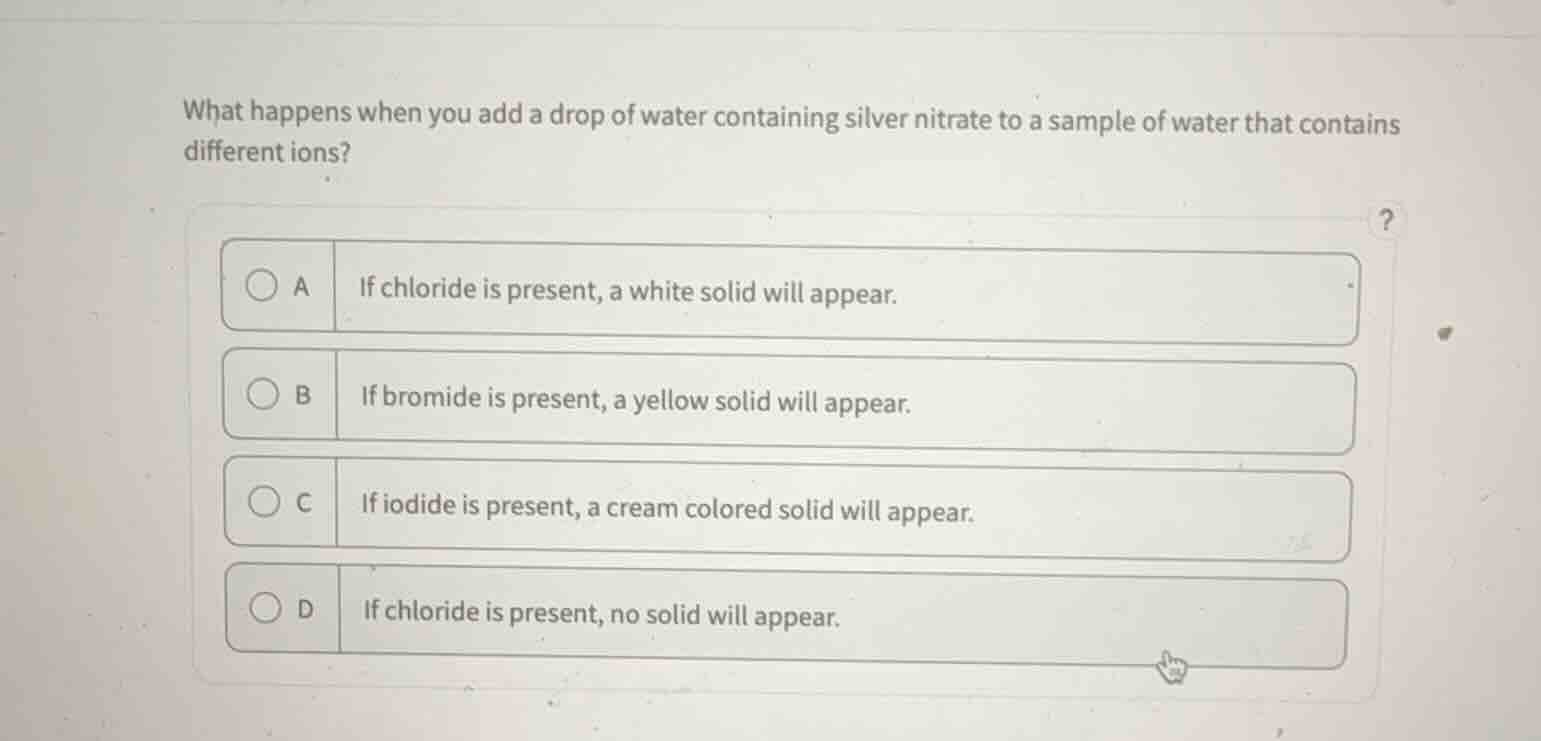
what happens when you add a drop of water containing silver nitrate to a sample of water that contains different ions? a if chloride is present, a white solid will appear. b if bromide is present, a yellow solid will appear. c if iodide is present, a cream colored solid will appear. d if chloride is present, no solid will appear.
To solve this, we recall the reactions of silver nitrate (\(AgNO_3\)) with halide ions:
- Reaction with chloride (\(Cl^-\)): \(Ag^+ + Cl^-
ightarrow AgCl(s)\). \(AgCl\) is a white precipitate.
- Reaction with bromide (\(Br^-\)): \(Ag^+ + Br^-
ightarrow AgBr(s)\). \(AgBr\) is a cream - colored precipitate.
- Reaction with iodide (\(I^-\)): \(Ag^+ + I^-
ightarrow AgI(s)\). \(AgI\) is a yellow precipitate.
Now let's analyze each option:
- Option A: When chloride is present, silver chloride (\(AgCl\)) is formed which is a white solid. This statement is correct.
- Option B: Bromide forms a cream - colored solid (AgBr), not a yellow solid. So this option is incorrect.
- Option C: Iodide forms a yellow solid (AgI), not a cream - colored solid. So this option is incorrect.
- Option D: Chloride reacts with silver ions to form a white solid (AgCl), so the statement that no solid will appear is incorrect.

Snap & solve any problem in the app
Get step-by-step solutions on Sovi AI
Photo-based solutions with guided steps
Explore more problems and detailed explanations
A. If chloride is present, a white solid will appear.