QUESTION IMAGE
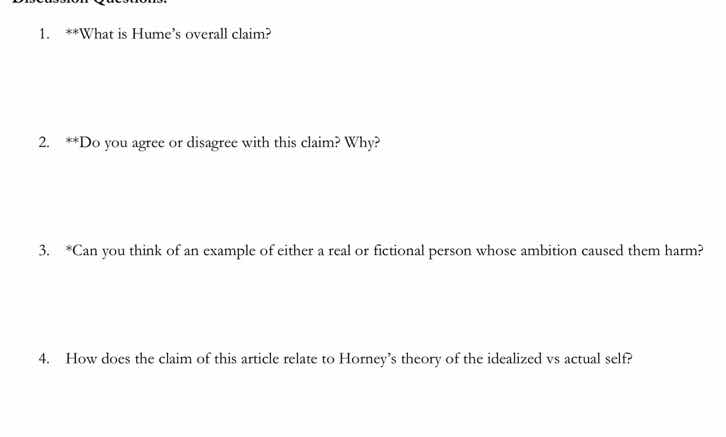
Question
- **what is hume’s overall claim?
- **do you agree or disagree with this claim? why?
- *can you think of an example of either a real or fictional person whose ambition caused them harm?
- how does the claim of this article relate to horney’s theory of the idealized vs actual self?**
Question 1: What is Hume’s overall claim?
David Hume, in his philosophical works (especially in relation to topics like human nature, reason, passion, and morality), often argued that reason is the “slave of the passions.” His overall claim typically centers around the idea that reason alone cannot motivate action; instead, human behavior is driven by passions (emotions, desires, sentiments). For example, in moral philosophy, he posited that moral judgments are not derived from reason but from sentimental responses (like approval or disapproval) to actions, and that reason’s role is mainly to help us navigate means to achieve ends set by our passions.
To answer, we analyze Hume’s “reason as slave of the passions” claim. If agreeing: Consider real - world examples (e.g., people pursue careers not just for rational “pros/cons” but for passion: an artist creates out of love for art, not just logical calculation). Emotions like empathy drive moral acts (helping others), showing passion (sentiment) as the motivator, with reason as a tool. If disagreeing: Argue that reason can override passion (e.g., a dieter using reason to resist the passionate desire for junk food; or ethical systems like Kantian deontology, where reason (duty - based) drives action, not passion).
For example, agreeing: Most daily choices (e.g., choosing a hobby, a relationship) are passion - led, and reason just refines how to pursue them (e.g., researching the best art supplies, not whether to create art). Disagreeing: In moral dilemmas, reason (e.g., weighing universal moral laws) can guide action without passion (e.g., a soldier following a just - war theory out of duty, not passion).
- Fictional example: Macbeth (from Shakespeare’s Macbeth). His ambition to become king (fueled by greed and the witches’ prophecy) led him to commit regicide, betrayal, and tyranny. This ambition caused his moral corruption, the loss of his wife (Lady Macbeth’s madness and death), and ultimately his own downfall (defeat and death in battle).
- Real - world example: Some historical figures (e.g., certain dictators or power - hungry leaders) whose ambition for absolute control led to war, human suffering, and their own eventual downfall (e.g., Napoleon’s ambition for European conquest led to his defeat at Waterloo and exile, after years of warfare and loss).

Snap & solve any problem in the app
Get step-by-step solutions on Sovi AI
Photo-based solutions with guided steps
Explore more problems and detailed explanations
Hume’s overall claim (often regarding human motivation, reason, and passion) is that reason is the “slave of the passions”—reason alone cannot motivate action, and human behavior (including moral judgment and choice) is fundamentally driven by passions (desires, emotions, sentiments), with reason serving to identify means to achieve ends set by these passions.