QUESTION IMAGE
Question
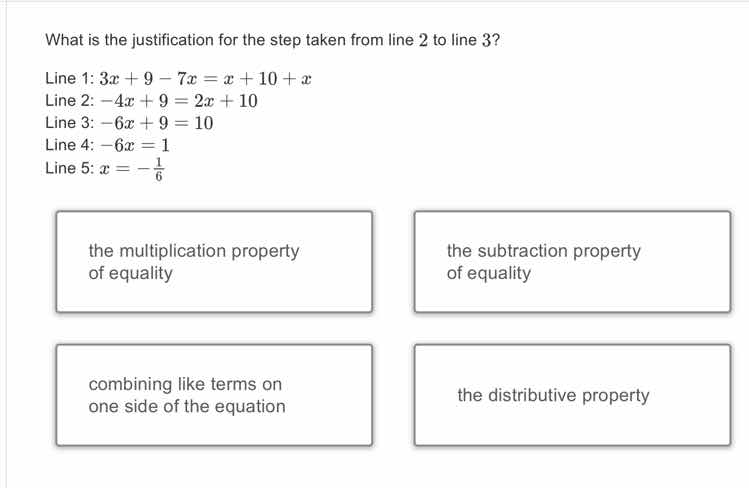
what is the justification for the step taken from line 2 to line 3?
line 1: 3x + 9 - 7x = x + 10 + x
line 2: -4x + 9 = 2x + 10
line 3: -6x + 9 = 10
line 4: -6x = 1
line 5: x = -\frac{1}{6}
- the multiplication property of equality
- the subtraction property of equality
- combining like terms on one side of the equation
- the distributive property
Step1: Analyze Line 2 and Line 3
Line 2 is \(-4x + 9 = 2x + 10\), Line 3 is \(-6x + 9 = 10\). To get from Line 2 to Line 3, we subtract \(2x\) from both sides. This is based on the subtraction property of equality, which states that if we subtract the same quantity from both sides of an equation, the equation remains true.
To go from Line 2 (\(-4x + 9 = 2x + 10\)) to Line 3 (\(-6x + 9 = 10\)), we subtract \(2x\) from both sides. This follows the subtraction property of equality (subtracting the same value from both sides of an equation keeps it balanced). Other options: "multiplication property" is for multiplying both sides, "combining like terms" would be for terms on the same side, and "distributive property" involves distributing a factor, none of which apply here.

Snap & solve any problem in the app
Get step-by-step solutions on Sovi AI
Photo-based solutions with guided steps
Explore more problems and detailed explanations
the subtraction property of equality