QUESTION IMAGE
Question
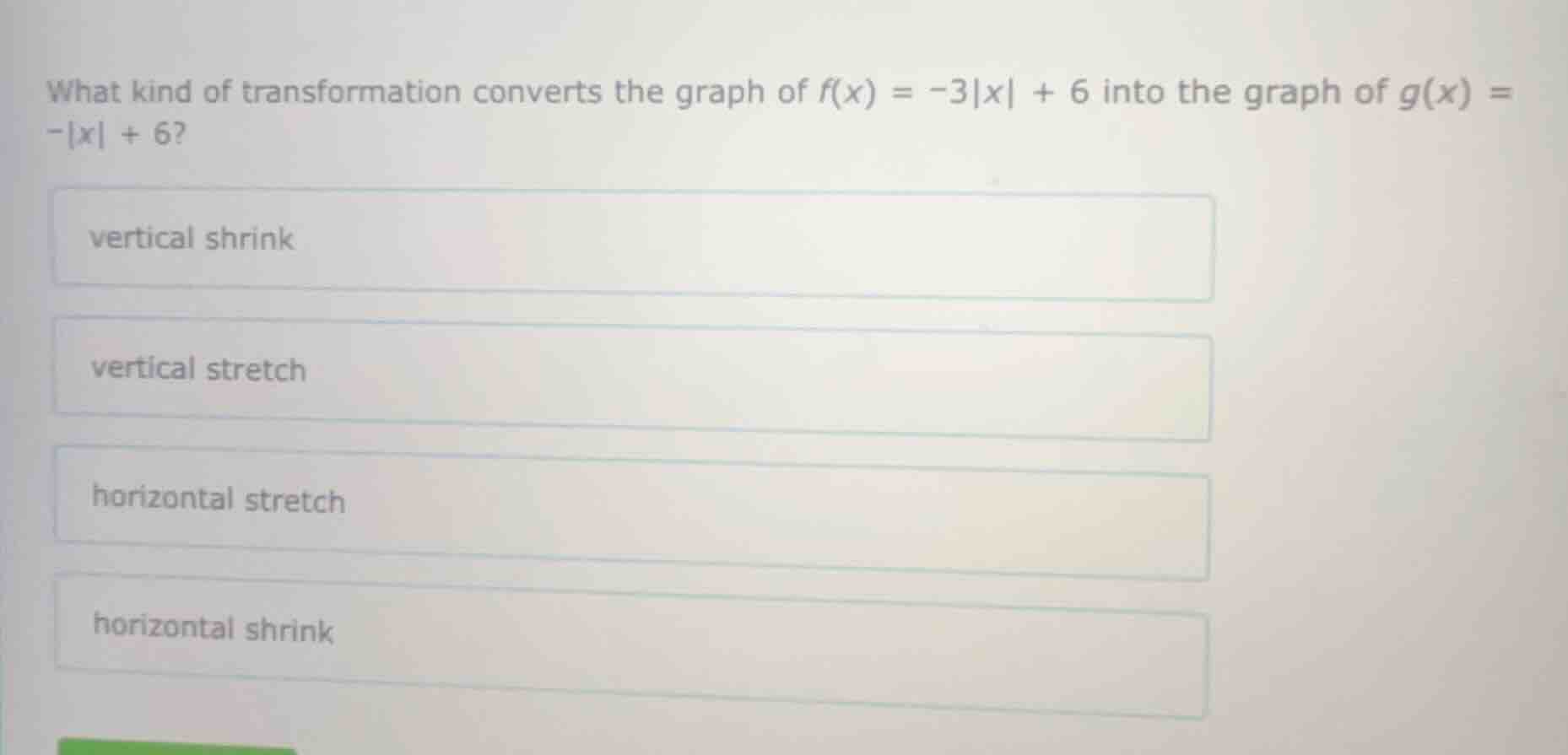
what kind of transformation converts the graph of $f(x) = -3|x| + 6$ into the graph of $g(x) = -|x| + 6$?
vertical shrink
vertical stretch
horizontal stretch
horizontal shrink
Step1: Recall Vertical Stretch/Shrink Rules
For a function \( y = a f(x) \), if \( |a|>1 \), it's a vertical stretch; if \( 0<|a|<1 \), it's a vertical shrink. Here, \( f(x)=-3|x| + 6 \) and \( g(x)=-|x| + 6 \). We can write \( g(x)=\frac{1}{3}f(x) \) (since \( \frac{1}{3}(-3|x| + 6)=-|x| + 2 \)? Wait, no, wait. Wait, \( f(x)=-3|x| + 6 \), \( g(x)=-|x| + 6 \). Let's factor out the coefficient of \( |x| \). For \( f(x) \), the coefficient of \( |x| \) is -3; for \( g(x) \), it's -1. So to get from \( f(x) \) to \( g(x) \), we divide the coefficient of \( |x| \) by 3 (since \( -3 \times \frac{1}{3}=-1 \)). So the transformation is \( g(x)=\frac{1}{3}f(x) \)? Wait, no, \( f(x)=-3|x| + 6 \), so \( \frac{1}{3}f(x)=\frac{1}{3}(-3|x| + 6)=-|x| + 2 \), which is not \( g(x) \). Wait, I made a mistake. Wait, the constant term is the same? Wait, no, \( f(x)=-3|x| + 6 \), \( g(x)=-|x| + 6 \). So the difference is in the coefficient of \( |x| \). Let's think of the general form for vertical stretch/shrink: if we have \( y = a f(x) \), but here the constant term is the same. Wait, actually, the function is \( f(x)=-3|x| + 6 \), \( g(x)=-|x| + 6 \). Let's let \( f(x)=-3|x| + 6 \), then \( g(x)=\frac{1}{3}(-3|x|) + 6 \)? Wait, no, \( \frac{1}{3} \times (-3|x|)=-|x| \), and the constant term remains 6? Wait, no, \( \frac{1}{3}f(x)=\frac{1}{3}(-3|x| + 6)=-|x| + 2 \), which is not \( g(x) \). Wait, maybe the constant term is a typo? No, the problem says \( g(x)=-|x| + 6 \). Wait, maybe I misread. Wait, \( f(x)=-3|x| + 6 \), \( g(x)=-|x| + 6 \). So the vertical transformation: the coefficient of \( |x| \) goes from -3 to -1, so the factor is \( \frac{1}{3} \) (since \( -3 \times \frac{1}{3}=-1 \)). So the transformation is a vertical shrink because the absolute value of the coefficient \( a \) (when considering the transformation from \( f(x) \) to \( g(x) \) as \( g(x)=a f(x) + b \), but here \( b \) is the same? Wait, no, the constant term is the same, so it's a vertical shrink because we're multiplying the \( |x| \) term by \( \frac{1}{3} \), and \( 0<\frac{1}{3}<1 \), so it's a vertical shrink.
Step2: Determine the Type of Transformation
Since the coefficient of \( |x| \) in \( f(x) \) is -3 and in \( g(x) \) is -1, we are multiplying the \( |x| \) term by \( \frac{1}{3} \) (because \( -3 \times \frac{1}{3} = -1 \)). The absolute value of \( \frac{1}{3} \) is between 0 and 1, so this is a vertical shrink. Horizontal stretch/shrink affects the input \( x \) (like \( f(bx) \)), but here the \( x \) inside the absolute value is the same, so it's a vertical transformation, not horizontal. So the transformation is a vertical shrink.

Snap & solve any problem in the app
Get step-by-step solutions on Sovi AI
Photo-based solutions with guided steps
Explore more problems and detailed explanations
vertical shrink