QUESTION IMAGE
Question
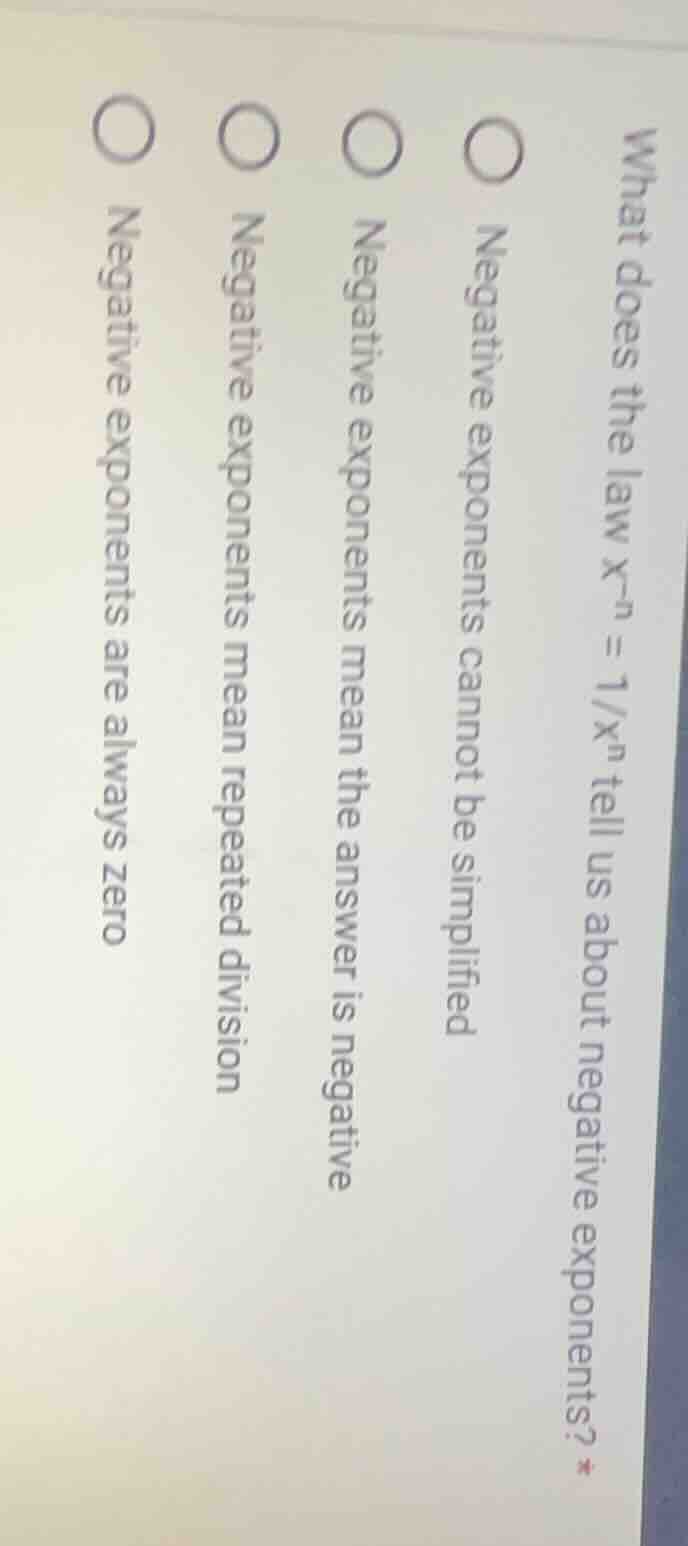
what does the law $x^{-n} = 1/x^n$ tell us about negative exponents? *
negative exponents cannot be simplified
negative exponents mean the answer is negative
negative exponents mean repeated division
negative exponents are always zero
Brief Explanations
Let's analyze each option:
- Option 1: Negative exponents can be simplified (e.g., \(2^{-1}=\frac{1}{2}\)), so this is wrong.
- Option 2: The formula \(x^{-n}=\frac{1}{x^{n}}\) shows that a negative exponent indicates taking the reciprocal, which is related to repeated division (since \(x^{n}\) is \(x\times x\times\cdots\times x\) and \(\frac{1}{x^{n}}\) can be thought of as dividing 1 by \(x\) repeatedly \(n\) times). This matches the meaning of the negative exponent law.
- Option 3: The sign of the exponent doesn't determine the sign of the result (e.g., \(2^{-1}=\frac{1}{2}\) is positive), so this is wrong.
- Option 4: Negative exponents are not always zero (e.g., \(3^{-2}=\frac{1}{9}
eq0\)), so this is wrong.

Snap & solve any problem in the app
Get step-by-step solutions on Sovi AI
Photo-based solutions with guided steps
Explore more problems and detailed explanations
B. Negative exponents mean repeated division (assuming the second option is labeled B, as per the order: first option A, second B, third C, fourth D)