QUESTION IMAGE
Question
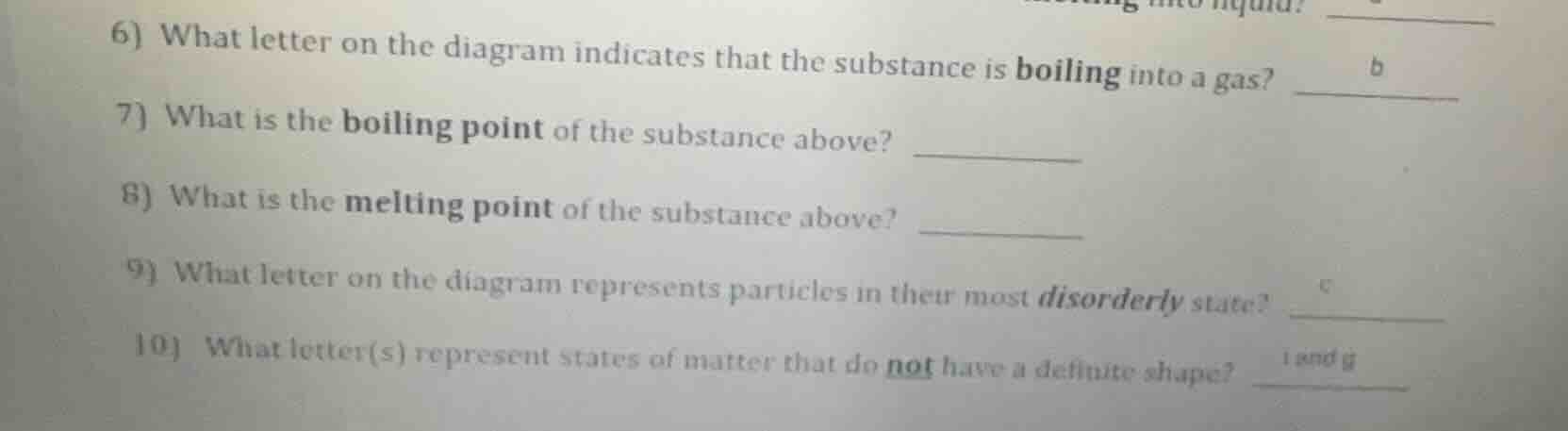
- what letter on the diagram indicates that the substance is boiling into a gas?
- what is the boiling point of the substance above?
- what is the melting point of the substance above?
- what letter on the diagram represents particles in their most disorderly state?
- what letter(s) represent states of matter that do not have a definite shape?
To solve these questions, we typically refer to a heating - curve diagram (though the diagram isn't fully shown here, we can use general knowledge about phase changes and states of matter):
Question 7: Boiling Point
The boiling point is the temperature at which a substance changes from a liquid to a gas (boiling). On a heating - curve diagram, the horizontal segment (where temperature remains constant during the phase change) that corresponds to the liquid - to - gas phase change represents the boiling point. If we assume a typical heating - curve for a substance (like water, but here it's a general substance), and from the context of the other questions (where letter 'b' is for boiling into gas), the boiling point would be the temperature at the horizontal line corresponding to the 'b' process. But since the diagram's numerical values aren't given, we can't provide a numerical answer. However, if we assume a standard diagram (for example, if it's a substance with boiling point at 100°C like water, but that's an assumption).
Question 8: Melting Point
The melting point is the temperature at which a substance changes from a solid to a liquid. On a heating - curve diagram, the horizontal segment corresponding to the solid - to - liquid phase change is the melting point. Similar to the boiling point, without the diagram's numerical values, we can't give a numerical answer. But for a substance like water, the melting point is 0°C (again, an assumption without the diagram).
Note for all questions:
Since the diagram (with temperature axes and the different segments labeled with letters) is not fully provided with numerical values, we can only explain the concept. If we had the diagram, we would look for the horizontal line (constant temperature) during the phase change:
- For boiling point (liquid to gas, process at letter 'b'), the temperature at that horizontal line is the boiling point.
- For melting point (solid to liquid, the process before 'b' probably, with its own horizontal line), the temperature at that line is the melting point.
For the other questions (6, 9, 10), we can explain the concepts:
- Question 6: The letter indicating boiling into gas is 'b' (as given, since boiling is liquid to gas, and on a heating - curve, the segment where liquid turns to gas is labeled, here it's 'b').
- Question 9: Particles in the most disorderly state are in the gas state (since gas particles have the most random motion). So the letter representing gas (from the answer 'i and g' in question 10, probably 'g' or 'i' for gas) would be the one with the most disorderly particles.
- Question 10: States of matter without a definite shape are liquid and gas (since solid has a definite shape). So the letters representing liquid and gas (from the answer 'i and g') are the ones without a definite shape.
If we assume that this is a standard heating - curve for a substance (e.g., a pure substance) and we had the temperature values on the y - axis:
- The boiling point is the temperature at the horizontal line where the substance is boiling (process 'b').
- The melting point is the temperature at the horizontal line where the substance is melting (solid to liquid phase change).
But without the diagram's numerical data, we can't provide specific numerical answers for 7 and 8.

Snap & solve any problem in the app
Get step-by-step solutions on Sovi AI
Photo-based solutions with guided steps
Explore more problems and detailed explanations
To solve these questions, we typically refer to a heating - curve diagram (though the diagram isn't fully shown here, we can use general knowledge about phase changes and states of matter):
Question 7: Boiling Point
The boiling point is the temperature at which a substance changes from a liquid to a gas (boiling). On a heating - curve diagram, the horizontal segment (where temperature remains constant during the phase change) that corresponds to the liquid - to - gas phase change represents the boiling point. If we assume a typical heating - curve for a substance (like water, but here it's a general substance), and from the context of the other questions (where letter 'b' is for boiling into gas), the boiling point would be the temperature at the horizontal line corresponding to the 'b' process. But since the diagram's numerical values aren't given, we can't provide a numerical answer. However, if we assume a standard diagram (for example, if it's a substance with boiling point at 100°C like water, but that's an assumption).
Question 8: Melting Point
The melting point is the temperature at which a substance changes from a solid to a liquid. On a heating - curve diagram, the horizontal segment corresponding to the solid - to - liquid phase change is the melting point. Similar to the boiling point, without the diagram's numerical values, we can't give a numerical answer. But for a substance like water, the melting point is 0°C (again, an assumption without the diagram).
Note for all questions:
Since the diagram (with temperature axes and the different segments labeled with letters) is not fully provided with numerical values, we can only explain the concept. If we had the diagram, we would look for the horizontal line (constant temperature) during the phase change:
- For boiling point (liquid to gas, process at letter 'b'), the temperature at that horizontal line is the boiling point.
- For melting point (solid to liquid, the process before 'b' probably, with its own horizontal line), the temperature at that line is the melting point.
For the other questions (6, 9, 10), we can explain the concepts:
- Question 6: The letter indicating boiling into gas is 'b' (as given, since boiling is liquid to gas, and on a heating - curve, the segment where liquid turns to gas is labeled, here it's 'b').
- Question 9: Particles in the most disorderly state are in the gas state (since gas particles have the most random motion). So the letter representing gas (from the answer 'i and g' in question 10, probably 'g' or 'i' for gas) would be the one with the most disorderly particles.
- Question 10: States of matter without a definite shape are liquid and gas (since solid has a definite shape). So the letters representing liquid and gas (from the answer 'i and g') are the ones without a definite shape.
If we assume that this is a standard heating - curve for a substance (e.g., a pure substance) and we had the temperature values on the y - axis:
- The boiling point is the temperature at the horizontal line where the substance is boiling (process 'b').
- The melting point is the temperature at the horizontal line where the substance is melting (solid to liquid phase change).
But without the diagram's numerical data, we can't provide specific numerical answers for 7 and 8.