QUESTION IMAGE
Question
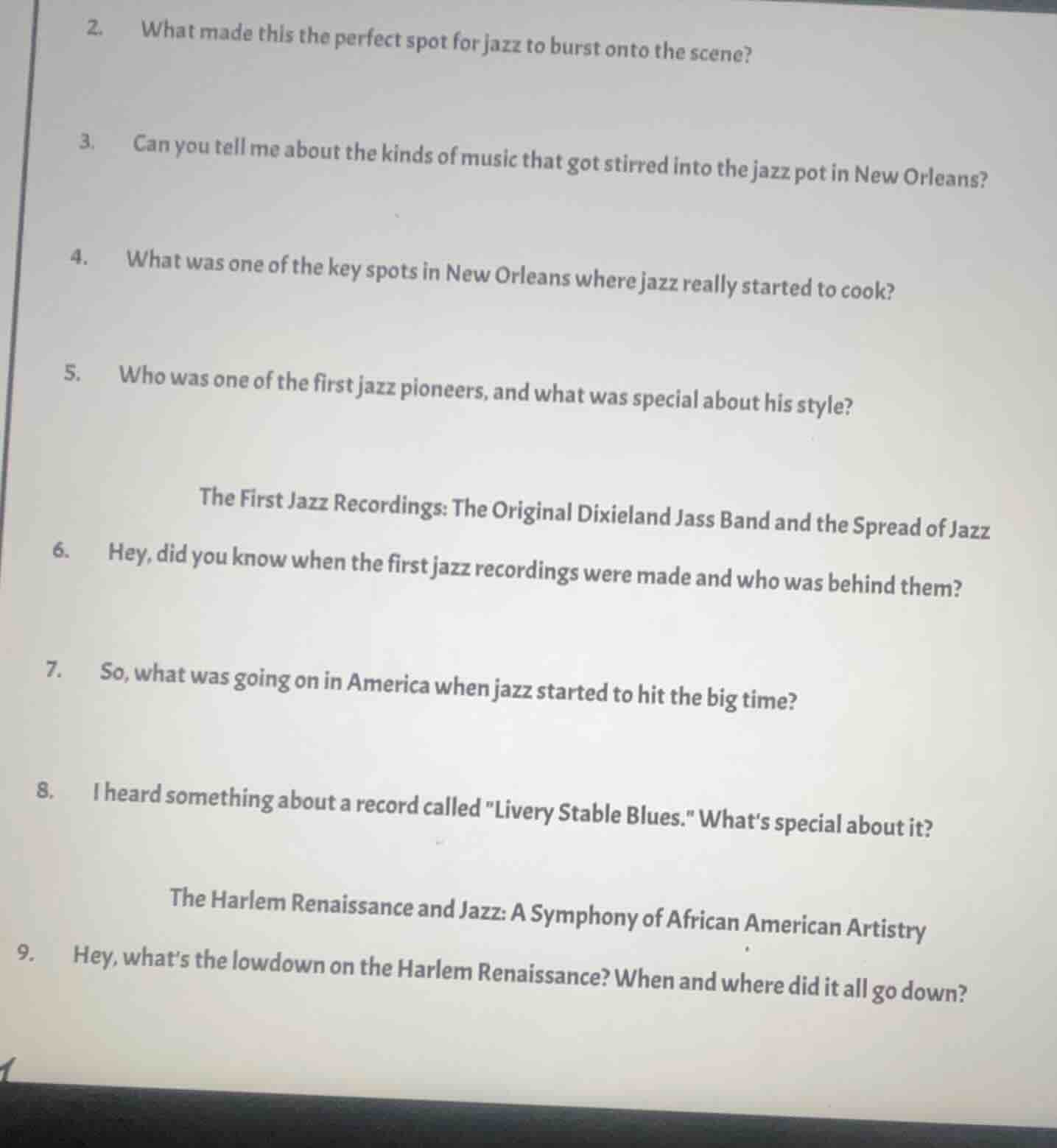
- what made this the perfect spot for jazz to burst onto the scene?
- can you tell me about the kinds of music that got stirred into the jazz pot in new orleans?
- what was one of the key spots in new orleans where jazz really started to cook?
- who was one of the first jazz pioneers, and what was special about his style?
the first jazz recordings: the original dixieland jass band and the spread of jazz
- hey, did you know when the first jazz recordings were made and who was behind them?
- so, what was going on in america when jazz started to hit the big time?
- i heard something about a record called \livery stable blues.\ whats special about it?
the harlem renaissance and jazz: a symphony of african american artistry
- hey, whats the lowdown on the harlem renaissance? when and where did it all go down?
These questions are about the history and development of jazz music, as well as the Harlem Renaissance. To answer them, we can draw on knowledge from the field of Arts (specifically Music History, which falls under the broader umbrella of Arts or could also be related to Social Science in terms of cultural history). Here are brief explanations and answers for each question:
Question 2: What made this the perfect spot for jazz to burst onto the scene?
New Orleans had a unique cultural mix. It was a port city with diverse populations (African, Caribbean, European, etc.) bringing different musical traditions. The city had a vibrant nightlife, with brass bands for parades and social events, and a tolerance for African - American musical expression in places like Storyville (the red - light district) which allowed for musical experimentation. The blend of African rhythms, European musical theory, and Caribbean influences, along with the availability of musical instruments and a community that supported live music, made it ideal for jazz's birth.
African music (with complex rhythms, call - and - response patterns) was a base. European music contributed musical notation, harmony, and instruments like the trumpet and clarinet. Caribbean music (with syncopated rhythms) added flavor. Brass band music (used in parades, with lively melodies) and ragtime (syncopated piano - based music with a strong rhythm) were also key ingredients. Blues, with its emotional expression and 12 - bar structure, was another important component.
Storyville, the red - light district of New Orleans, was a key spot. It had numerous brothels, saloons, and clubs where musicians could perform. Musicians from different backgrounds came together here to play, experiment with different musical styles, and develop the jazz sound. The bars and dance halls in Storyville provided a venue for the mixing of musical traditions that led to the growth of jazz.

Snap & solve any problem in the app
Get step-by-step solutions on Sovi AI
Photo-based solutions with guided steps
Explore more problems and detailed explanations
New Orleans' diverse cultural mix (African, Caribbean, European traditions), vibrant nightlife with brass bands, tolerance for African - American musical expression (e.g., in Storyville), and blend of musical influences made it perfect for jazz.