QUESTION IMAGE
Question
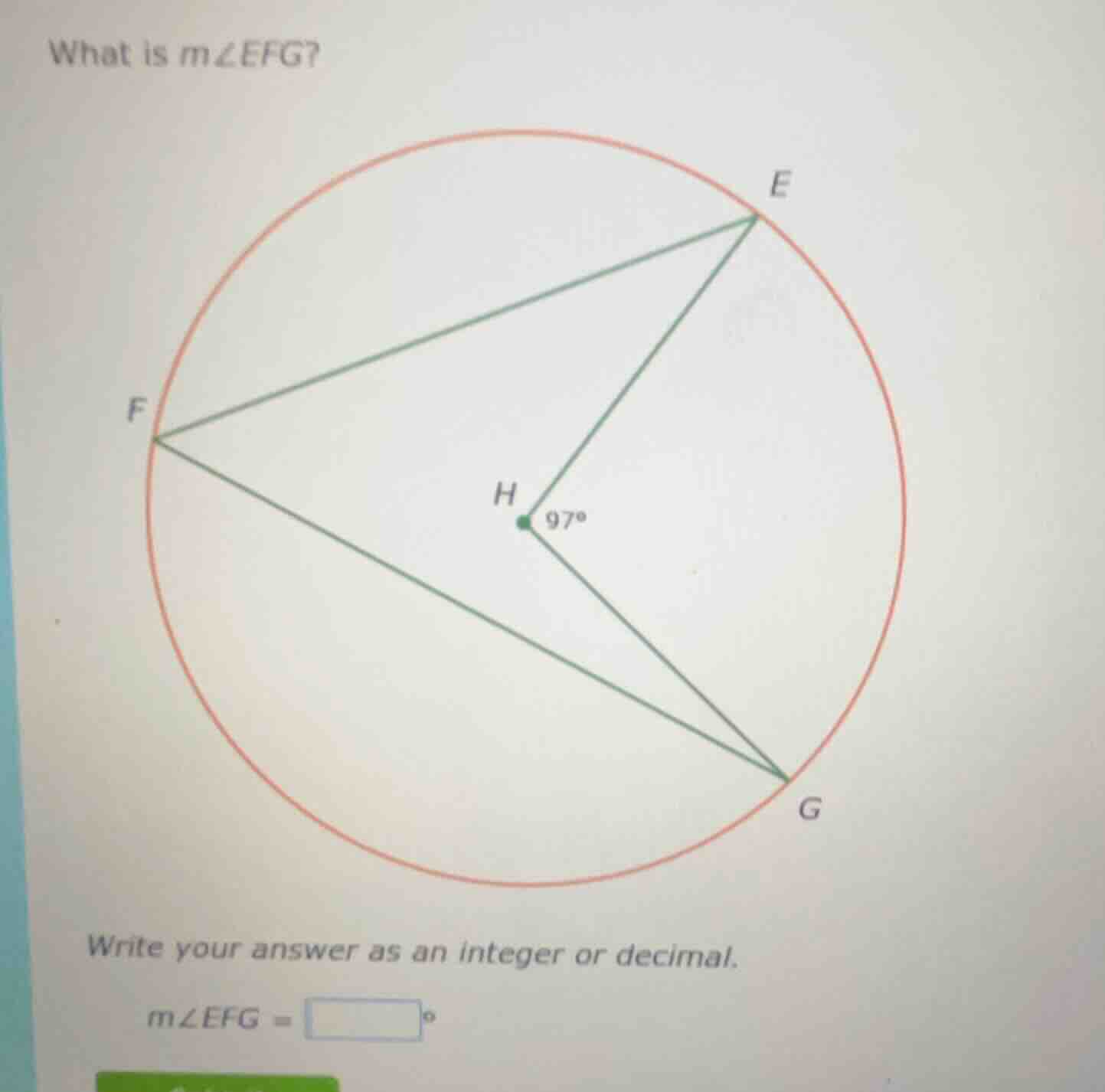
what is ( mangle efg )?
write your answer as an integer or decimal.
( mangle efg = square^circ )
Step1: Find arc EG measure
The central angle $\angle EHG = 97^\circ$, so the measure of arc $EG$ is equal to the central angle: $m\overset{\frown}{EG} = 97^\circ$.
Step2: Find arc EFG measure
The total circumference of a circle is $360^\circ$, so the measure of the major arc $EFG$ is:
$m\overset{\frown}{EFG} = 360^\circ - 97^\circ = 263^\circ$
Step3: Calculate $\angle EFG$
$\angle EFG$ is an inscribed angle intercepting arc $EG$. Wait, correction: $\angle EFG$ intercepts arc $EG$, but inscribed angle is half the measure of its intercepted arc? No, correction: $\angle EFG$ is an inscribed angle intercepting the arc that is opposite, the arc $EG$ is the minor arc, but actually, the inscribed angle formula: the measure of an inscribed angle is half the measure of its intercepted arc. Wait, no, $\angle EFG$ is on the circumference, intercepting arc $EG$. Wait, no, the inscribed angle over arc $EG$ would be half the measure of arc $EG$, but wait, no: the central angle is $97^\circ$ for arc $EG$, so the inscribed angle over arc $EG$ is $\frac{97^\circ}{2}$? No, wait, no, $\angle EFG$ is formed by chords $FE$ and $FG$, so it intercepts arc $EG$. Wait, no, actually, the inscribed angle theorem says that an angle formed by two chords in a circle with the vertex on the circle is half the measure of the intercepted arc. But wait, if the angle is on the circumference, and the intercepted arc is the one not containing the angle, wait no: if the angle is on the circumference, the intercepted arc is the arc that is cut off by the two sides of the angle, and does not contain the vertex. So arc $EG$ is $97^\circ$, so the inscribed angle over arc $EG$ is $\frac{1}{2} \times 97^\circ$? No, wait, no, the central angle is equal to the arc measure, inscribed angle is half. Wait, but let's check: the inscribed angle $\angle EFG$ intercepts arc $EG$, so $m\angle EFG = \frac{1}{2} \times m\overset{\frown}{EG}$? No, wait, no, that's if the angle is on the opposite side. Wait, no, the vertex F is on the circumference, so the arc that is opposite is arc EG, which is $97^\circ$, so the inscribed angle is half of that? Wait, no, no, the inscribed angle theorem: the measure of an inscribed angle is half the measure of its intercepted arc. The intercepted arc is the arc that is inside the angle? No, no, the intercepted arc is the arc that is not containing the vertex. Wait, no, let's clarify:
Wait, the central angle $\angle EHG = 97^\circ$, so arc $EG = 97^\circ$. The inscribed angle that intercepts arc $EG$ would be an angle whose vertex is on the circumference, and whose sides pass through E and G. So $\angle EFG$ is such an angle, with vertex at F, so yes, $m\angle EFG = \frac{1}{2} \times m\overset{\frown}{EG}$? No, wait, no, that's only if the angle is on the major arc side. Wait, no, if the vertex is on the major arc (the arc that is not arc EG, which is $263^\circ$), then the inscribed angle is half the measure of the minor arc EG. If the vertex is on the minor arc, the inscribed angle is half the measure of the major arc.
Ah, right! F is on the major arc EFG (the arc that is $263^\circ$), so $\angle EFG$ intercepts the minor arc EG, so its measure is half the measure of the minor arc EG. Wait, no, no: if the vertex is on the major arc, the inscribed angle is half the measure of the minor arc. If the vertex is on the minor arc, the inscribed angle is half the measure of the major arc.
So F is on the major arc (the arc that is not EG, which is $360-97=263^\circ$), so $\angle EFG$ is half the measure of the minor arc EG:
$m\angle EFG = \frac{1}{2}…

Snap & solve any problem in the app
Get step-by-step solutions on Sovi AI
Photo-based solutions with guided steps
Explore more problems and detailed explanations
$48.5$