QUESTION IMAGE
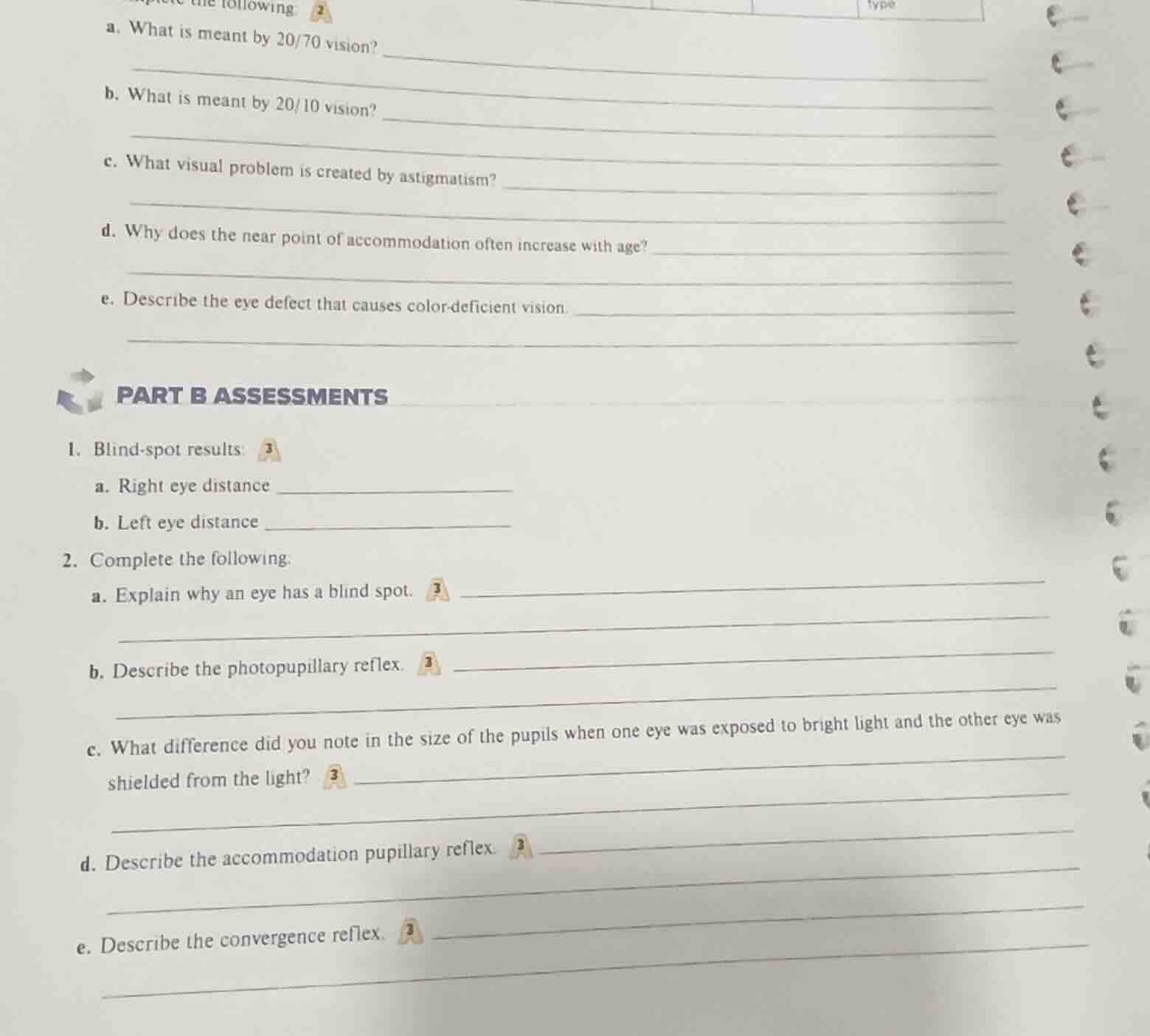
Question
a. what is meant by 20/70 vision?
b. what is meant by 20/10 vision?
c. what visual problem is created by astigmatism?
d. why does the near point of accommodation often increase with age?
e. describe the eye defect that causes color - deficient vision.
part b assessments
- blind - spot results
a. right eye distance
b. left eye distance
- complete the following.
a. explain why an eye has a blind spot.
b. describe the photopupillary reflex.
c. what difference did you note in the size of the pupils when one eye was exposed to bright light and the other eye was shielded from the light?
d. describe the accommodation pupillary reflex.
e. describe the convergence reflex.
Part A
a. Defines 20/70 vision using standard Snellen chart scale.
b. Defines 20/10 vision using standard Snellen chart scale.
c. States the visual distortion caused by astigmatism.
d. Explains age-related loss of lens flexibility.
e. Identifies the retinal cone cell abnormality causing color deficiency.
Part B
- (Note: Blind spot distances are experimental values; typical ranges are provided as reference)
a. Reference for right eye blind spot distance.
b. Reference for left eye blind spot distance.
- a. Explains the anatomical lack of photoreceptors at the optic disc.
b. Defines the pupil's light-responsive size change.
c. Describes the consensual pupillary light reflex response.
d. Links pupil constriction to near focusing.
e. Explains eye movement alignment for near objects.

Snap & solve any problem in the app
Get step-by-step solutions on Sovi AI
Photo-based solutions with guided steps
Explore more problems and detailed explanations
Part A
a. A person with 20/70 vision can see at 20 feet what a person with normal vision can see at 70 feet; their visual acuity is below average.
b. A person with 20/10 vision can see at 20 feet what a person with normal vision can see at 10 feet; their visual acuity is better than average.
c. Astigmatism causes blurred or distorted vision at all distances due to an irregularly curved cornea or lens.
d. This occurs due to presbyopia: the eye's lens loses flexibility with age, making it harder to focus on close objects.
e. Color-deficient vision is caused by a lack of or dysfunction in one or more types of cone cells in the retina, which detect different wavelengths of light (colors).
Part B
1.
a. Typical reference range: 15-25 cm (experimental value varies by individual)
b. Typical reference range: 15-25 cm (experimental value varies by individual)
2.
a. The blind spot exists because the optic disc (where the optic nerve exits the eye) has no photoreceptor cells (rods or cones) to detect light.
b. The photopupillary reflex is the automatic constriction of the pupil in response to bright light, and dilation in dim light, to regulate the amount of light entering the eye.
c. Both pupils constricted: the exposed eye constricts directly, and the shielded eye constricts consensually.
d. The accommodation pupillary reflex is the constriction of the pupils that occurs when the eye focuses on a near object, along with lens thickening and eye convergence, to improve close-up visual acuity.
e. The convergence reflex is the inward turning of both eyes when focusing on a near object, which ensures the image of the object falls on the fovea of each eye for clear, single vision.