QUESTION IMAGE
Question
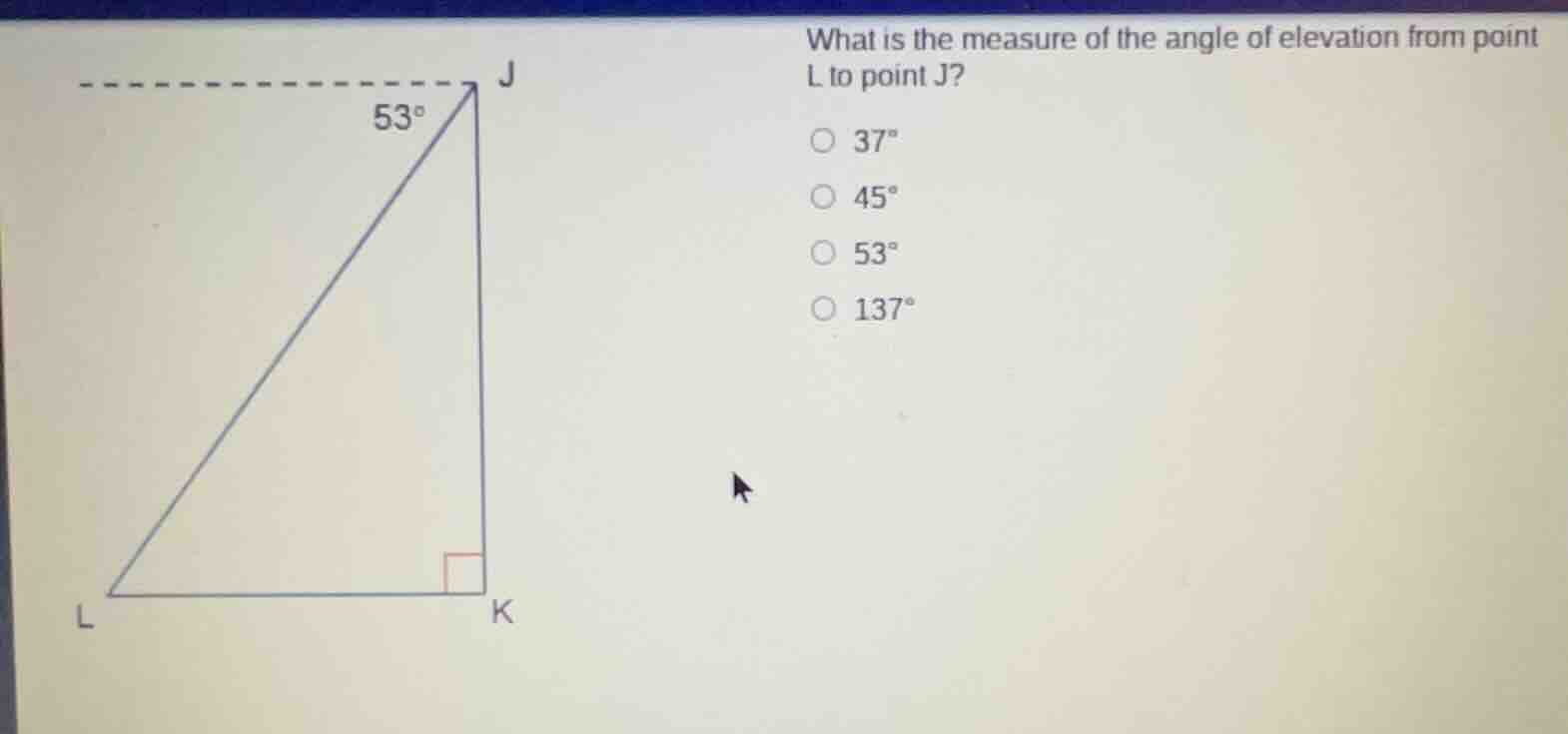
what is the measure of the angle of elevation from point l to point j? 37° 45° 53° 137° (and a right triangle diagram with right angle at k, points l, k, j, and angle at j of 53°)
Step1: Identify triangle type
Triangle \( LKJ \) is right - angled at \( K \), so \( \angle K = 90^{\circ} \), and we know \( \angle J \) (the angle at \( J \) between the horizontal and the line \( LJ \)) is \( 53^{\circ} \).
Step2: Use angle sum property
In a triangle, the sum of interior angles is \( 180^{\circ} \). For right - triangle \( LKJ \), let the angle of elevation from \( L \) to \( J \) be \( \angle L \). We know that \( \angle K=90^{\circ} \) and the angle between the horizontal (from \( J \)) and \( LJ \) is \( 53^{\circ} \). The angle of elevation from \( L \) to \( J \) and the angle of depression from \( J \) to \( L \) are related, and also in the right - triangle, \( \angle L+\angle J + \angle K=180^{\circ} \). Since \( \angle K = 90^{\circ} \) and the non - right non - elevation angle at \( J \) (the angle between \( JK \) and \( LJ \)): we know that the angle between the horizontal (dashed line) and \( LJ \) is \( 53^{\circ} \), and \( JK \) is vertical. So the angle at \( J \) inside the triangle (between \( JK \) and \( LJ \)) is \( 90^{\circ}- 53^{\circ}=37^{\circ} \)? Wait, no. Wait, the angle of elevation from \( L \) to \( J \) is the angle between the horizontal line from \( L \) and the line \( LJ \). Since the triangle is right - angled at \( K \), the horizontal from \( L \) is parallel to the horizontal from \( J \) (the dashed line). So by alternate interior angles, the angle of elevation from \( L \) to \( J \) is equal to the angle at \( J \) between the horizontal (dashed line) and \( LJ \)? No, wait. Let's think again. In right triangle \( LKJ \), \( \angle K = 90^{\circ} \), and we know that one of the acute angles: if we consider the angle at \( J \) between the horizontal (dashed) and \( LJ \) is \( 53^{\circ} \), then the angle at \( L \) (angle of elevation) can be found by \( 90^{\circ}-53^{\circ}=37^{\circ} \)? Wait, no, wait. Wait, the sum of angles in a triangle is \( 180^{\circ} \). So \( \angle L+\angle J+\angle K = 180^{\circ} \). We know \( \angle K = 90^{\circ} \), and the angle at \( J \) (the angle between \( JK \) and \( LJ \)): since the horizontal line from \( J \) and \( JK \) are perpendicular (horizontal and vertical), the angle between the horizontal line (dashed) and \( LJ \) is \( 53^{\circ} \), so the angle between \( JK \) and \( LJ \) is \( 90^{\circ}-53^{\circ}=37^{\circ} \)? No, that's not right. Wait, actually, the angle of elevation from \( L \) to \( J \) is the angle between the horizontal line through \( L \) and the line \( LJ \). Since the horizontal line through \( J \) (dashed) and the horizontal line through \( L \) are parallel, the angle of elevation from \( L \) to \( J \) is equal to the angle of depression from \( J \) to \( L \). But also, in the right triangle, the two acute angles sum to \( 90^{\circ} \). If one of the angles (at \( J \)) related to the horizontal is \( 53^{\circ} \), then the angle of elevation at \( L \) is \( 90^{\circ}-53^{\circ}=37^{\circ} \)? Wait, no, let's calculate the angles. Let's denote: the angle at \( J \) between the dashed line (horizontal) and \( LJ \) is \( 53^{\circ} \). The dashed line and \( JK \) are perpendicular (since \( JK \) is vertical), so the angle between \( JK \) and \( LJ \) is \( 90^{\circ}-53^{\circ}=37^{\circ} \). Then, in triangle \( LKJ \), \( \angle K = 90^{\circ} \), \( \angle J \) (between \( JK \) and \( LJ \)) is \( 37^{\circ} \), so \( \angle L=180^{\circ}-\angle K-\angle J=180 - 90 - 37 = 53^{\circ} \)? Wait, I'm getting confused. Wait, maybe the angle of elevation from \( L \) to…

Snap & solve any problem in the app
Get step-by-step solutions on Sovi AI
Photo-based solutions with guided steps
Explore more problems and detailed explanations
\( 37^{\circ} \) (corresponding to the option with \( 37^{\circ} \))