QUESTION IMAGE
Question
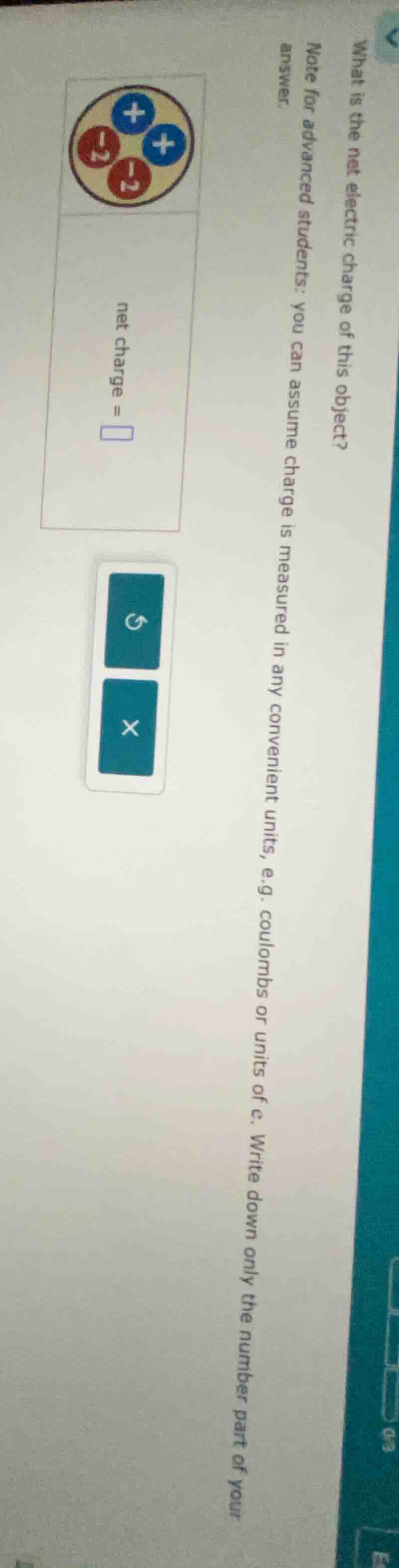
what is the net electric charge of this object?
note for advanced students: you can assume charge is measured in any convenient units, e.g. coulombs or units of e. write down only the number part of your answer.
net charge =
Step1: Count positive charges
There are 2 positive charges, each with a value (let's assume the charge magnitude is 1 unit for each symbol, but the red ones are -2? Wait, no, looking at the symbols: blue are +, red are -2? Wait, no, maybe the blue are +1 each, red are -1 each? Wait, the red ones have -2? Wait, the image shows two blue + and two red -2? Wait, no, maybe the red are -1 each? Wait, no, the problem: let's re-express. Wait, the blue circles: 2 of them, each with + (let's say charge +1 each), red circles: 2 of them, each with -2? No, that can't be. Wait, maybe the red are -1 each? Wait, no, the text says "charge is measured in any convenient units, e.g., coulombs or units of e". Wait, looking at the image: two blue + (so +1 each? Or +2? Wait, the red ones have -2? Wait, no, maybe the blue are +2? No, the red are -2, two of them, and blue are +, two of them. Wait, let's calculate:
Number of positive charges: 2, each with charge + (let's assume the magnitude is, say, +x, but the red are -2. Wait, maybe the blue are +1, red are -1? No, the red have -2 written. Wait, maybe the blue are +2? No, the red are -2, two of them: total negative charge: 2(-2) = -4. Positive charge: 2(+2)? No, the blue are +, two of them. Wait, maybe the blue are +1, red are -2? No, that's confusing. Wait, no, maybe the blue are + (charge +1) and red are - (charge -1), but the red have -2? Wait, no, the image: two blue +, two red -2. Wait, no, the red circles have -2, so each red is -2, two reds: 2*(-2) = -4. Two blues: each +, so +2 (if each blue is +1). Then net charge: +2 + (-4) = -2. Wait, that makes sense. Let's check:
Step 1: Calculate total positive charge. Number of positive charges: 2, each with charge +1 (assuming the + is +1 unit, and -2 is -2 units? No, wait, maybe the blue are +2? No, the red are -2. Wait, no, maybe the blue are + (charge +2) and red are - (charge -2)? No, that would cancel. Wait, no, the red have -2, two of them: 2(-2) = -4. Blue: 2 of them, each + (so +2, if each is +1? No, 2+1 = +2. Then net charge: +2 + (-4) = -2. Yes, that works.
Wait, let's do it properly:
Total positive charge: number of positive charges charge per positive = 2 (+1) = +2 (assuming each blue is +1 unit).
Total negative charge: number of negative charges charge per negative = 2 (-2) = -4 (assuming each red is -2 units).
Net charge = total positive + total negative = 2 + (-4) = -2.
Yes, that's the calculation.
Step1: Calculate total positive charge
Number of positive charges: 2, each with charge \( +1 \) (assuming unit charge for +).
Total positive charge: \( 2 \times (+1) = +2 \)
Step2: Calculate total negative charge
Number of negative charges: 2, each with charge \( -2 \).
Total negative charge: \( 2 \times (-2) = -4 \)
Step3: Calculate net charge
Net charge = total positive charge + total negative charge
\( 2 + (-4) = -2 \)

Snap & solve any problem in the app
Get step-by-step solutions on Sovi AI
Photo-based solutions with guided steps
Explore more problems and detailed explanations
-2