QUESTION IMAGE
Question
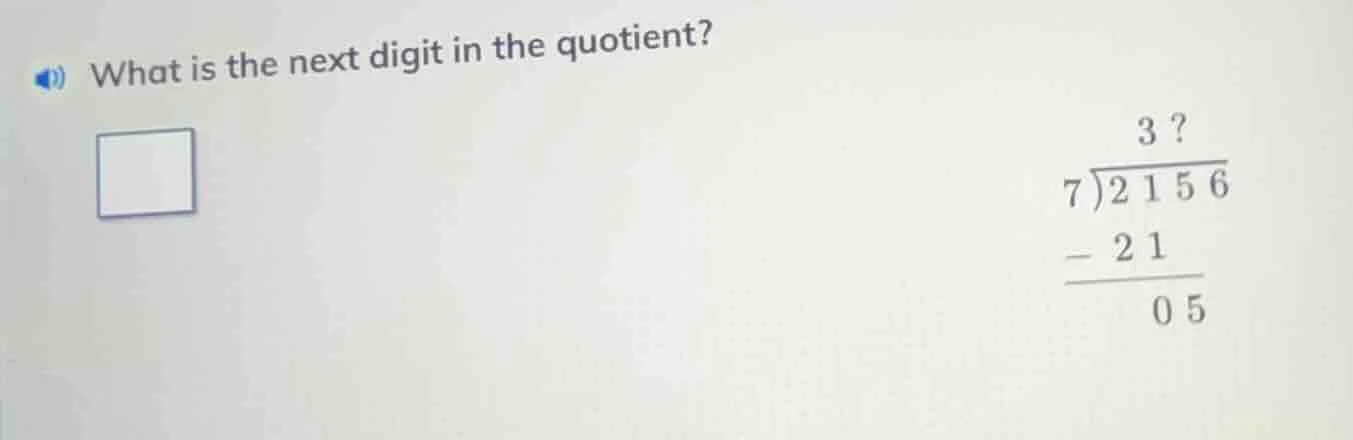
what is the next digit in the quotient?
\overline{\
}
Step1: Analyze the division process
After subtracting 21 from 21 (in the thousands and hundreds place), we bring down the 5, getting a remainder of 5 (now we're looking at the tens place: 5). We need to find how many times 7 goes into 5. Since 7 is larger than 5, the next digit in the quotient (for the tens place) is 0. Wait, no, wait. Wait, actually, after the first step (3 in the hundreds place, since 7*3=21), we have the remainder 0, then we bring down the 5 (from 2156, so now we're at the tens digit: 5). So we need to divide 5 by 7. But 7 doesn't go into 5, so the next digit (the tens place of the quotient) is 0? Wait, no, maybe I misread. Wait, the dividend is 2156, divisor 7. Let's do the long division properly.
First, 7 into 21 (the first two digits) is 3, so 3*7=21, subtract, get 0. Then we bring down the 5 (so now we have 05, which is 5, in the tens place). Now we need to divide 5 by 7. Since 7 > 5, we put 0 in the quotient (tens place), then bring down the 6? Wait, no, wait the dividend is 2156, so after 21 (hundreds and thousands), we have 5 (tens) and 6 (units). Wait, maybe the problem is showing the steps: after 3 (hundreds place), we have 0 remainder, then bring down 5 (tens digit), so now we have 5 (as the remainder from before? Wait, no, the long division steps:
    3 0?
  _______
7 | 2 1 5 6
    2 1
    ----
      0 5
Wait, so now we have 5 (from 05, which is 5) and we need to find how many times 7 goes into 5. Since 7 is larger than 5, the next digit (the tens place of the quotient) is 0? But that seems odd. Wait, maybe I made a mistake. Wait, no, let's check again. Wait, 2156 divided by 7. Let's do 7300=2100, 2156-2100=56. Then 56 divided by 7 is 8. So the quotient is 308. Wait, so the first digit is 3 (hundreds), then 0 (tens), then 8 (units). Wait, but in the given long division, after 3, we have 05 (remainder 5, after bringing down 5). So the next digit (tens place) is 0, because 7 doesn't go into 5. Then we bring down the 6, making it 56, and 78=56. So the next digit (after 3) is 0? Wait, but maybe the problem is showing the tens place. Wait, the quotient is 3? (the first digit) and then the next digit (tens place). So when we have 5 (after bringing down), we need to see how many times 7 fits into 5. Since 7 > 5, the next digit is 0. Wait, but maybe I messed up. Wait, let's do the long division step by step:
- Divide 21 (thousands and hundreds) by 7: 21 ÷ 7 = 3. So write 3 in the hundreds place of the quotient.
- Multiply 3 by 7: 3 × 7 = 21. Subtract: 21 - 21 = 0.
- Bring down the next digit (5 from the tens place) to get 05 (which is 5).
- Now, divide 5 by 7. Since 7 > 5, we write 0 in the tens place of the quotient.
- Bring down the next digit (6 from the units place) to get 56.
- Divide 56 by 7: 56 ÷ 7 = 8. Write 8 in the units place.
So the quotient is 308. Therefore, the next digit after 3 (in the quotient) is 0. Wait, but the problem is asking "What is the next digit in the quotient?" after the 3. So the first digit is 3 (hundreds), then the next digit (tens) is 0? But let's check again. Wait, maybe the problem is showing the remainder as 05 (which is 5) after the first subtraction, so we have to divide 5 by 7. Since 7 doesn't go into 5, the next digit is 0. So the answer should be 0.
Wait, but maybe I made a mistake. Let's confirm with actual division: 7 × 308 = 2156. Yes, 7300=2100, 78=56, 2100+56=2156. So the quotient is 308. So the digits are 3 (hundreds), 0 (tens), 8 (units). So after 3, the next digit is 0.
Step2: Confirm the next digit
After the first step (3 in hundr…

Snap & solve any problem in the app
Get step-by-step solutions on Sovi AI
Photo-based solutions with guided steps
Explore more problems and detailed explanations
0