QUESTION IMAGE
Question
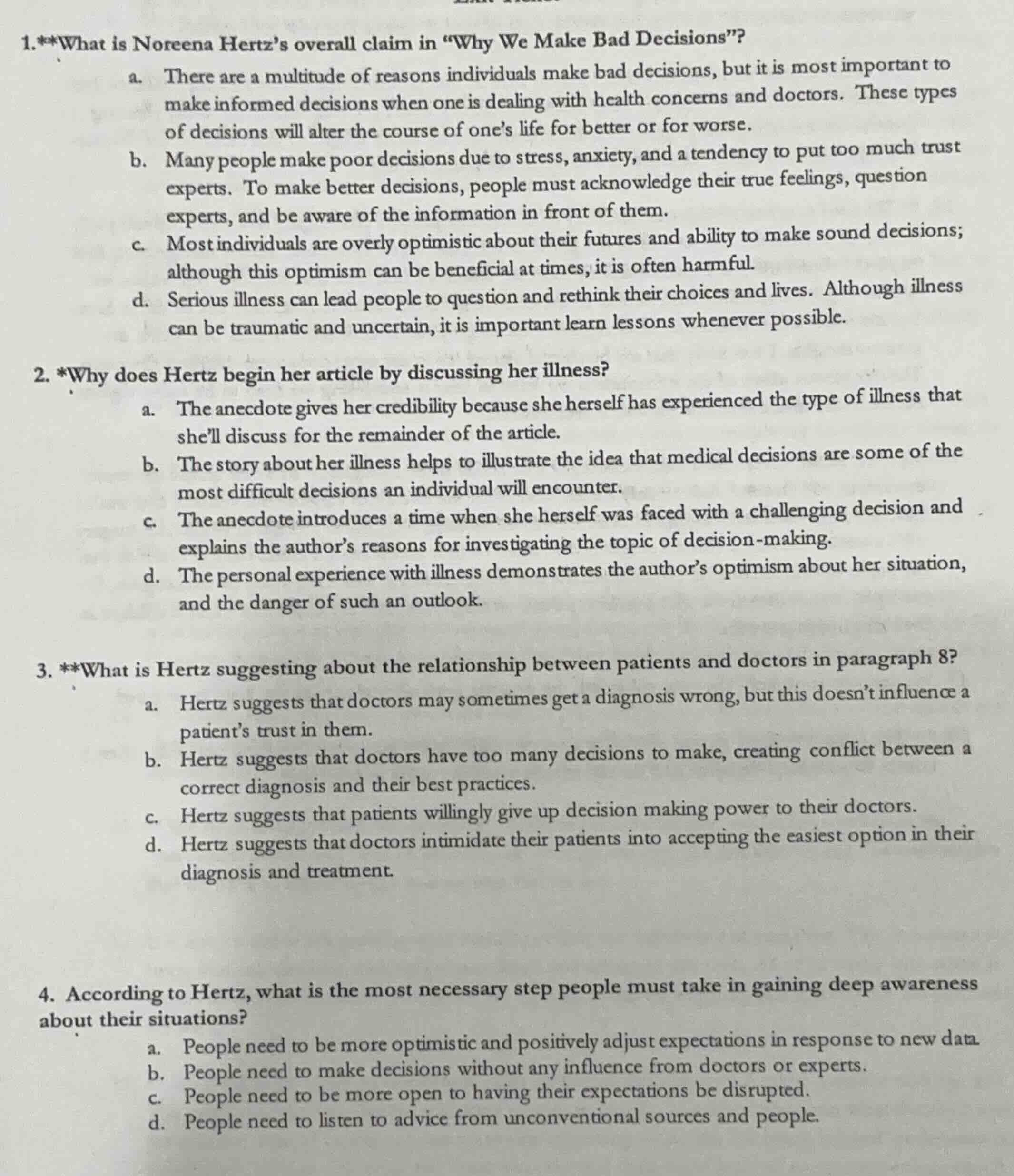
1.**what is noreena hertzs overall claim in \why we make bad decisions\?
a. there are a multitude of reasons individuals make bad decisions, but it is most important to make informed decisions when one is dealing with health concerns and doctors. these types of decisions will alter the course of ones life for better or for worse.
b. many people make poor decisions due to stress, anxiety, and a tendency to put too much trust experts. to make better decisions, people must acknowledge their true feelings, question experts, and be aware of the information in front of them.
c. most individuals are overly optimistic about their futures and ability to make sound decisions; although this optimism can be beneficial at times, it is often harmful.
d. serious illness can lead people to question and rethink their choices and lives. although illness can be traumatic and uncertain, it is important learn lessons whenever possible.
- *why does hertz begin her article by discussing her illness?
a. the anecdote gives her credibility because she herself has experienced the type of illness that shell discuss for the remainder of the article.
b. the story about her illness helps to illustrate the idea that medical decisions are some of the most difficult decisions an individual will encounter.
c. the anecdote introduces a time when she herself was faced with a challenging decision and explains the authors reasons for investigating the topic of decision - making.
d. the personal experience with illness demonstrates the authors optimism about her situation, and the danger of such an outlook.
- **what is hertz suggesting about the relationship between patients and doctors in paragraph 8?
a. hertz suggests that doctors may sometimes get a diagnosis wrong, but this doesnt influence a patients trust in them.
b. hertz suggests that doctors have too many decisions to make, creating conflict between a correct diagnosis and their best practices.
c. hertz suggests that patients willingly give up decision making power to their doctors.
d. hertz suggests that doctors intimidate their patients into accepting the easiest option in their diagnosis and treatment.
- according to hertz, what is the most necessary step people must take in gaining deep awareness about their situations?
a. people need to be more optimistic and positively adjust expectations in response to new data.
b. people need to make decisions without any influence from doctors or experts.
c. people need to be more open to having their expectations be disrupted.
d. people need to listen to advice from unconventional sources and people.
Question 1
To find Noreena Hertz's overall claim, we analyze each option:
- Option a focuses only on health - related decisions, while the article's claim is broader about bad decision - making in general.
- Option b: The article discusses that stress, anxiety, and over - trusting experts lead to bad decisions, and also provides ways to make better decisions (acknowledge feelings, question experts, be aware of information), which matches the overall claim.
- Option c only talks about optimism and its harm, not the main claim about bad decision - making and how to improve.
- Option d focuses on illness and learning lessons, not the overall claim about bad decisions.
Analyzing why Hertz begins with her illness:
- Option a: The illness anecdote is not mainly for credibility about the illness type, but about decision - making.
- Option b: It's not about showing medical decisions are the most difficult, but about her own decision - making experience related to the topic.
- Option c: Her illness story is a personal experience of a challenging decision, which introduces her reason for studying decision - making, this is correct.
- Option d: The anecdote is not about demonstrating optimism and its danger, but about decision - making.
For the patient - doctor relationship in paragraph 8:
- Option a: The paragraph is not about doctors' misdiagnosis and patient trust.
- Option b: It's not about doctors' decision - making conflict.
- Option c: Hertz suggests that patients are willing to let doctors make decisions for them, which matches the idea of patients giving up decision - making power.
- Option d: There's no suggestion that doctors intimidate patients.

Snap & solve any problem in the app
Get step-by-step solutions on Sovi AI
Photo-based solutions with guided steps
Explore more problems and detailed explanations
b. Many people make poor decisions due to stress, anxiety, and a tendency to put too much trust experts. To make better decisions, people must acknowledge their true feelings, question experts, and be aware of the information in front of them.