QUESTION IMAGE
Question
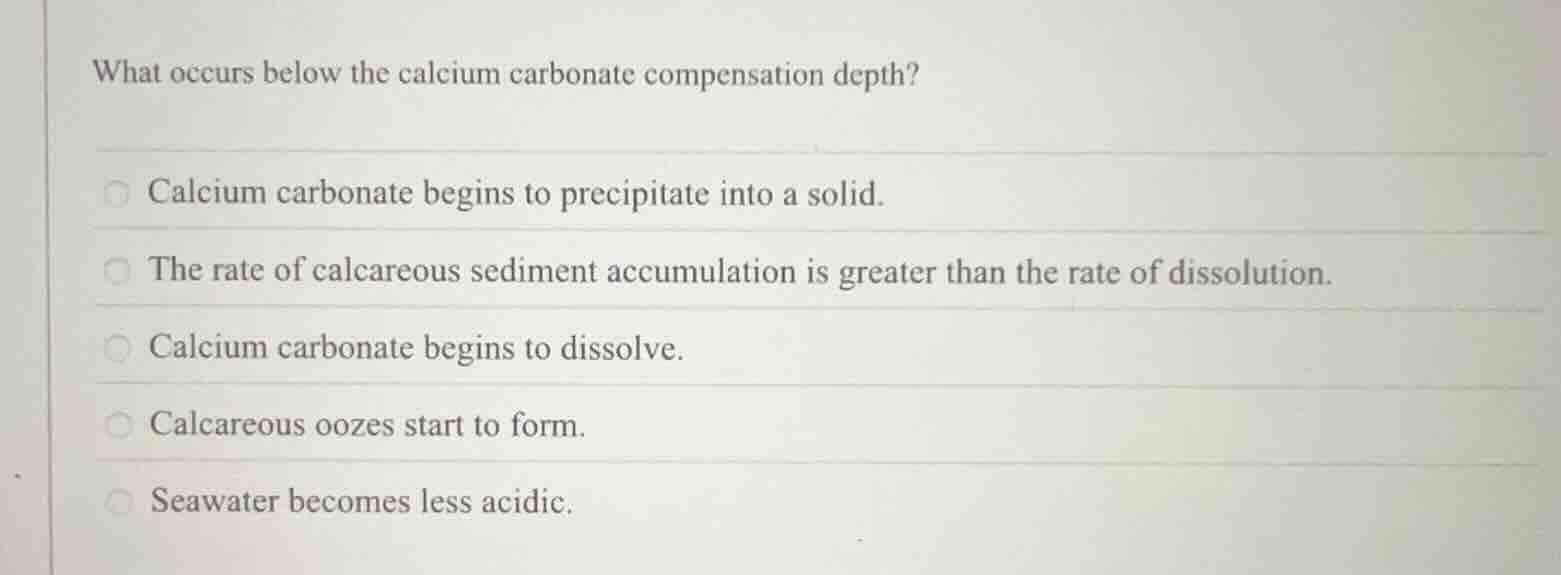
what occurs below the calcium carbonate compensation depth? calcium carbonate begins to precipitate into a solid. the rate of calcareous sediment accumulation is greater than the rate of dissolution. calcium carbonate begins to dissolve. calcareous oozes start to form. seawater becomes less acidic.
The calcium carbonate compensation depth (CCD) is the depth in the ocean where the rate of calcium carbonate (CaCO₃) dissolution equals the rate of supply. Below the CCD, the pressure and acidity conditions cause calcium carbonate to dissolve faster than it accumulates. Let's analyze each option:
- "Calcium carbonate begins to precipitate into a solid": Precipitation (formation of solid CaCO₃) is more likely above the CCD where conditions favor accumulation, not below. Eliminate this.
- "The rate of calcareous sediment accumulation is greater than the rate of dissolution": Above the CCD, accumulation rate > dissolution rate. Below CCD, dissolution rate > accumulation rate. Eliminate this.
- "Calcium carbonate begins to dissolve": Below the CCD, the environment (higher pressure, more acidic) makes CaCO₃ start to dissolve because dissolution rate exceeds accumulation. This matches.
- "Calcareous oozes start to form": Calcareous oozes form above the CCD where CaCO₃ accumulates. Below CCD, they don't form as CaCO₃ dissolves. Eliminate this.
- "Seawater becomes less acidic": As depth increases, seawater becomes more acidic (due to more CO₂ dissolution), not less. Eliminate this.

Snap & solve any problem in the app
Get step-by-step solutions on Sovi AI
Photo-based solutions with guided steps
Explore more problems and detailed explanations
Calcium carbonate begins to dissolve.