QUESTION IMAGE
Question
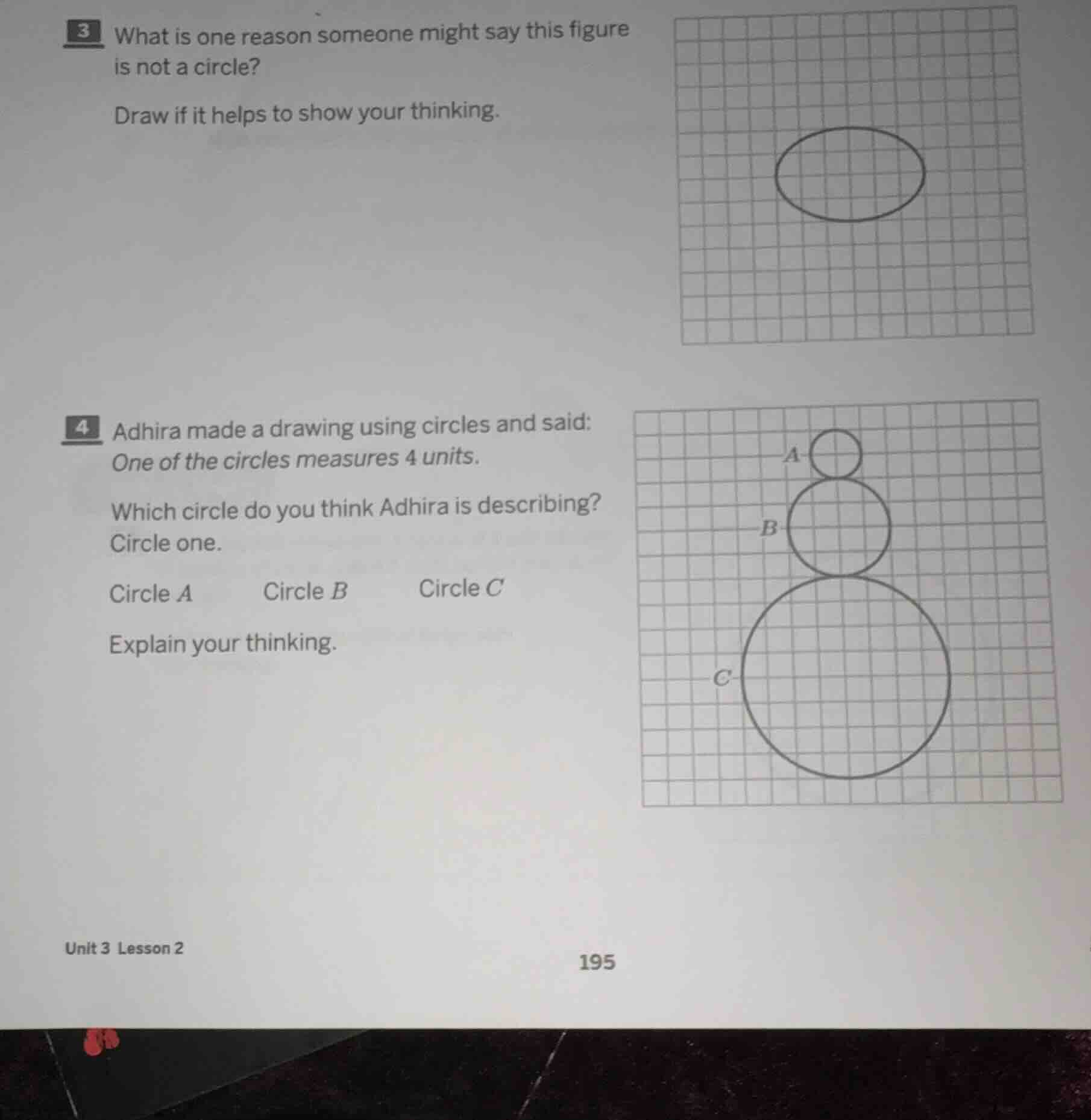
3 what is one reason someone might say this figure
is not a circle?
draw if it helps to show your thinking.
4 adhira made a drawing using circles and said:
one of the circles measures 4 units.
which circle do you think adhira is describing?
circle one.
circle a circle b circle c
explain your thinking.
unit 3 lesson 2
Question 3
A circle is defined as a set of points equidistant from a center. The figure on the grid looks oval - like. When we check the distance from the center to the edge (radius) in different directions (horizontal and vertical), these distances are not equal. For example, the horizontal "radius" (half of the horizontal length) and vertical "radius" (half of the vertical length) of the figure are different. A circle requires all radii to be equal, so this figure fails that condition, which is why someone might say it's not a circle.
To determine which circle measures 4 units, we analyze the diameter (or radius) of each circle using the grid. Let's assume each grid square has a side length of 1 unit.
- For Circle A: Looking at the grid, its diameter seems to be 2 units (since it spans 2 grid squares).
- For Circle B: Its diameter appears to be 4 units (spanning 4 grid squares).
- For Circle C: Its diameter is larger than 4 units (spanning more than 4 grid squares).
If "measures 4 units" refers to the diameter, then Circle B has a diameter of 4 units. If it referred to the radius, the diameter would be 8 units, which doesn't match any, so it's more likely the diameter. So Adhira is describing Circle B.
By analyzing the grid, Circle B's diameter spans 4 grid units (assuming each grid square is 1 unit). A circle's "measurement" here likely refers to its diameter (or a linear measurement like diameter). Circle A has a smaller diameter (2 units), and Circle C has a larger diameter, so Circle B is the one that measures 4 units.

Snap & solve any problem in the app
Get step-by-step solutions on Sovi AI
Photo-based solutions with guided steps
Explore more problems and detailed explanations
One reason is that the distance from the center to the edge (radius) is not the same in all directions (e.g., horizontal and vertical radii are different), so it doesn't meet the definition of a circle (all points equidistant from the center).