QUESTION IMAGE
Question
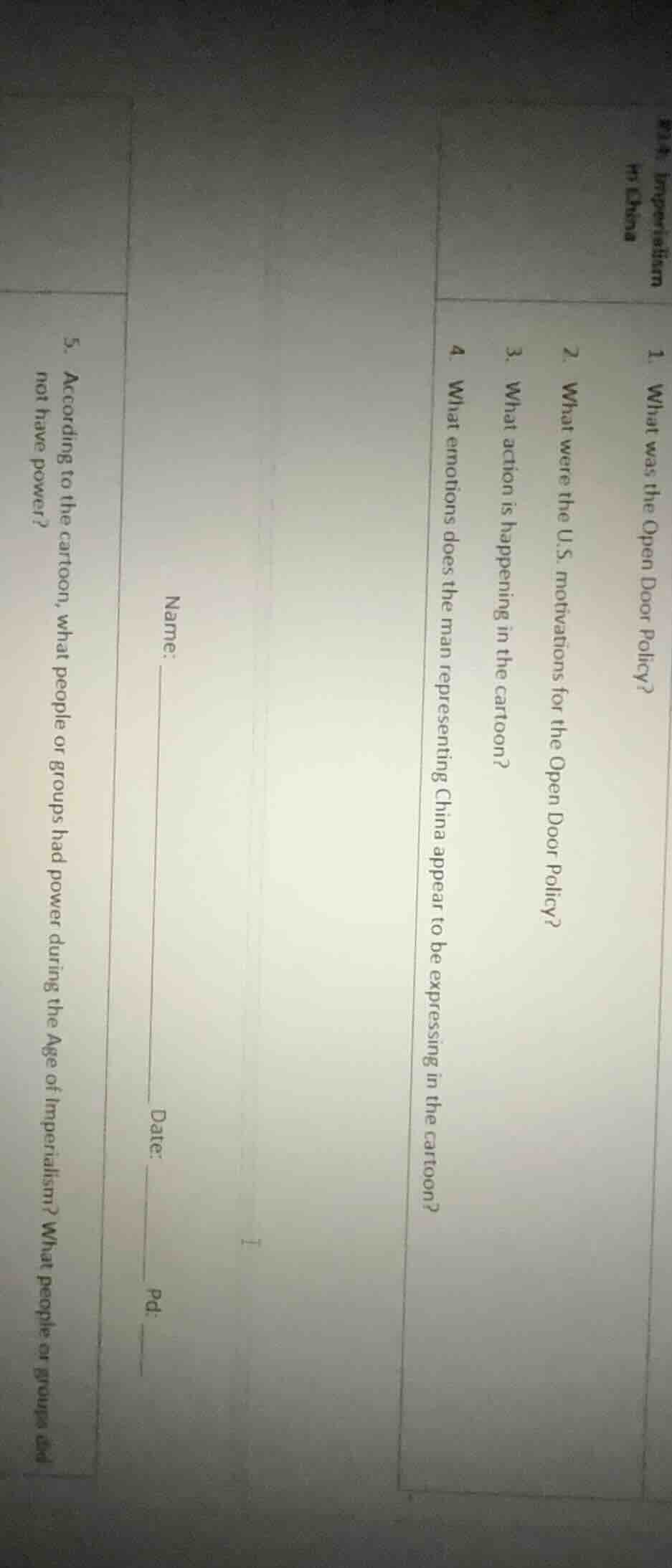
- what was the open door policy?
- what were the u.s. motivations for the open door policy?
- what action is happening in the cartoon?
- what emotions does the man representing china appear to be expressing in the cartoon?
- according to the cartoon, what people or groups had power during the age of imperialism? what people or groups did not have power?
name:
date:
pd:
To answer these questions, we analyze each one based on historical context (Imperialism in China, Open Door Policy):
Question 1: What was the Open Door Policy?
The Open Door Policy (late 19th/early 20th century) was a U.S.-led initiative to ensure equal trading rights and access to China’s markets for all imperial powers (e.g., U.S., Britain, France, Germany, Japan, Russia). It aimed to prevent any single nation from monopolizing Chinese trade or territory, maintaining “open doors” for commerce while preserving China’s territorial integrity (in theory) to avoid conflicts between imperial powers over Chinese spheres of influence.
Question 2: What were the U.S. motivations for the Open Door Policy?
- Economic Interests: The U.S. wanted to secure access to China’s vast markets for American goods and investment, especially as industrialization increased production.
- Strategic/Political: To prevent European powers and Japan from dividing China into exclusive spheres of influence (which would block U.S. access). By advocating for equal access, the U.S. avoided being shut out of Chinese trade.
- Late to Imperialism: The U.S. had expanded westward and focused on the Philippines (post-Spanish-American War) but lacked a pre-existing sphere in China. The Open Door allowed it to compete economically without direct territorial control.
Question 3: What action is happening in the cartoon?
(Note: Since the cartoon is not visible, we infer common imperial-era China cartoons.) Typical cartoons from this period depict:
- Imperial powers (e.g., figures representing Britain, France, Germany, Japan, Russia) carving up or dominating China (e.g., dividing a “Chinese pie,” controlling regions, or oppressing Chinese figures).
- The U.S. (via the Open Door) either mediating, asserting its right to “open doors,” or reacting to other powers’ aggression.
- Chinese figures (e.g., a symbolic “China” character) showing vulnerability, resistance, or powerlessness against foreign domination.
Question 4: What emotions does the man representing China appear to express?
In imperial-era cartoons, the Chinese figure (or “China” personified) often shows:
- Powerlessness/Defeat: Slumped posture, sad/angry facial expressions, or submission to foreign powers.
- Anger/Resentment: At foreign exploitation (e.g., being carved up, forced into unequal treaties).
- Desperation/Hopelessness: As imperial powers impose control, the figure conveys frustration at losing sovereignty.
Question 5: Who had power? Who did not?
- Had Power: Imperial powers (Britain, France, Germany, Japan, Russia, later the U.S. via economic influence). These nations controlled Chinese ports, railways, mines, and trade through spheres of influence, unequal treaties (e.g., Treaty of Nanking, Boxer Protocol), and military/political coercion.
- Did Not Have Power: The Chinese government (Qing Dynasty, later warlord governments) and ordinary Chinese people. The Qing was weakened by internal decline (e.g., Opium Wars, Taiping Rebellion) and external pressure, losing sovereignty over trade, tariffs, and territory. Ordinary Chinese faced exploitation, poverty, and loss of self-governance under foreign domination.

Snap & solve any problem in the app
Get step-by-step solutions on Sovi AI
Photo-based solutions with guided steps
Explore more problems and detailed explanations
s (Summarized):
- The Open Door Policy was a U.S. initiative for equal trade access to China for all imperial powers, preserving (in theory) Chinese territorial integrity to avoid conflicts over spheres of influence.
- U.S. motivations: Economic access to Chinese markets, preventing exclusion by other powers, and competing as a late imperial actor.
- (Cartoon action) Likely: Foreign powers dominating/partitioning China; U.S. asserting Open Door; or Chinese resistance/powerlessness.
- (Emotions) Likely: Powerlessness, anger, or despair at foreign imperialism.
- Powerful: Imperial nations (U.S., Europe, Japan). Powerless: Qing China, Chinese people, local governments.
(For the cartoon-specific questions, provide the cartoon’s details for precise analysis.)