QUESTION IMAGE
Question
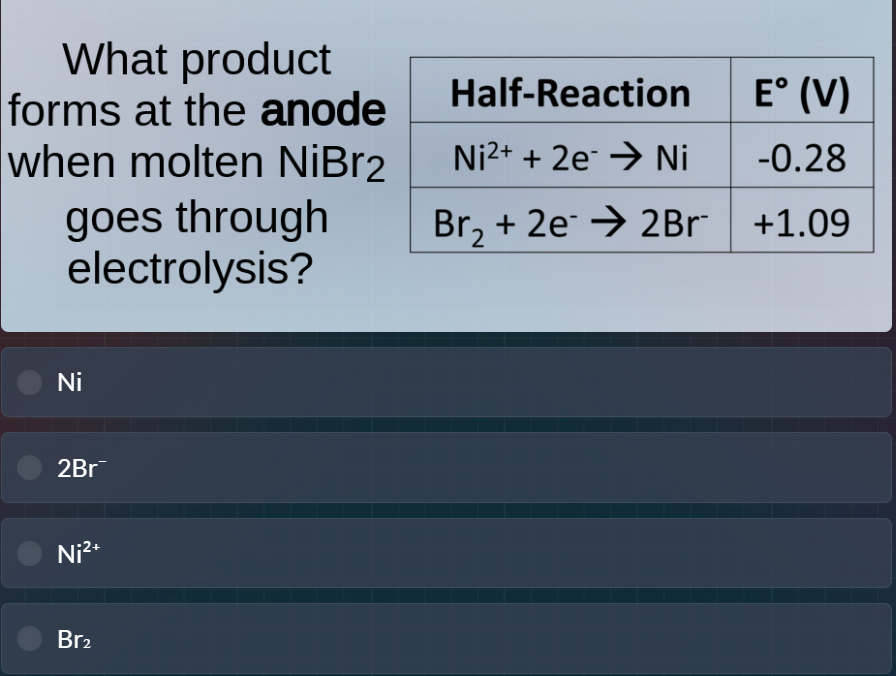
what product forms at the anode when molten nibr₂ goes through electrolysis?
half-reaction | e° (v)
ni²⁺ + 2e⁻ → ni | -0.28
br₂ + 2e⁻ → 2br⁻ | +1.09
options: ni, 2br⁻, ni²⁺, br₂
Step1: Recall Anode Reaction in Electrolysis
In electrolysis, oxidation occurs at the anode. Oxidation is the loss of electrons (reverse of reduction half - reaction).
Step2: Analyze the Ions in Molten \(NiBr_2\)
Molten \(NiBr_2\) dissociates into \(Ni^{2 + }\) and \(Br^-\) ions.
Step3: Determine the Anode Reaction
For the given half - reactions:
- The reduction half - reaction for \(Ni\) is \(Ni^{2+}+2e^-
ightarrow Ni\) (\(E^o=- 0.28\ V\)). The oxidation (reverse) would be \(Ni
ightarrow Ni^{2+}+2e^-\).
- The reduction half - reaction for \(Br_2\) is \(Br_2 + 2e^-
ightarrow2Br^-\) (\(E^o = + 1.09\ V\)). The oxidation (reverse) is \(2Br^-
ightarrow Br_2+2e^-\).
In electrolysis of molten salts, we consider the oxidation of the anion (since the cation is from a metal that is less reactive in terms of oxidation, or we can also think in terms of the ease of oxidation). The bromide ion (\(Br^-\)) will be oxidized at the anode. The oxidation of \(Br^-\) gives \(Br_2\) (from the reverse of \(Br_2 + 2e^-
ightarrow2Br^-\)).

Snap & solve any problem in the app
Get step-by-step solutions on Sovi AI
Photo-based solutions with guided steps
Explore more problems and detailed explanations
\(Br_2\) (the option: \(Br_2\))