QUESTION IMAGE
Question
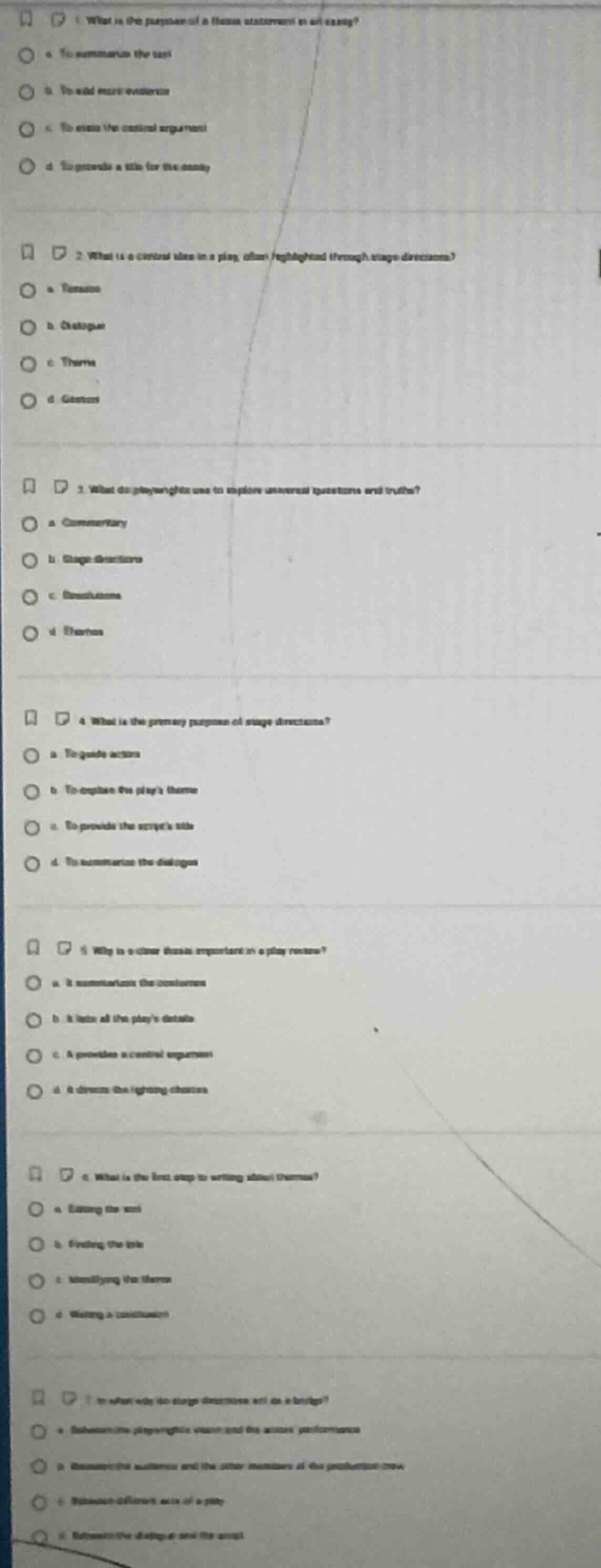
- what is the purpose of a thesis statement in an essay?a. to summarize the textb. to add more evidencec. to state the central argumentd. to provide a title for the essay2. what is a central idea in a play, often highlighted through stage directions?a. tensionb. dialoguec. themed. gesture3. what do playwrights use to explore universal questions and truths?a. commentaryb. stage directionsc. situationsd. themes4. what is the primary purpose of stage directions?a. to guide actorsb. to explain the plays themec. to provide the scripts titled. to summarize the dialogue5. why is a clear thesis important in a play review?a. it summarizes the conclusionb. it lists all the plays detailsc. it provides a central argumentd. it directs the lighting choices6. what is the first step to writing about themes?a. editing the textb. finding the titlec. identifying the themed. writing a conclusion7. in what way do stage directions act as a bridge?a. between the playwrights vision and the actors performanceb. between the audience and the other members of the production crewc. between different acts of a playd. between the dialogue and the actors
Brief Explanations
- A thesis statement in an essay clearly states the core argument the writer will defend.
- Stage directions in a play often highlight the underlying theme, the central idea of the work.
- Playwrights use themes to explore universal questions and truths about the human experience.
- Stage directions primarily guide actors on how to perform, move, and interact on stage.
- A clear thesis in a play review provides a central argument that structures the critique.
- The first step to writing about themes is identifying what the core message or idea of the work is.
- Stage directions act as a bridge between the playwright's creative vision and how actors bring that vision to life in performance.

Snap & solve any problem in the app
Get step-by-step solutions on Sovi AI
Photo-based solutions with guided steps
Explore more problems and detailed explanations
- c. To state the central argument
- c. Theme
- d. Themes
- a. To guide actors
- c. It provides a central argument
- c. Identifying the theme
- a. Between the playwright's vision and the actors' performance