QUESTION IMAGE
Question
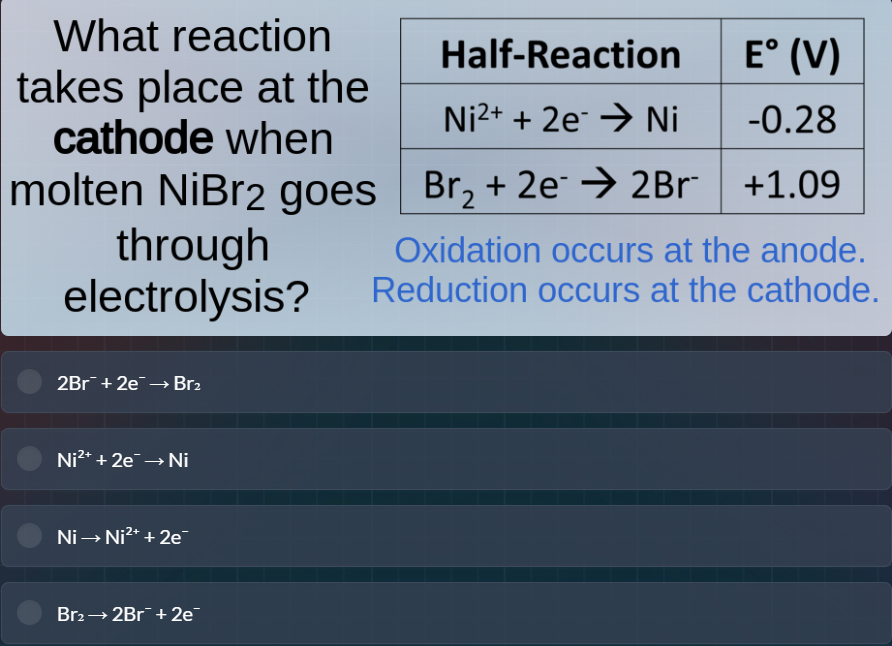
what reaction takes place at the cathode when molten nibr₂ goes through electrolysis?
half-reaction | e° (v)
ni²⁺ + 2e⁻ → ni | -0.28
br₂ + 2e⁻ → 2br⁻ | +1.09
oxidation occurs at the anode. reduction occurs at the cathode.
2br⁻ + 2e⁻ → br₂
ni²⁺ + 2e⁻ → ni
ni → ni²⁺ + 2e⁻
br₂ → 2br⁻ + 2e⁻
Step1: Recall cathode reaction type
Cathode in electrolysis has reduction (gain of electrons). So we look for half - reactions with electron gain.
Step2: Analyze each option
- Option 1: \(2\text{Br}^- + 2\text{e}^-
ightarrow \text{Br}_2\) is incorrect. This is an oxidation (losing electrons would be oxidation, but here it's written as gain, but \(\text{Br}^-\) to \(\text{Br}_2\) is oxidation in normal, and this reaction as written is non - spontaneous and not the cathode reaction here. Also, the standard reduction potential for \(\text{Br}_2+2\text{e}^-
ightarrow 2\text{Br}^-\) is \(+ 1.09\) V, and for \(\text{Ni}^{2 +}+2\text{e}^-
ightarrow\text{Ni}\) is \(- 0.28\) V. In electrolysis of molten salt, the cation is reduced at cathode.
- Option 2: \( \text{Ni}^{2+}+2\text{e}^-
ightarrow\text{Ni}\) is correct. Because at cathode, reduction (gain of electrons) occurs. The cation \(\text{Ni}^{2+}\) gains electrons to form \(\text{Ni}\).
- Option 3: \( \text{Ni}
ightarrow\text{Ni}^{2+}+2\text{e}^-\) is oxidation (losing electrons), which occurs at anode, not cathode.
- Option 4: \( \text{Br}_2
ightarrow2\text{Br}^- + 2\text{e}^-\) is oxidation (losing electrons), occurs at anode.

Snap & solve any problem in the app
Get step-by-step solutions on Sovi AI
Photo-based solutions with guided steps
Explore more problems and detailed explanations
B. \( \text{Ni}^{2+}+2\text{e}^-
ightarrow\text{Ni}\)