QUESTION IMAGE
Question
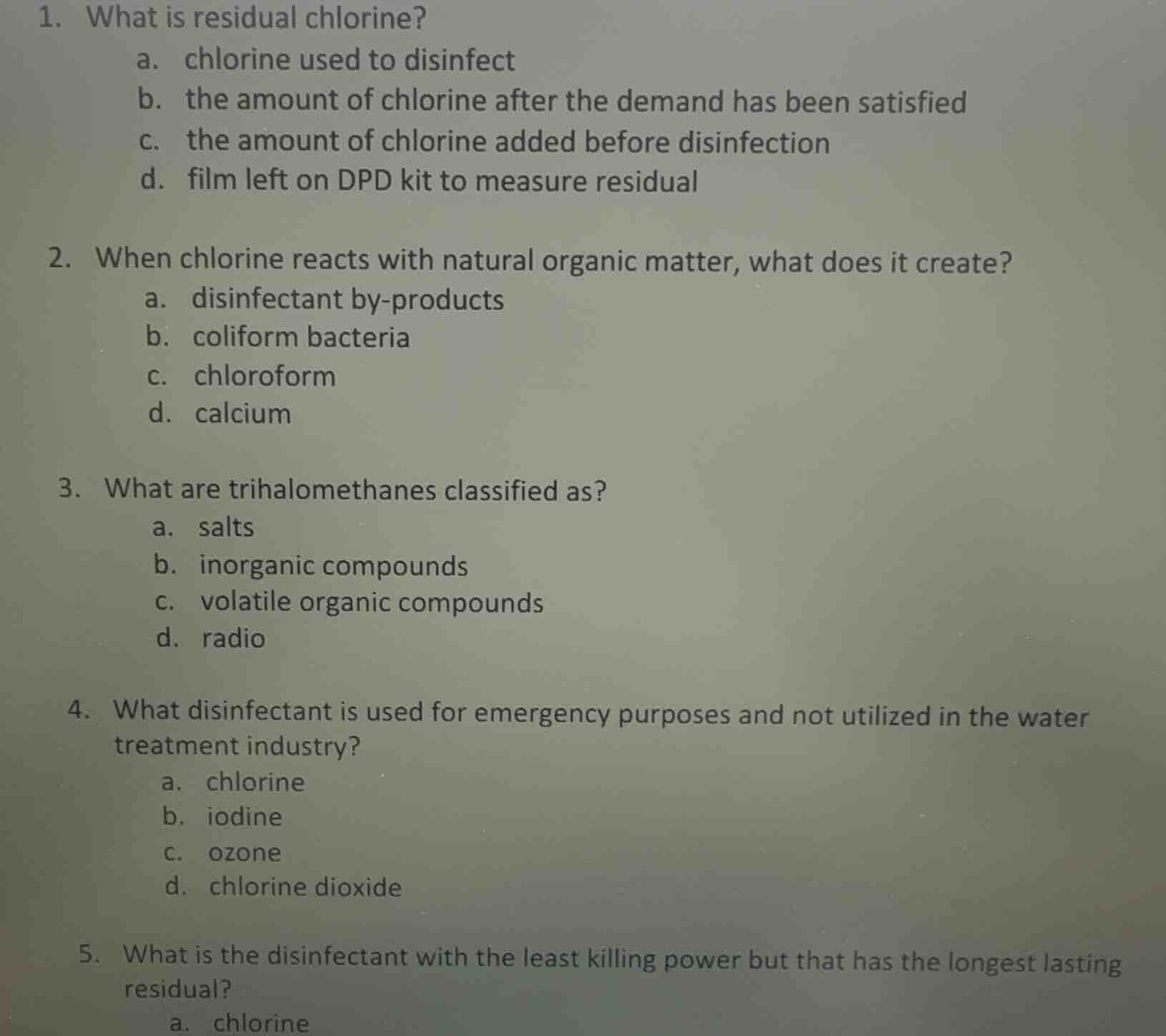
- what is residual chlorine?
a. chlorine used to disinfect
b. the amount of chlorine after the demand has been satisfied
c. the amount of chlorine added before disinfection
d. film left on dpd kit to measure residual
- when chlorine reacts with natural organic matter, what does it create?
a. disinfectant by-products
b. coliform bacteria
c. chloroform
d. calcium
- what are trihalomethanes classified as?
a. salts
b. inorganic compounds
c. volatile organic compounds
d. radio
- what disinfectant is used for emergency purposes and not utilized in the water treatment industry?
a. chlorine
b. iodine
c. ozone
d. chlorine dioxide
- what is the disinfectant with the least killing power but that has the longest lasting residual?
a. chlorine
Brief Explanations
- Residual chlorine is the remaining chlorine after it has reacted with contaminants (satisfied chlorine demand) in water, providing ongoing disinfection.
- Chlorine reacts with natural organic matter in water to form unintended chemical compounds called disinfectant by-products, with chloroform being one specific type of these.
- Trihalomethanes are organic compounds that easily turn into vapor, so they are categorized as volatile organic compounds.
- Iodine is used for emergency water disinfection (e.g., for hikers) but is not a standard disinfectant in large-scale water treatment industries.
- (Note: The options for question 5 are cut off, but based on standard water knowledge, chloramine is the disinfectant with low killing power but long-lasting residual; if chlorine is paired with another option like chloramine, chloramine is the answer. However, based on the partial option provided, if only chlorine is listed, this question is incomplete, but for the complete questions 1-4, the answers are as follows.)

Snap & solve any problem in the app
Get step-by-step solutions on Sovi AI
Photo-based solutions with guided steps
Explore more problems and detailed explanations
- b. the amount of chlorine after the demand has been satisfied
- a. disinfectant by-products
- c. volatile organic compounds
- b. iodine
- (Incomplete options provided; standard correct answer is chloramine, which is not listed in the partial image)