QUESTION IMAGE
Question
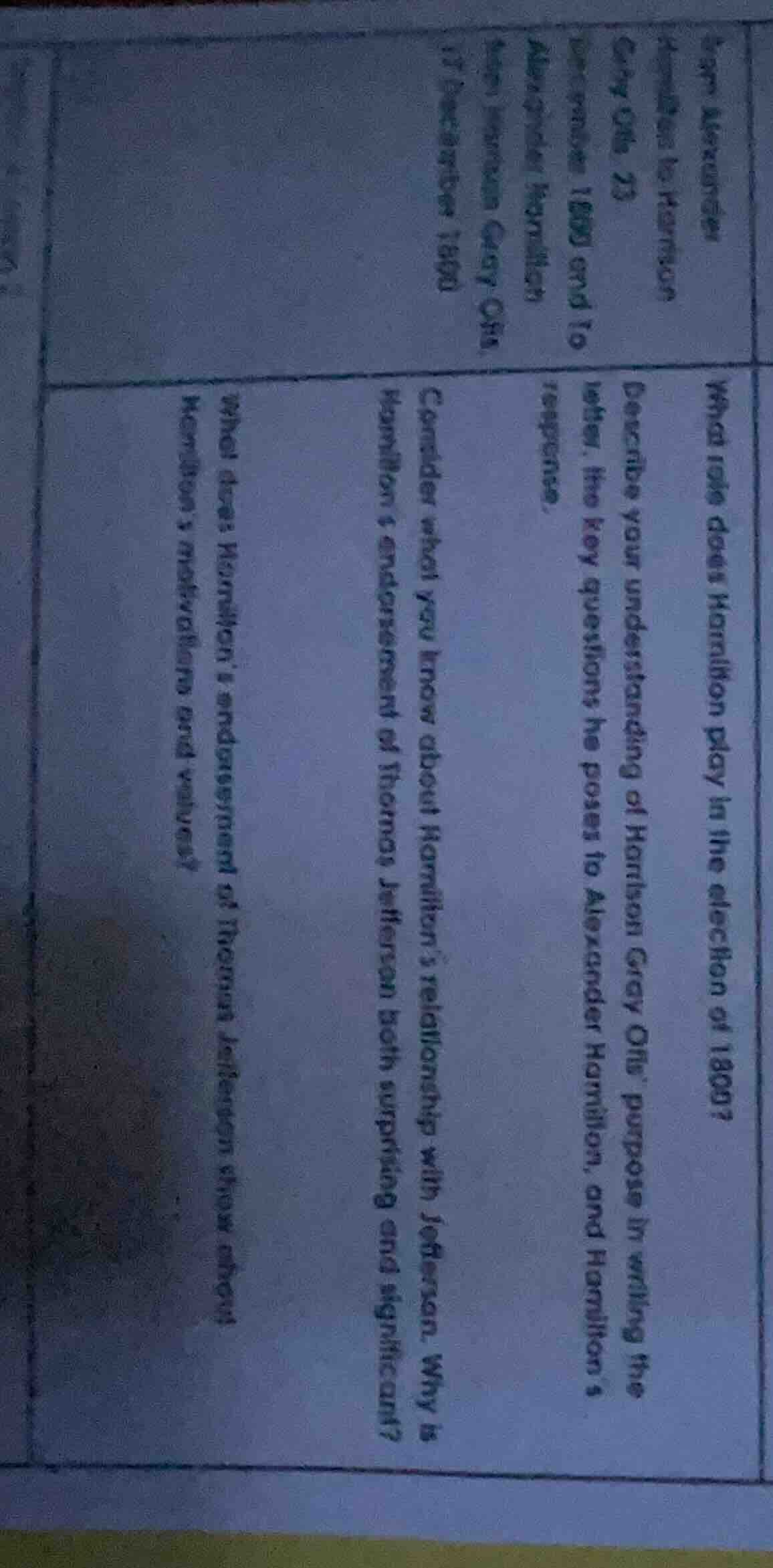
what role does hamilton play in the election of 1800?
describe your understanding of harrison gray otis’ purpose in writing the letter, the key questions he poses to alexander hamilton, and hamilton’s response.
consider what you know about hamilton’s relationship with jefferson. why is hamilton’s endorsement of thomas jefferson both surprising and significant?
what does hamilton’s endorsement of thomas jefferson show about hamilton’s motivations and values?
Sub - question 1: What role does Hamilton play in the election of 1800?
In the 1800 U.S. presidential election, the race was between Thomas Jefferson and Aaron Burr (both Democratic - Republicans) and John Adams (Federalist). The election ended in a tie between Jefferson and Burr in the Electoral College. Alexander Hamilton, a leading Federalist, had significant influence. He disliked Burr and believed Jefferson, despite their political differences, was more principled and a better choice for the nation. Hamilton used his influence within the Federalist - leaning House of Representatives (which had to decide the election due to the tie) to persuade representatives to vote for Jefferson. His actions were crucial in breaking the tie and leading to Jefferson's election as President.
Assuming the "Cry Out" (possibly a mis - OCR and related to a letter in the 1800 election context), Hamilton's purpose in writing such a letter (likely to influence the election outcome) was to make his stance clear about the candidates (Jefferson and Burr) and to urge others (perhaps Federalist representatives) to act in a way that would lead to a favorable (in his view) outcome. The key questions he might pose to himself (or to Hamilton, if it's a letter to himself or another) could be about the moral and political implications of supporting either Jefferson or Burr, and what the long - term consequences for the nation would be. Hamilton's response (either in the letter or in his actions) was to advocate for Jefferson's election, as he believed Jefferson, while having different political ideologies from Federalists, was a more honorable and capable leader than Burr, and that his election would be better for the stability and future of the United States.
Hamilton and Jefferson had deep - seated political differences. Hamilton was a Federalist who supported a strong central government, a national bank, and a more commercial - oriented economy. Jefferson was a Democratic - Republican who favored states' rights, an agrarian - based economy, and a more limited central government. Their ideological differences led to intense political rivalry. Hamilton's endorsement of Jefferson was surprising because of these long - standing, bitter political differences. It was significant because Hamilton's influence as a leading Federalist was crucial in the 1800 election's House - decided phase, and his endorsement helped secure Jefferson's victory, showing that Hamilton prioritized what he saw as the nation's best interests (opposing Burr) over his political ideology differences with Jefferson.

Snap & solve any problem in the app
Get step-by-step solutions on Sovi AI
Photo-based solutions with guided steps
Explore more problems and detailed explanations
Alexander Hamilton played a crucial role in the 1800 election. After the Electoral College resulted in a tie between Thomas Jefferson and Aaron Burr, the election was decided by the House of Representatives. Hamilton, though a Federalist and having political differences with Jefferson, viewed Burr as unprincipled. He used his influence to persuade Federalist - leaning representatives in the House to vote for Jefferson, which was instrumental in Jefferson being elected as President.