QUESTION IMAGE
Question
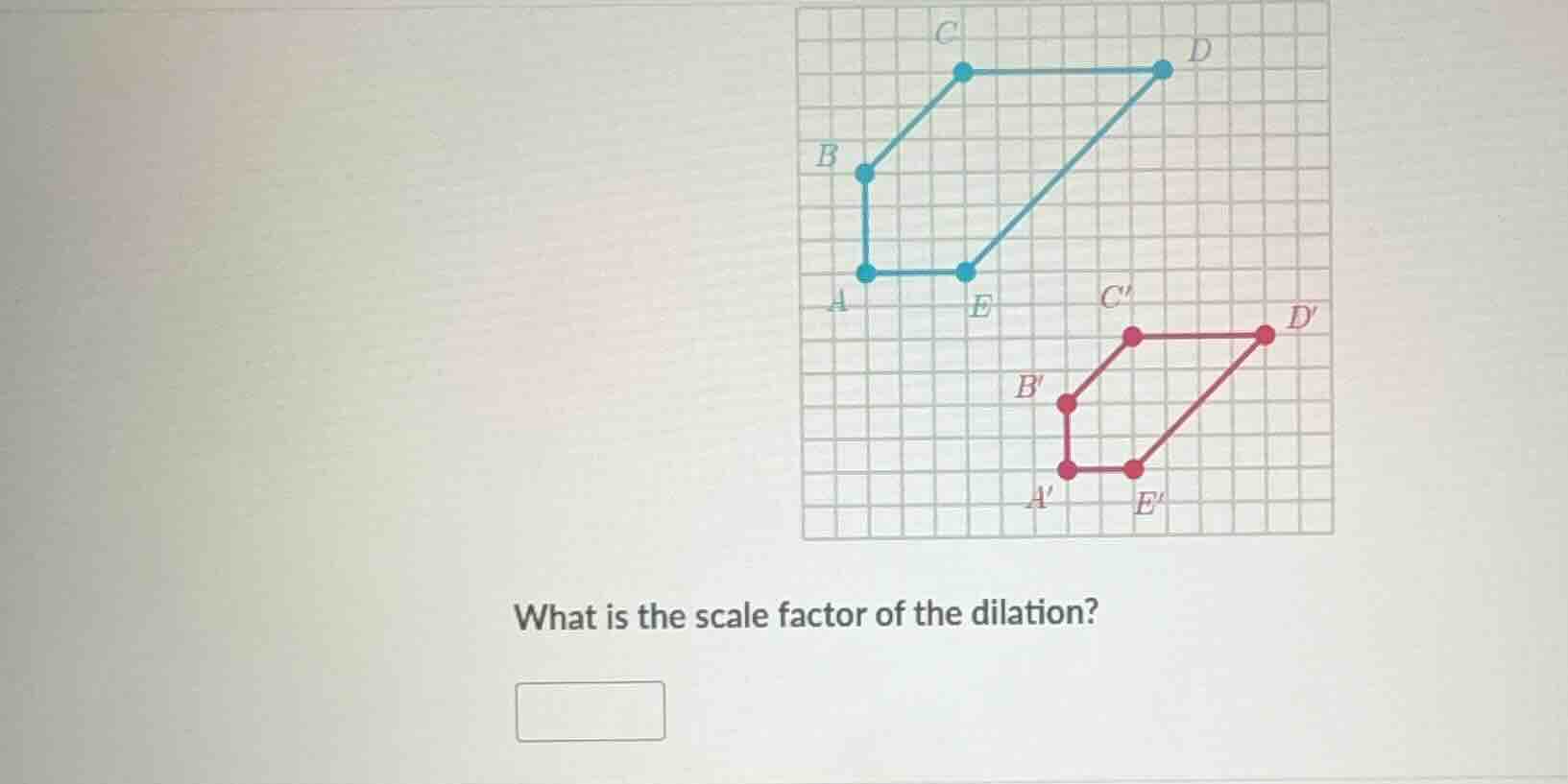
what is the scale factor of the dilation?
Step1: Identify corresponding sides
First, we find the length of a side in the original figure (blue) and the corresponding side in the dilated figure (red). Let's take side \( AE \) and \( A'E' \). From the grid, assume each grid square has side length 1. Length of \( AE \): let's count the grids. \( A \) to \( E \) is 2 units (since from \( A \) (let's say at (x1,y1)) to \( E \) (x2,y2), the horizontal distance is 2). Length of \( A'E' \): from \( A' \) to \( E' \), horizontal distance is 1 unit? Wait, no, maybe I messed up. Wait, let's check another side. Let's take \( CD \) and \( C'D' \). \( CD \): from \( C \) to \( D \), horizontal distance is 4 units (count the grids: \( C \) is at some x, \( D \) is 4 units to the right). \( C'D' \): from \( C' \) to \( D' \), horizontal distance is 2 units? Wait, no, maybe the original figure's side \( AE \) is 2 units (from \( A \) to \( E \), 2 grid squares), and the dilated figure's \( A'E' \) is 1 unit? Wait, no, let's look at the vertical or horizontal segments. Let's take segment \( AE \) in the blue figure: \( A \) to \( E \) is 2 units (since they are 2 squares apart horizontally). In the red figure, \( A' \) to \( E' \) is 1 unit (1 square apart). So the scale factor is the ratio of the dilated length to the original length. Wait, dilation: scale factor \( k \) where new length = \( k \times \) original length. So if original \( AE = 2 \), new \( A'E' = 1 \), then \( k = \frac{1}{2} \)? Wait, no, wait: maybe I got original and dilated reversed. Wait, the blue figure is the original, red is the image after dilation. So scale factor is (length of image) / (length of original). Let's check another side. Let's take \( AB \): \( A \) to \( B \) is 3 units vertically (from \( A \) (y-coordinate, say) to \( B \), 3 squares up). \( A' \) to \( B' \): from \( A' \) to \( B' \), 1.5 units? No, wait, maybe the grid is such that each square is 1 unit. Let's assign coordinates. Let's say \( A \) is at (0,0), \( E \) is at (2,0) (so \( AE = 2 \)). \( A' \) is at (4, -3), \( E' \) is at (5, -3) (so \( A'E' = 1 \)). Wait, no, maybe the coordinates are better. Alternatively, let's take \( CD \): \( C \) is at (3, 5), \( D \) is at (7, 5) (so \( CD = 4 \) units). \( C' \) is at (6, 1), \( D' \) is at (8, 1) (so \( C'D' = 2 \) units). So \( C'D' = 2 \), \( CD = 4 \), so scale factor is \( \frac{2}{4} = \frac{1}{2} \). Alternatively, \( AE \) is 2 units, \( A'E' \) is 1 unit, so \( \frac{1}{2} \). So the scale factor is \( \frac{1}{2} \).
Step2: Calculate scale factor
Scale factor \( k \) is the ratio of the length of the dilated (image) figure to the original figure. Let's take segment \( AE \) (original) length = 2, segment \( A'E' \) (image) length = 1. So \( k = \frac{\text{image length}}{\text{original length}} = \frac{1}{2} \).

Snap & solve any problem in the app
Get step-by-step solutions on Sovi AI
Photo-based solutions with guided steps
Explore more problems and detailed explanations
\(\frac{1}{2}\)