QUESTION IMAGE
Question
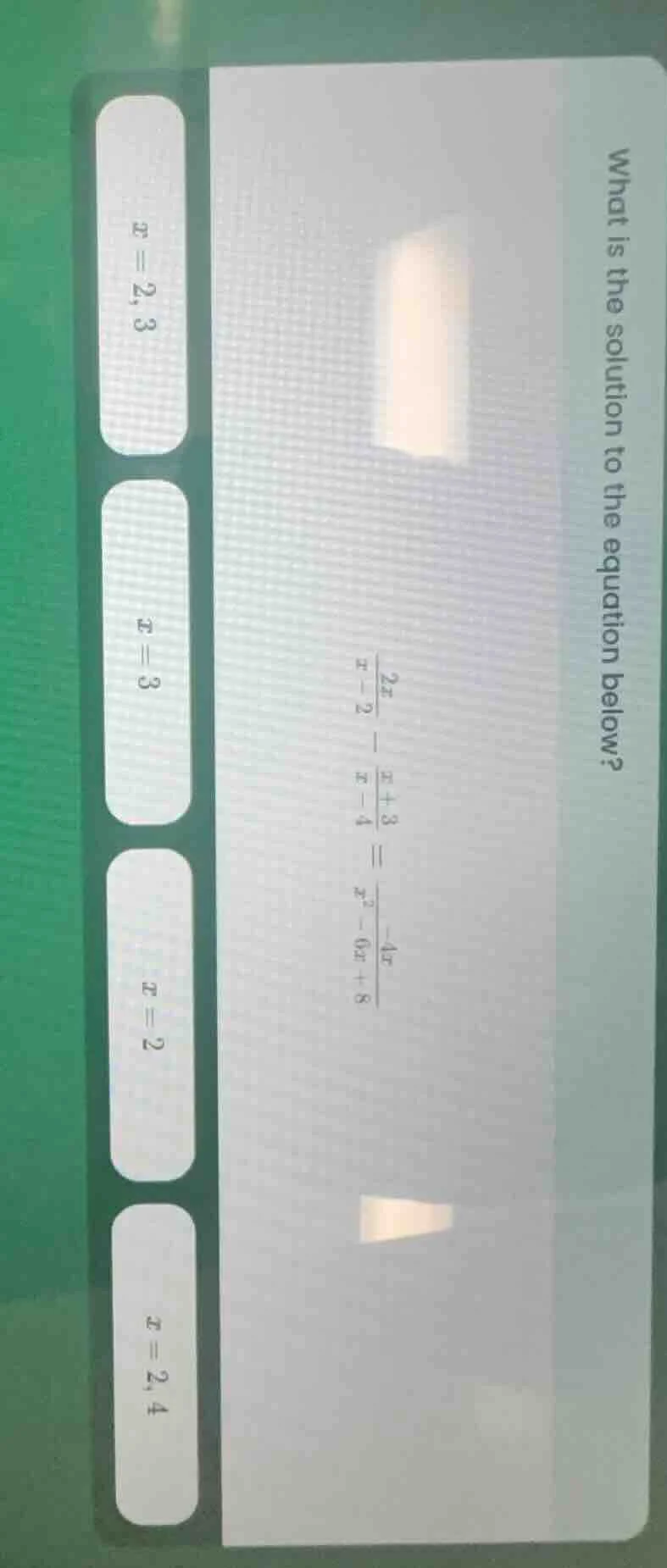
what is the solution to the equation below?
\frac{2x}{x - 2} - \frac{x + 3}{x - 4} = \frac{-4x}{x^2 - 6x + 8}
options:
x = 2, 3
x = 3
x = 2
x = 2, 4
Step1: Factor the denominator
The denominator \(x^2 - 6x + 8\) can be factored as \((x - 2)(x - 4)\). So the equation becomes \(\frac{2x}{x - 2}-\frac{x + 3}{x - 4}=\frac{-4x}{(x - 2)(x - 4)}\).
Step2: Multiply through by the LCD
The least common denominator (LCD) of the fractions is \((x - 2)(x - 4)\). Multiply each term by \((x - 2)(x - 4)\):
\(2x(x - 4)-(x + 3)(x - 2)=-4x\)
Step3: Expand the terms
Expand \(2x(x - 4)\) to get \(2x^2-8x\), expand \((x + 3)(x - 2)\) to get \(x^2+x - 6\). So the equation is:
\(2x^2-8x-(x^2+x - 6)=-4x\)
\(2x^2-8x-x^2-x + 6=-4x\)
Step4: Simplify the equation
Combine like terms:
\(x^2-9x + 6=-4x\)
\(x^2-5x + 6 = 0\)
Step5: Factor the quadratic
Factor \(x^2-5x + 6\) as \((x - 2)(x - 3)=0\)
Step6: Solve for x
Set each factor equal to zero:
\(x - 2 = 0\) or \(x - 3 = 0\)
\(x = 2\) or \(x = 3\)
But we need to check for extraneous solutions. If \(x = 2\), the denominator \(x - 2 = 0\) in the original equation, so \(x = 2\) is extraneous. If \(x = 3\), all denominators are non - zero.

Snap & solve any problem in the app
Get step-by-step solutions on Sovi AI
Photo-based solutions with guided steps
Explore more problems and detailed explanations
\(x = 3\) (corresponding to the option "x = 3")