QUESTION IMAGE
Question
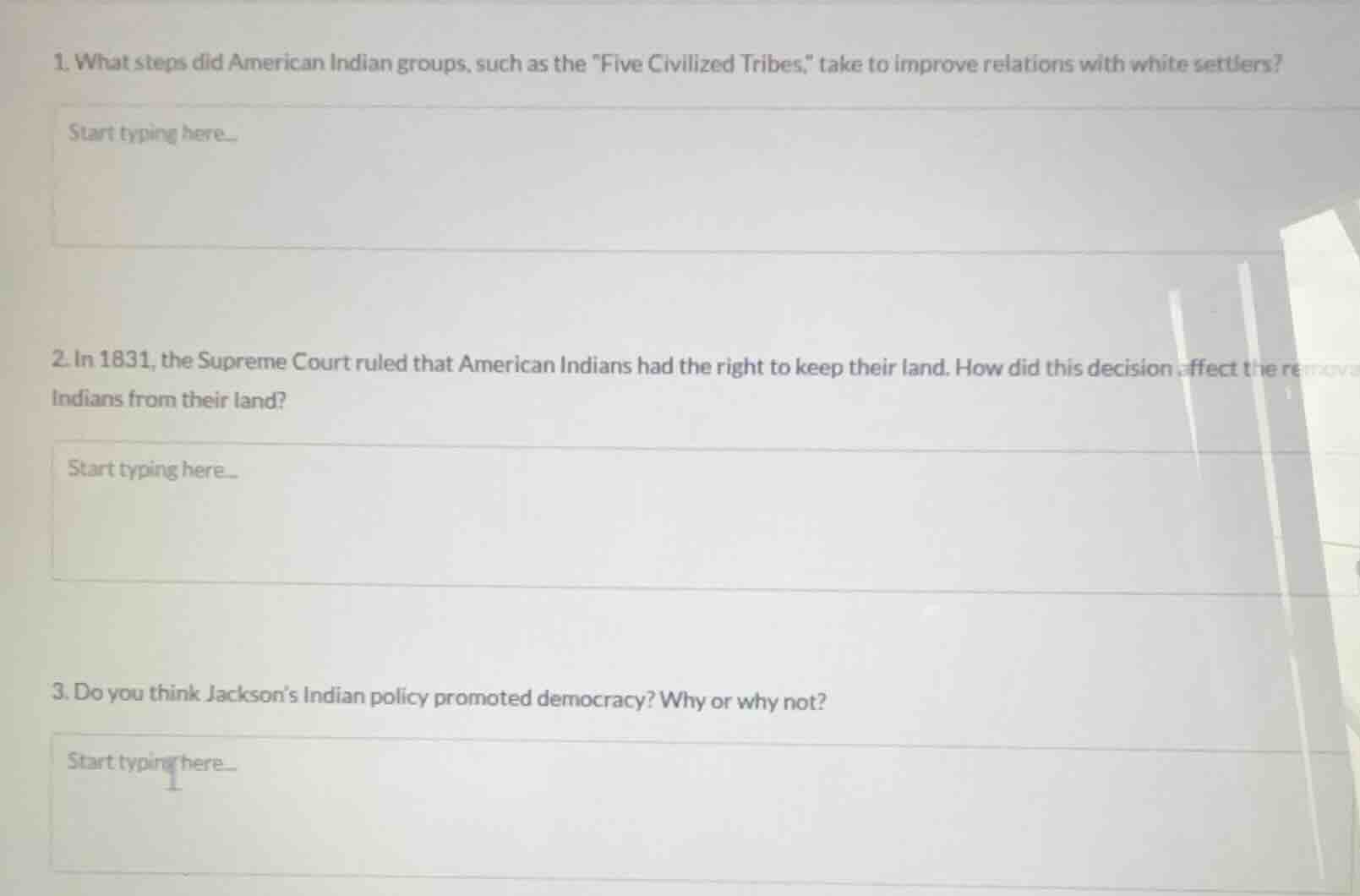
- what steps did american indian groups, such as the \five civilized tribes,\ take to improve relations with white settlers?
start typing here...
- in 1831, the supreme court ruled that american indians had the right to keep their land. how did this decision affect the removal of indians from their land?
start typing here...
- do you think jacksons indian policy promoted democracy? why or why not?
start typing here...
Brief Explanations
- The Five Civilized Tribes adopted European-American cultural practices to ease tensions with white settlers, including adopting agricultural systems modeled on white farms, converting to Christianity, establishing written legal systems and constitutions, and educating their children in European-style schools. Some also engaged in trade with white settlers and attempted to negotiate formal treaties to secure land rights.
- The 1831 Supreme Court ruling (Cherokee Nation v. Georgia) recognized American Indians as "domestic dependent nations" with land rights, but it was not enforced by President Andrew Jackson. This allowed the federal and state governments to continue pressuring and forcing Indian removal, as the ruling lacked executive backing to stop displacement efforts like the Trail of Tears.
- Jackson's Indian policy did not promote democracy. It prioritized the interests of white settler voters over the inherent political rights of American Indian nations, who were sovereign peoples. By ignoring Supreme Court rulings and enforcing forced removal, it violated the core democratic principle of equal rights and self-determination for all groups within the U.S.

Snap & solve any problem in the app
Get step-by-step solutions on Sovi AI
Photo-based solutions with guided steps
Explore more problems and detailed explanations
- They adopted European-American cultural norms (farming, Christianity, written laws), engaged in trade, and negotiated treaties to improve relations with white settlers.
- The ruling was unenforced by President Jackson, so it did not stop the forced removal of American Indians from their land; displacement efforts like the Trail of Tears proceeded.
- No, Jackson's Indian policy did not promote democracy. It prioritized white settler interests over the sovereign rights of American Indian nations, ignored judicial rulings, and violated the democratic principle of equal self-determination.