QUESTION IMAGE
Question
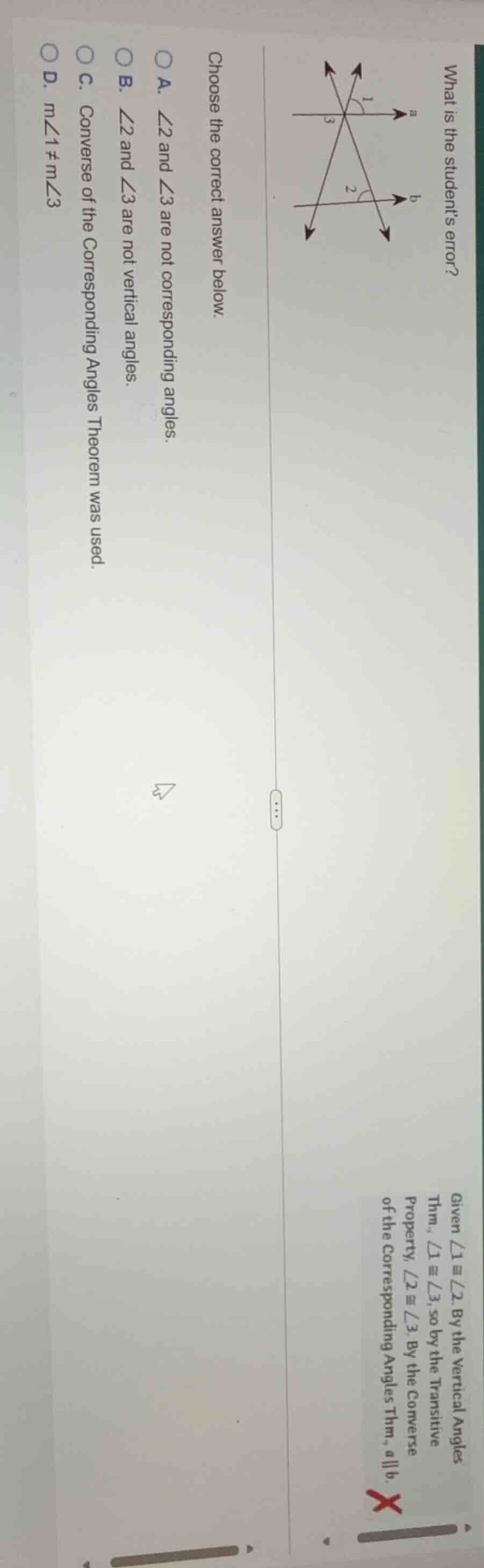
what is the students error? given ∠1 ≅ ∠2. by the vertical angles thm, ∠1 ≅ ∠3, so by the transitive property, ∠2 ≅ ∠3. by the converse of the corresponding angles thm, a || b. choose the correct answer below. a. ∠2 and ∠3 are not corresponding angles. b. ∠2 and ∠3 are not vertical angles. c. converse of the corresponding angles theorem was used. d. m∠1 ≠ m∠3
Brief Explanations
To determine the student's error, we analyze each option:
- Option A: Corresponding angles are in the same relative position at each intersection. ∠2 and ∠3 do not have this relationship, so using them as corresponding angles is incorrect.
- Option B: Vertical angles are opposite each other when two lines intersect. ∠2 and ∠3 are not vertical angles, but this is not the core error here.
- Option C: The Converse of the Corresponding Angles Theorem requires corresponding angles to be congruent. Since ∠2 and ∠3 are not corresponding angles, the theorem’s converse was misapplied, but the primary error is misidentifying corresponding angles.
- Option D: ∠1 and ∠3 are vertical angles (so \( m\angle1 = m\angle3 \)), so this is false.
The student incorrectly assumed ∠2 and ∠3 are corresponding angles, which they are not.

Snap & solve any problem in the app
Get step-by-step solutions on Sovi AI
Photo-based solutions with guided steps
Explore more problems and detailed explanations
A. ∠2 and ∠3 are not corresponding angles.