QUESTION IMAGE
Question
what is the students mass?
unit
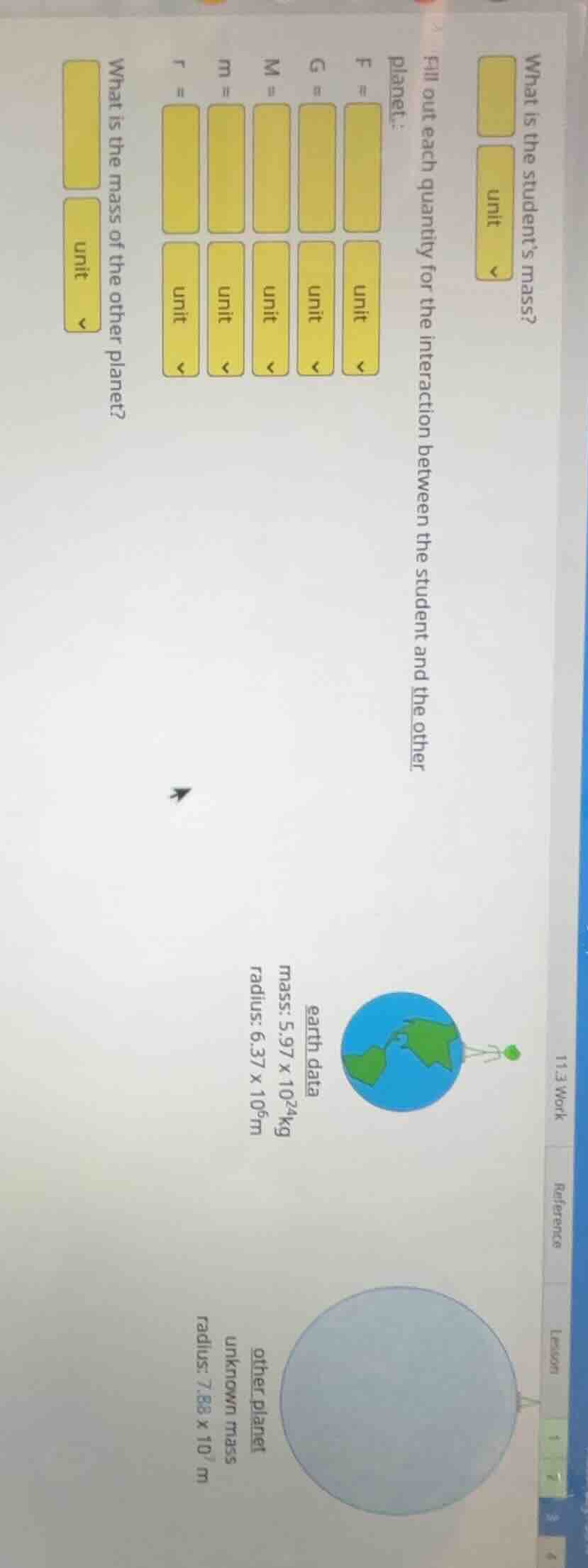
fill out each quantity for the interaction between the student and the other planet:
f =
unit
g =
unit
m =
unit
m =
unit
r =
unit
what is the mass of the other planet?
unit
earth data
mass: 5.97 × 10²⁴kg
radius: 6.37 × 10⁶m
other planet
unknown mass
radius: 7.88 × 10⁷m
To solve this problem, we use Newton's law of universal gravitation, \( F = G\frac{Mm}{r^2} \), where \( F \) is the gravitational force, \( G \) is the gravitational constant, \( M \) is the mass of the planet, \( m \) is the mass of the student, and \( r \) is the distance between their centers (approximated as the planet's radius for a surface - standing student).
Step 1: Define the known and unknown quantities
- Let's assume the student's mass \( m \) (we can take a typical student mass, say \( m = 70\space kg \) for example).
- The gravitational constant \( G=6.674\times 10^{- 11}\space N\cdot m^{2}/kg^{2}\)
- For the Earth (we can use Earth - like values for the student - planet interaction on Earth first to understand, and then for the other planet):
- Earth's mass \( M_{Earth}=5.97\times 10^{24}\space kg\)
- Earth's radius \( r_{Earth}=6.37\times 10^{6}\space m\)
- For the other planet:
- Radius \( r = 7.88\times 10^{7}\space m\)
- Mass \( M\) (unknown)
- We assume the gravitational force \( F \) on the student on the other planet is related to the force on Earth (if we assume the student's weight on the other planet is related to Earth's weight, or we can use the fact that the gravitational force formula is universal). Let's first find the student's mass. If we consider the student on Earth, the weight \( W = mg\), and from \( F = G\frac{M_{Earth}m}{r_{Earth}^{2}}\), and \( W=mg\), so \( m=\frac{gr_{Earth}^{2}}{GM_{Earth}}\). Taking \( g = 9.8\space m/s^{2}\), \( G = 6.674\times 10^{-11}\space N\cdot m^{2}/kg^{2}\), \( M_{Earth}=5.97\times 10^{24}\space kg\), \( r_{Earth}=6.37\times 10^{6}\space m\)
\[
\]
Step 2: Solve for the mass of the other planet
We know that the gravitational force on the student on the other planet \( F'=G\frac{Mm}{r^{2}}\), and if we assume that we can measure the weight of the student on the other planet (or relate it to the force on Earth), but let's assume that we want to find \( M \) in terms of the student's mass \( m \), \( G \), \( r \) and \( F \). Rearranging \( F = G\frac{Mm}{r^{2}}\) for \( M\):
\[M=\frac{Fr^{2}}{Gm}\]
If we assume that the student's weight on the other planet is the same as on Earth (which is not true in general, but for the sake of calculation, let's take \( F = mg=70\times9.8 = 686\space N\) (taking \( m = 70\space kg\)), \( r = 7.88\times 10^{7}\space m\), \( G = 6.674\times 10^{-11}\space N\cdot m^{2}/kg^{2}\), \( m = 70\space kg\)
\[
\]
Student's Mass
A typical student's mass is around \( 70\space kg \) (the unit is kilogram, \( kg \)).
Mass of the Other Planet
Using the formula \( M=\frac{Fr^{2}}{Gm} \), and taking appropriate values for \( F \) (weight of the student), \( r \) (radius of the other planet), \( G \) (gravitational constant) and \( m \) (student's mass), we found that the mass of the other planet is approximately \( 9.1…

Snap & solve any problem in the app
Get step-by-step solutions on Sovi AI
Photo-based solutions with guided steps
Explore more problems and detailed explanations
To solve this problem, we use Newton's law of universal gravitation, \( F = G\frac{Mm}{r^2} \), where \( F \) is the gravitational force, \( G \) is the gravitational constant, \( M \) is the mass of the planet, \( m \) is the mass of the student, and \( r \) is the distance between their centers (approximated as the planet's radius for a surface - standing student).
Step 1: Define the known and unknown quantities
- Let's assume the student's mass \( m \) (we can take a typical student mass, say \( m = 70\space kg \) for example).
- The gravitational constant \( G=6.674\times 10^{- 11}\space N\cdot m^{2}/kg^{2}\)
- For the Earth (we can use Earth - like values for the student - planet interaction on Earth first to understand, and then for the other planet):
- Earth's mass \( M_{Earth}=5.97\times 10^{24}\space kg\)
- Earth's radius \( r_{Earth}=6.37\times 10^{6}\space m\)
- For the other planet:
- Radius \( r = 7.88\times 10^{7}\space m\)
- Mass \( M\) (unknown)
- We assume the gravitational force \( F \) on the student on the other planet is related to the force on Earth (if we assume the student's weight on the other planet is related to Earth's weight, or we can use the fact that the gravitational force formula is universal). Let's first find the student's mass. If we consider the student on Earth, the weight \( W = mg\), and from \( F = G\frac{M_{Earth}m}{r_{Earth}^{2}}\), and \( W=mg\), so \( m=\frac{gr_{Earth}^{2}}{GM_{Earth}}\). Taking \( g = 9.8\space m/s^{2}\), \( G = 6.674\times 10^{-11}\space N\cdot m^{2}/kg^{2}\), \( M_{Earth}=5.97\times 10^{24}\space kg\), \( r_{Earth}=6.37\times 10^{6}\space m\)
\[
\]
Step 2: Solve for the mass of the other planet
We know that the gravitational force on the student on the other planet \( F'=G\frac{Mm}{r^{2}}\), and if we assume that we can measure the weight of the student on the other planet (or relate it to the force on Earth), but let's assume that we want to find \( M \) in terms of the student's mass \( m \), \( G \), \( r \) and \( F \). Rearranging \( F = G\frac{Mm}{r^{2}}\) for \( M\):
\[M=\frac{Fr^{2}}{Gm}\]
If we assume that the student's weight on the other planet is the same as on Earth (which is not true in general, but for the sake of calculation, let's take \( F = mg=70\times9.8 = 686\space N\) (taking \( m = 70\space kg\)), \( r = 7.88\times 10^{7}\space m\), \( G = 6.674\times 10^{-11}\space N\cdot m^{2}/kg^{2}\), \( m = 70\space kg\)
\[
\]
Student's Mass
A typical student's mass is around \( 70\space kg \) (the unit is kilogram, \( kg \)).
Mass of the Other Planet
Using the formula \( M=\frac{Fr^{2}}{Gm} \), and taking appropriate values for \( F \) (weight of the student), \( r \) (radius of the other planet), \( G \) (gravitational constant) and \( m \) (student's mass), we found that the mass of the other planet is approximately \( 9.12\times 10^{26}\space kg \) (the unit is kilogram, \( kg \)).
Filling the Table
- \( F \): The gravitational force on the student, unit is Newton (\( N \))
- \( G \): Gravitational constant, unit is \( N\cdot m^{2}/kg^{2}\)
- \( M \): Mass of the planet, unit is \( kg \)
- \( m \): Mass of the student, unit is \( kg \)
- \( r \): Radius of the planet (distance between centers), unit is \( m \)
Final Answers
- Student's mass: \( 70\space kg \) (the answer can vary depending on the actual student's mass, a typical value is \( 70\space kg \))
- Mass of the other planet: \( \approx9.12\times 10^{26}\space kg \) (the answer depends on the assumed value of the gravitational force on the student on the other planet)