QUESTION IMAGE
Question
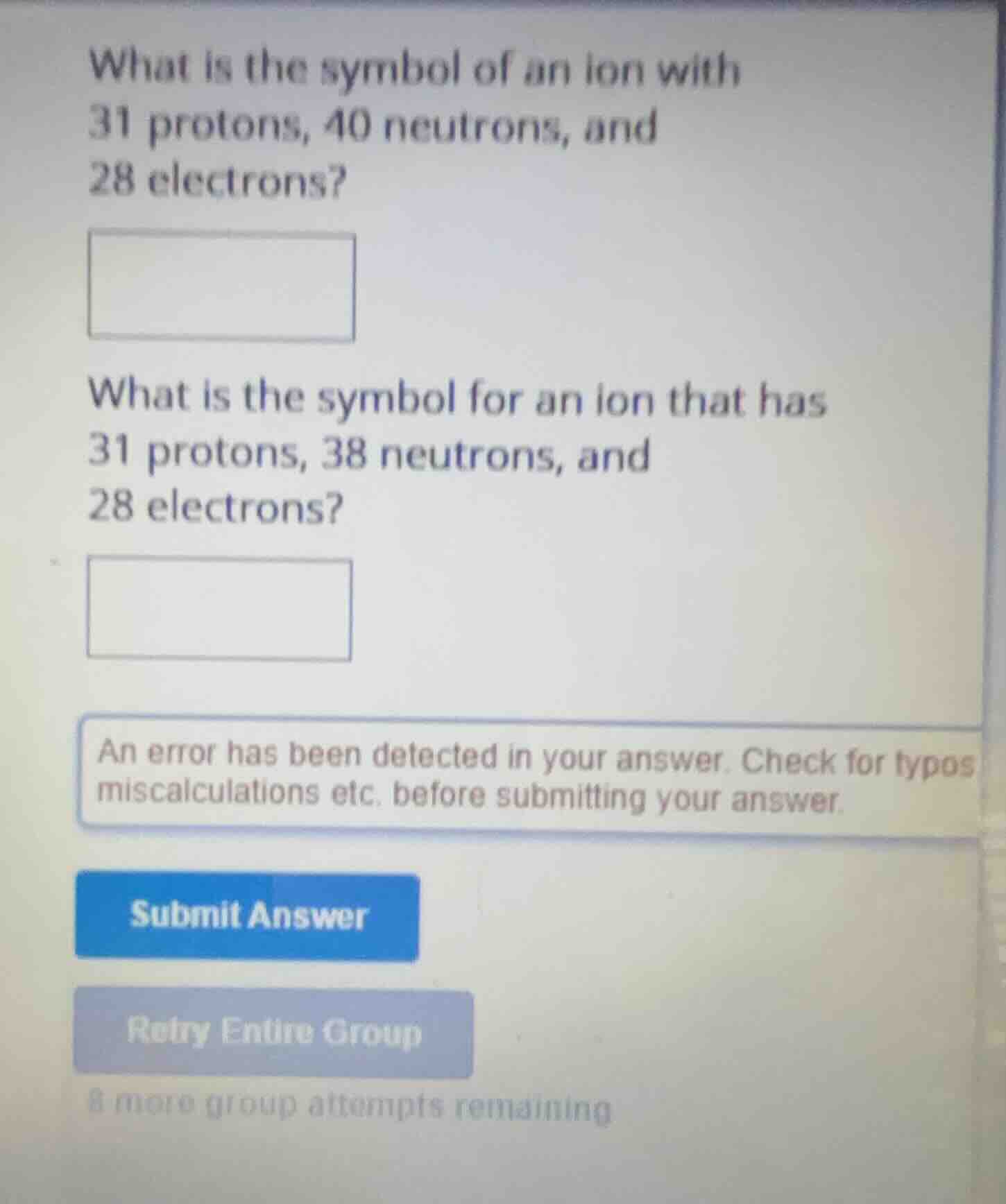
what is the symbol of an ion with 31 protons, 40 neutrons, and 28 electrons? what is the symbol for an ion that has 31 protons, 38 neutrons, and 28 electrons? an error has been detected in your answer. check for typos miscalculations etc. before submitting your answer. submit answer retry entire group 8 more group attempts remaining
First Sub - Question
Step 1: Identify the element
The number of protons is equal to the atomic number. Since there are 31 protons, the atomic number \(Z = 31\). The element with atomic number 31 is gallium (Ga).
Step 2: Calculate the mass number
The mass number \(A\) is the sum of protons and neutrons. Here, protons \(= 31\) and neutrons \(= 40\), so \(A=31 + 40=71\).
Step 3: Determine the charge of the ion
The charge of the ion is given by the number of protons minus the number of electrons. Protons \(= 31\), electrons \(= 28\), so charge \(=31 - 28 = + 3\).
Step 4: Write the ion symbol
The symbol of the ion is written as \(\ce{^{A}_{Z}X^{n+}}\) (or \(\ce{^{A}_{Z}X^{n -}}\) for negative charge), where \(X\) is the element symbol, \(A\) is the mass number, \(Z\) is the atomic number, and \(n\) is the magnitude of the charge. So for gallium, it is \(\ce{^{71}_{31}Ga^{3+}}\).
Step 1: Identify the element
The number of protons is 31, so the atomic number \(Z = 31\), and the element is gallium (Ga).
Step 2: Calculate the mass number
The mass number \(A\) is the sum of protons and neutrons. Protons \(= 31\), neutrons \(= 38\), so \(A = 31+38 = 69\).
Step 3: Determine the charge of the ion
The charge is protons minus electrons. Protons \(= 31\), electrons \(= 28\), so charge \(=31 - 28=+3\).
Step 4: Write the ion symbol
Using the ion symbol format \(\ce{^{A}_{Z}X^{n+}}\), with \(X = \ce{Ga}\), \(A = 69\), \(Z = 31\), and charge \(+ 3\), the symbol is \(\ce{^{69}_{31}Ga^{3+}}\).

Snap & solve any problem in the app
Get step-by-step solutions on Sovi AI
Photo-based solutions with guided steps
Explore more problems and detailed explanations
\(\ce{^{71}_{31}Ga^{3+}}\)