QUESTION IMAGE
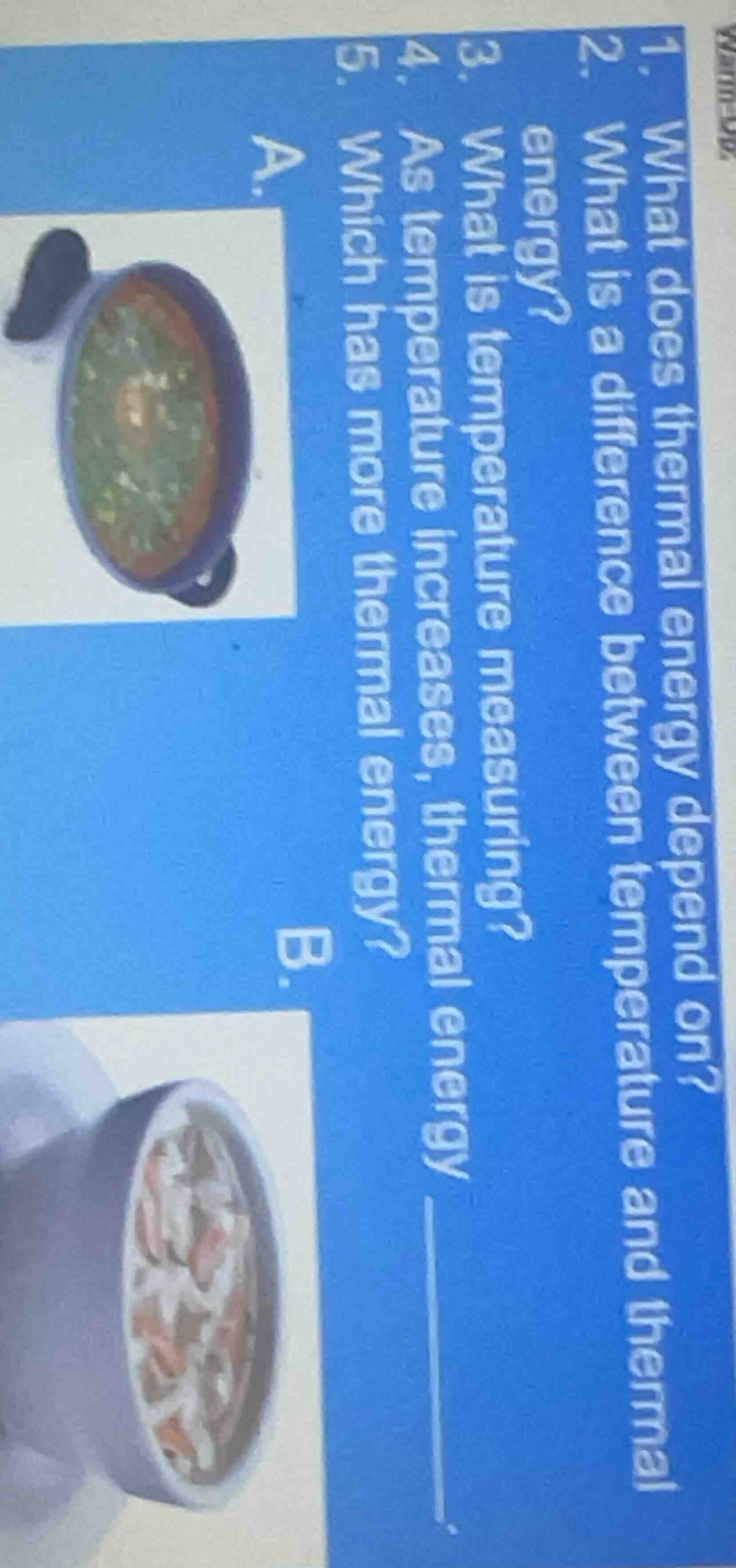
Question
- what does thermal energy depend on?
- what is a difference between temperature and thermal energy?
- what is temperature measuring?
- as temperature increases, thermal energy ______.
- which has more thermal energy?
a. image of a pot with food
b. image of a bowl with food
1. What does thermal energy depend on?
Thermal energy depends on the mass of the substance, its specific heat capacity, and its temperature. The formula for thermal energy is \( Q = mc\Delta T \), where \( m \) is mass, \( c \) is specific heat capacity, and \( \Delta T \) is the change in temperature. So, a larger mass, higher specific heat, or greater temperature change (or higher initial temperature) leads to more thermal energy.
- Temperature: A measure of the average kinetic energy of the particles in a substance (e.g., measured in °C, °F, K). It’s about how “hot” or “cold” a substance is.
- Thermal Energy: The total kinetic energy of all the particles in a substance (dependent on mass, temperature, and specific heat). A large object at a lower temperature can have more thermal energy than a small object at a higher temperature (e.g., a swimming pool at 25°C has more thermal energy than a cup of boiling water at 100°C because of its greater mass).
Temperature measures the average kinetic energy of the particles in a substance. As particles move faster (higher kinetic energy), temperature increases; slower movement (lower kinetic energy) means lower temperature.

Snap & solve any problem in the app
Get step-by-step solutions on Sovi AI
Photo-based solutions with guided steps
Explore more problems and detailed explanations
Thermal energy depends on the mass of the substance, its specific heat capacity, and its temperature (or the average kinetic energy of its particles, and the number of particles).