QUESTION IMAGE
Question
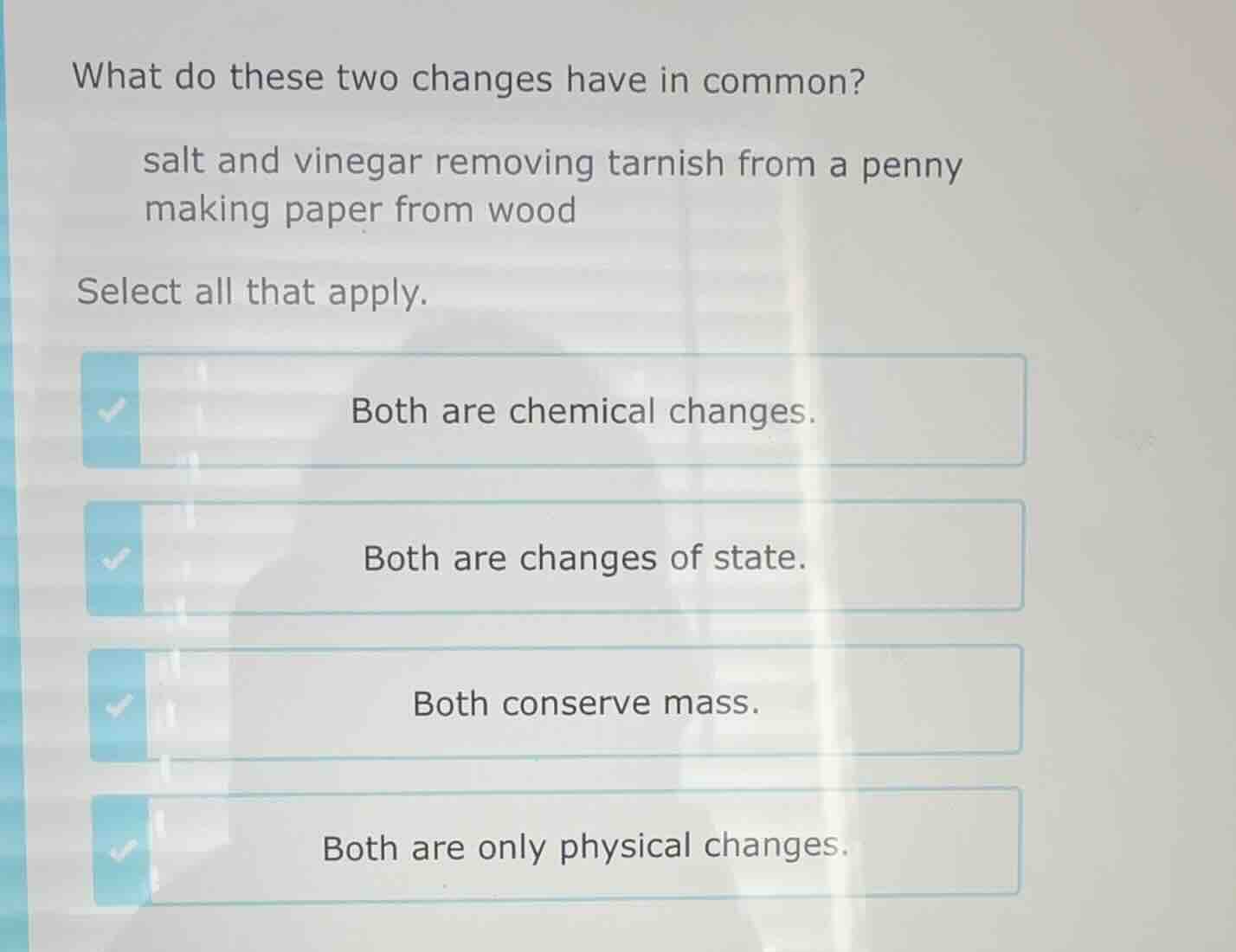
what do these two changes have in common? salt and vinegar removing tarnish from a penny making paper from wood select all that apply. both are chemical changes. both are changes of state. both conserve mass. both are only physical changes.
Brief Explanations
- Analyze "salt and vinegar removing tarnish from a penny": This is a chemical reaction (tarnish reacts with acid), so it's a chemical change. In any chemical reaction, mass is conserved (Law of Conservation of Mass). It's not a change of state (no phase change like solid→liquid→gas) and not a physical change (new substances form).
- Analyze "making paper from wood": This involves chemical processes (breaking down wood components, forming new structures), so it's a chemical change. Mass is conserved here too. It's not a change of state (still solid - related) and not a physical change (chemical transformations occur).
Now, evaluate each option:
- "Both are chemical changes": Correct, as both involve chemical reactions (tarnish removal is a chemical reaction, paper making from wood has chemical processes).
- "Both are changes of state": Incorrect, neither is a phase change (like melting, freezing, etc.).
- "Both conserve mass": Correct, according to the Law of Conservation of Mass, mass is conserved in all chemical (and physical) changes.
- "Both are only physical changes": Incorrect, both involve chemical changes (new substances or chemical transformations).

Snap & solve any problem in the app
Get step-by-step solutions on Sovi AI
Photo-based solutions with guided steps
Explore more problems and detailed explanations
A. Both are chemical changes.
C. Both conserve mass.