QUESTION IMAGE
Question
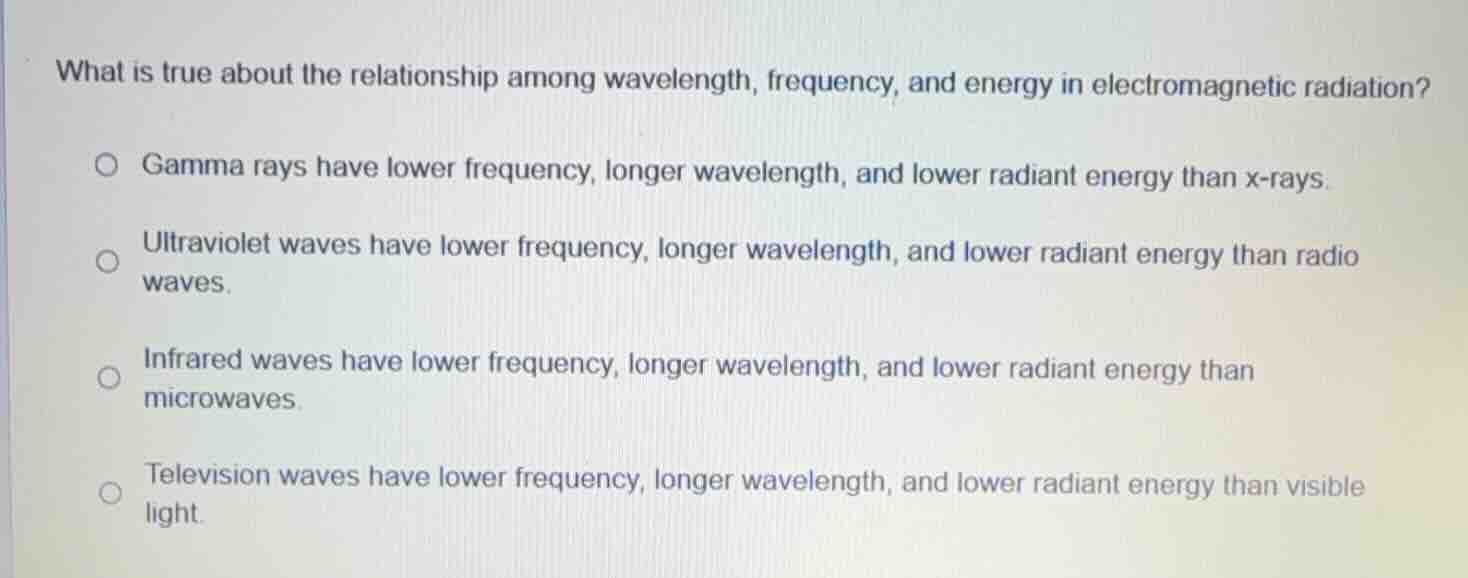
what is true about the relationship among wavelength, frequency, and energy in electromagnetic radiation?
○ gamma rays have lower frequency, longer wavelength, and lower radiant energy than x - rays.
○ ultraviolet waves have lower frequency, longer wavelength, and lower radiant energy than radio waves.
○ infrared waves have lower frequency, longer wavelength, and lower radiant energy than microwaves.
○ television waves have lower frequency, longer wavelength, and lower radiant energy than visible light.
Electromagnetic radiation follows these relationships:
- Frequency ($f$) and wavelength ($\lambda$) are inversely proportional: $c = f\lambda$, where $c$ is the speed of light. Longer wavelength means lower frequency.
- Energy ($E$) is directly proportional to frequency: $E = hf$, where $h$ is Planck's constant. Lower frequency means lower energy.
- Gamma rays have higher frequency, shorter wavelength, higher energy than X-rays, so the first option is false.
- Ultraviolet waves have higher frequency, shorter wavelength, higher energy than radio waves, so the second option is false.
- Infrared waves have higher frequency, shorter wavelength, higher energy than microwaves, so the third option is false.
- Television waves are radio waves, which have lower frequency, longer wavelength, lower energy than visible light, so this option is true.

Snap & solve any problem in the app
Get step-by-step solutions on Sovi AI
Photo-based solutions with guided steps
Explore more problems and detailed explanations
Television waves have lower frequency, longer wavelength, and lower radiant energy than visible light.