QUESTION IMAGE
Question
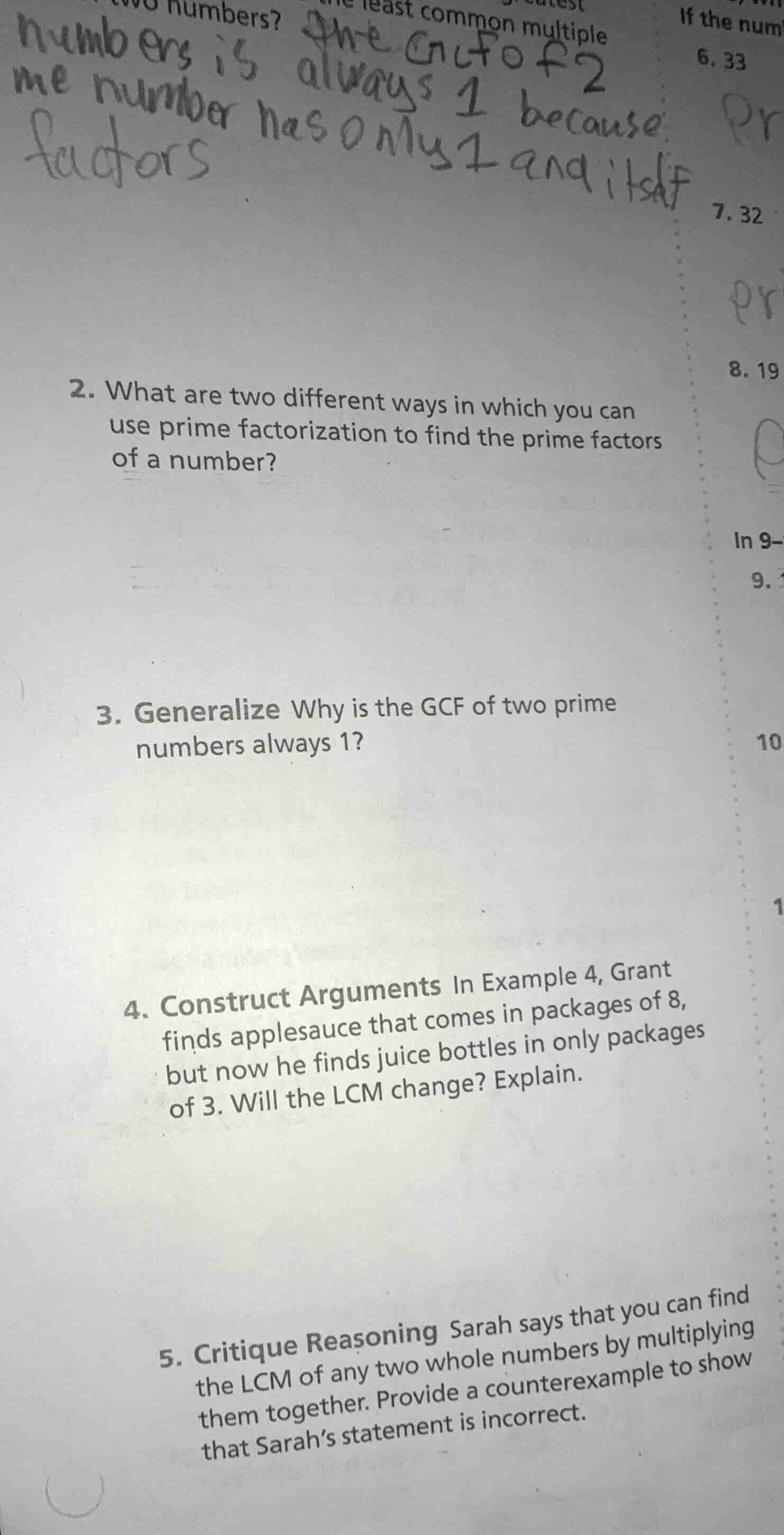
- what are two different ways in which you can use prime factorization to find the prime factors of a number?
- generalize why is the gcf of two prime numbers always 1?
- construct arguments in example 4, grant finds applesauce that comes in packages of 8, but now he finds juice bottles in only packages of 3. will the lcm change? explain.
- critique reasoning sarah says that you can find the lcm of any two whole numbers by multiplying them together. provide a counterexample to show that sarah’s statement is incorrect.
Question 2
One way is the factor tree method: start with the number, split it into two factors, and continue splitting until all factors are prime. Another way is successive division: divide the number by the smallest prime (2, 3, 5, ...) that divides it, then divide the quotient by the smallest prime, and repeat until the quotient is 1. The divisors used are the prime factors.
A prime number has only two distinct positive divisors: 1 and itself. For two different prime numbers, the only common positive divisor is 1 (since their only divisors are 1 and themselves, and they are different primes, so themselves can’t be common). Thus, their greatest common factor (GCF) is 1.
Step1: Recall LCM formula
The formula for LCM of two numbers \(a\) and \(b\) is \( \text{LCM}(a,b)=\frac{a\times b}{\text{GCF}(a,b)} \). Initially, if applesauce was in packages of 8 (let's assume the other number was, say, 8 and another number, but now juice is in packages of 3. Let's assume the original numbers were 8 and some number, now they are 8 and 3.
Step2: Analyze GCF of 8 and 3
Since 8 (factors: \(2\times2\times2\)) and 3 (prime) are coprime (GCF(8,3) = 1).
Step3: Calculate LCM change
Originally, if the other number was, for example, 8 (but the problem implies a change in one number from, say, a previous number to 3). Wait, more simply: LCM depends on the numbers. If before, the numbers were 8 and \(n\), now they are 8 and 3. Since 3 is new (and coprime with 8), the LCM will change because LCM(8, \(n\)) vs LCM(8, 3). For example, if originally it was LCM(8,8)=8, now LCM(8,3)=24, so it changes. The key is that changing one number (from the original to 3) changes the set of numbers, so LCM changes because LCM is based on the prime factors of the numbers.

Snap & solve any problem in the app
Get step-by-step solutions on Sovi AI
Photo-based solutions with guided steps
Explore more problems and detailed explanations
- Factor Tree: Split the number into factors, keep splitting until all are prime.
- Successive Division: Divide by smallest primes repeatedly until quotient is 1; divisors are prime factors.