QUESTION IMAGE
Question
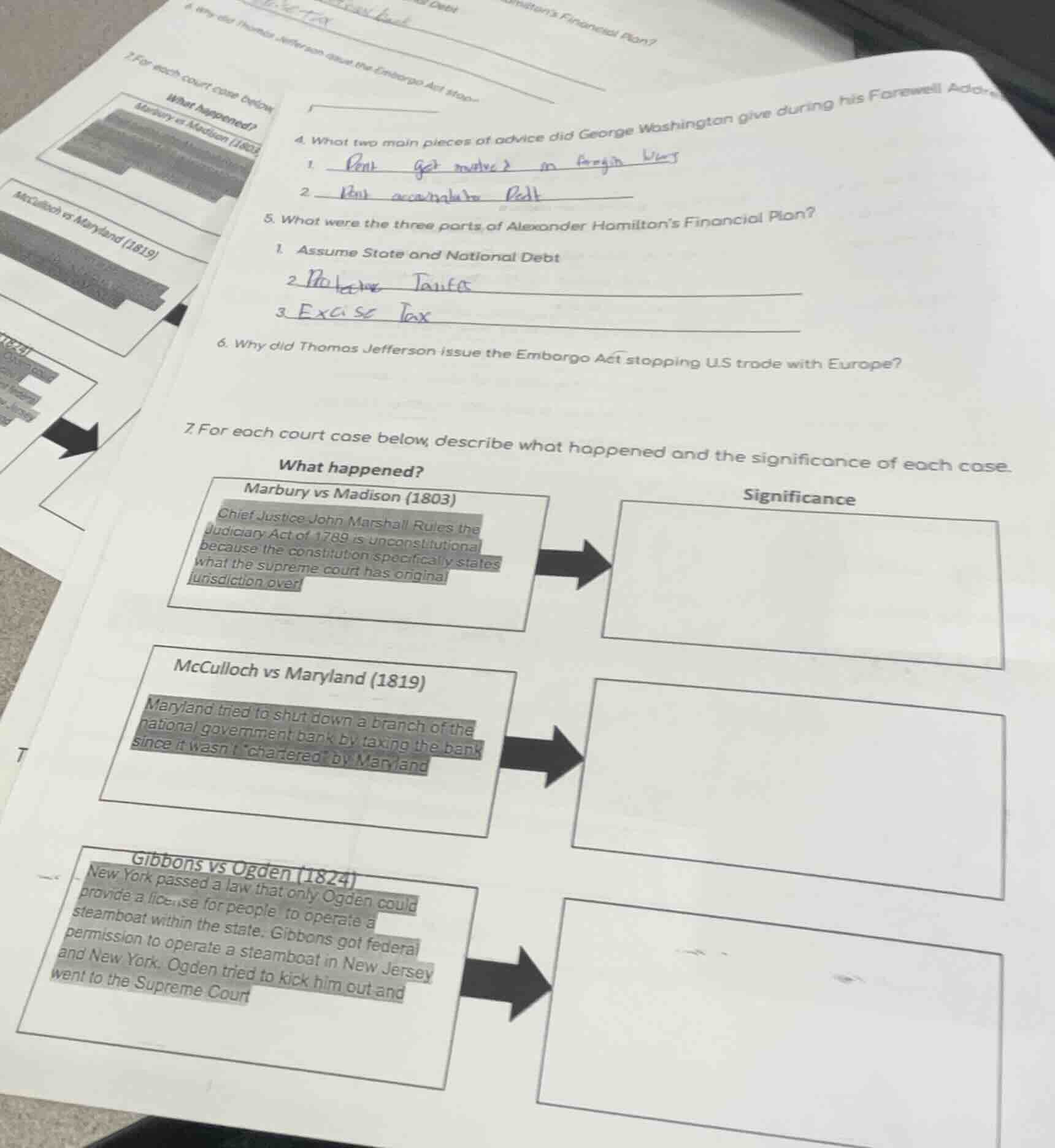
- what two main pieces of advice did george washington give during his farewell addre1. 2.5. what were the three parts of alexander hamiltons financial plan?1. assume state and national debt2.3.6. why did thomas jefferson issue the embargo act stopping u.s trade with europe?7. for each court case below, describe what happened and the significance of each case.what happened?marbury vs madison (1803)chief justice john marshall rules the judiciary act of 1789 is unconstitutional because the constitution specifically states what the supreme court has original jurisdiction oversignificancemcculloch vs maryland (1819)maryland tried to shut down a branch of the national government bank by taxing the bank since it wasnt chartered by marylandsignificancegibbons vs ogden (1824)new york passed a law that only ogden could provide a license for people to operate a steamboat within the state. gibbons got federal permission to operate a steamboat in new jersey and new york. ogden tried to kick him out and went to the supreme courtsignificance
For Question 4:
George Washington's Farewell Address focused on two core warnings: avoiding permanent foreign alliances to keep U.S. neutrality, and preventing the rise of political factions that would divide the nation.
For Question 5:
Alexander Hamilton's Financial Plan had three official parts: assuming state and national debt, creating a national bank to unify the financial system, and implementing protective tariffs to support domestic industry.
For Question 6:
Thomas Jefferson issued the Embargo Act to protest British and French impressment of U.S. sailors and interference with U.S. trade, hoping to force the European powers to respect U.S. neutrality.
For Question 7:
- Marbury vs Madison (1803): The ruling established the principle of judicial review, giving the Supreme Court the power to declare federal laws unconstitutional.
- McCulloch vs Maryland (1819): The Court ruled Congress has implied powers to create a national bank, and states cannot tax federal institutions, affirming federal supremacy over states.
- Gibbons vs Ogden (1824): The Court held that the federal government has exclusive power to regulate interstate commerce, overriding state-granted monopolies.

Snap & solve any problem in the app
Get step-by-step solutions on Sovi AI
Photo-based solutions with guided steps
Explore more problems and detailed explanations
- 1. Avoid permanent foreign alliances
- Avoid political factions (parties)
- 2. Establish a national bank
- Implement protective tariffs
- To protest British and French impressment of U.S. sailors and trade interference, and force respect for U.S. neutrality
- Marbury vs Madison (1803) Significance: Established judicial review for the Supreme Court.
McCulloch vs Maryland (1819) Significance: Affirmed federal implied powers and federal supremacy over state taxation of federal entities.
Gibbons vs Ogden (1824) Significance: Upheld federal authority over interstate commerce, invalidating state monopolies.