QUESTION IMAGE
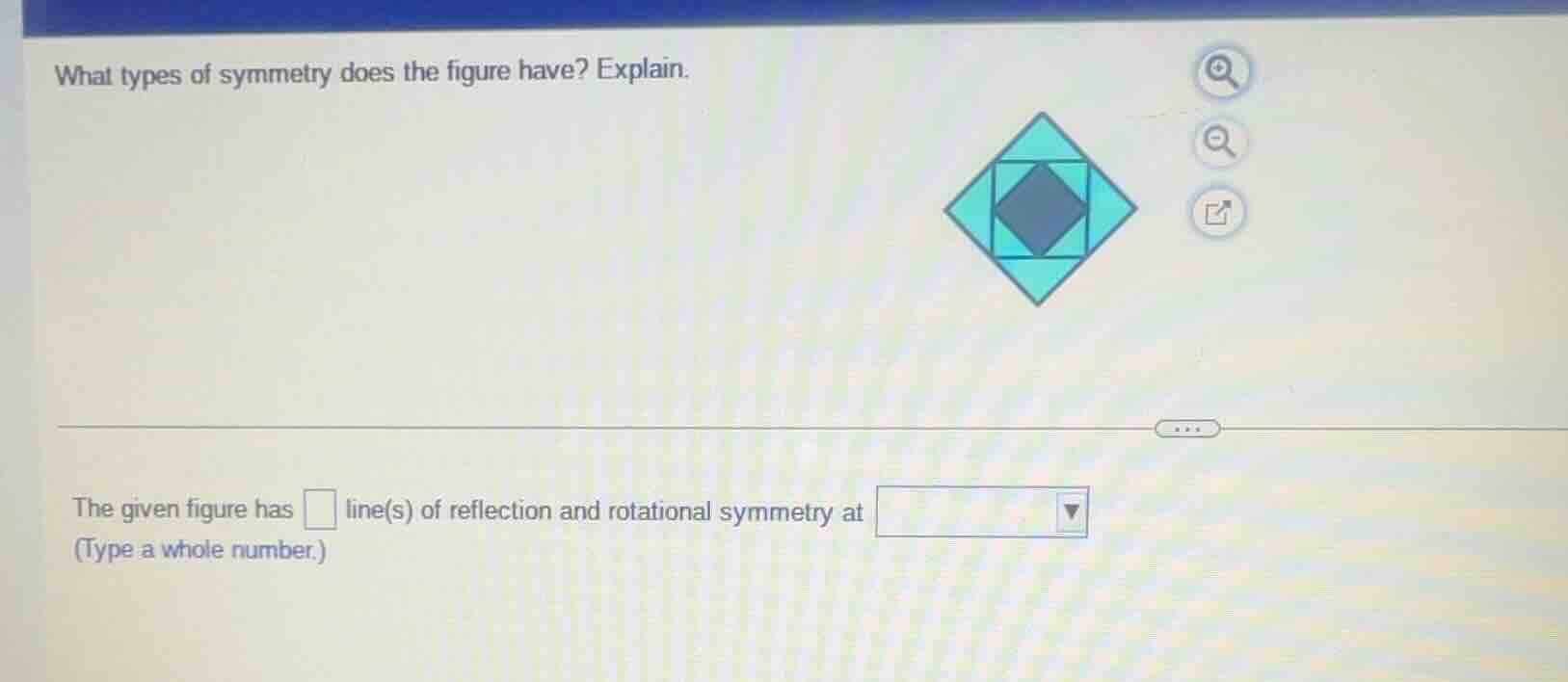
Question
what types of symmetry does the figure have? explain.
the given figure has \\(\square\\) line(s) of reflection and rotational symmetry at \\(\boxed{}\\) (type a whole number.)
Step1: Analyze Reflection Symmetry
The figure is a rhombus - like (or square - based) symmetric figure. A square (and this figure, being composed of squares rotated and nested) has 4 lines of reflection symmetry: one vertical, one horizontal, and two diagonal lines that pass through opposite vertices. So the number of lines of reflection is 4.
Step2: Analyze Rotational Symmetry
For rotational symmetry, we check the angle of rotation that maps the figure onto itself. The formula for the angle of rotational symmetry is $\frac{360^{\circ}}{n}$, where $n$ is the number of times it maps onto itself in a full rotation. For a square - like figure, it maps onto itself at $90^{\circ}$, $180^{\circ}$, $270^{\circ}$, and $360^{\circ}$. So the smallest non - zero angle of rotational symmetry is $90^{\circ}$, and the order of rotational symmetry (the number of times it maps onto itself in $360^{\circ}$) is 4. But the question asks for the angle of rotational symmetry (the measure of the smallest angle for which it has rotational symmetry). So the rotational symmetry angle is $90^{\circ}$ (and also $180^{\circ}$, $270^{\circ}$, $360^{\circ}$, but the smallest non - trivial one is $90^{\circ}$). But in the context of the problem, when we talk about rotational symmetry "at" a number, if we consider the order (number of times it repeats in $360^{\circ}$), the order is 4, but if we consider the angle, it's $90^{\circ}$. Wait, the problem says "rotational symmetry at" and the first blank is for the number of lines of reflection (4), and the second blank: let's re - examine. The figure is a square - based figure (nested squares rotated). A square has rotational symmetry of order 4 (rotates onto itself every $90^{\circ}$). So the number of lines of reflection is 4, and the rotational symmetry angle (the smallest angle) is $90^{\circ}$, but if we consider the order (number of rotational symmetries in $360^{\circ}$), it's 4. But the problem's first blank is "line(s) of reflection" (4), and the second blank: let's see the figure. The figure is a square (or rhombus with square properties) - like, so lines of reflection: 4. Rotational symmetry: the angle of rotation for which it is symmetric. For a square, the rotational symmetry angles are $90^{\circ}$, $180^{\circ}$, $270^{\circ}$, $360^{\circ}$. The smallest non - zero angle is $90^{\circ}$, but the order (number of times it maps to itself in $360^{\circ}$) is 4. But the problem says "rotational symmetry at" - maybe it's the angle? Wait, no, the first blank is a whole number (number of lines of reflection: 4), the second blank: let's check the figure again. The figure is composed of squares, so it has 4 lines of reflection (vertical, horizontal, two diagonals). For rotational symmetry, the angle of rotation that maps it to itself is $90^{\circ}$, but the order (number of rotational symmetries) is 4. But the problem's second blank: maybe the angle? Wait, no, the problem says "rotational symmetry at" and the first blank is "line(s) of reflection" (4), and the second blank: let's see the options (the dropdown). But since we have to type a whole number? Wait, no, maybe the order? Wait, the first blank: number of lines of reflection: 4. The second blank: the angle of rotational symmetry (the smallest angle) is $90^{\circ}$, but if we consider the order (number of times it rotates to itself in $360^{\circ}$), it's 4. But the problem says "rotational symmetry at" - maybe the angle. Wait, no, let's think again. The figure is a square (nested squares), so:
Lines of reflection: A square has 4 lines of reflect…

Snap & solve any problem in the app
Get step-by-step solutions on Sovi AI
Photo-based solutions with guided steps
Explore more problems and detailed explanations
The first blank (number of lines of reflection) is 4, and the second blank (rotational symmetry order or angle, but considering the figure is a square, rotational symmetry at $90^{\circ}$ or order 4. But since the first is a whole number (4) and the second, if we take the angle, 90, but maybe the order. Wait, no, the problem says "rotational symmetry at" - maybe the angle is $90^{\circ}$, but the first blank is 4. So:
The given figure has $\boldsymbol{4}$ line(s) of reflection and rotational symmetry at $\boldsymbol{90^{\circ}}$ (but if we consider the order, 4). Wait, no, the problem says "Type a whole number" for the first blank, and the second blank: maybe the angle is 90 (a whole number). So:
The given figure has $\boldsymbol{4}$ line(s) of reflection and rotational symmetry at $\boldsymbol{90}$ (degrees, but as a whole number).