QUESTION IMAGE
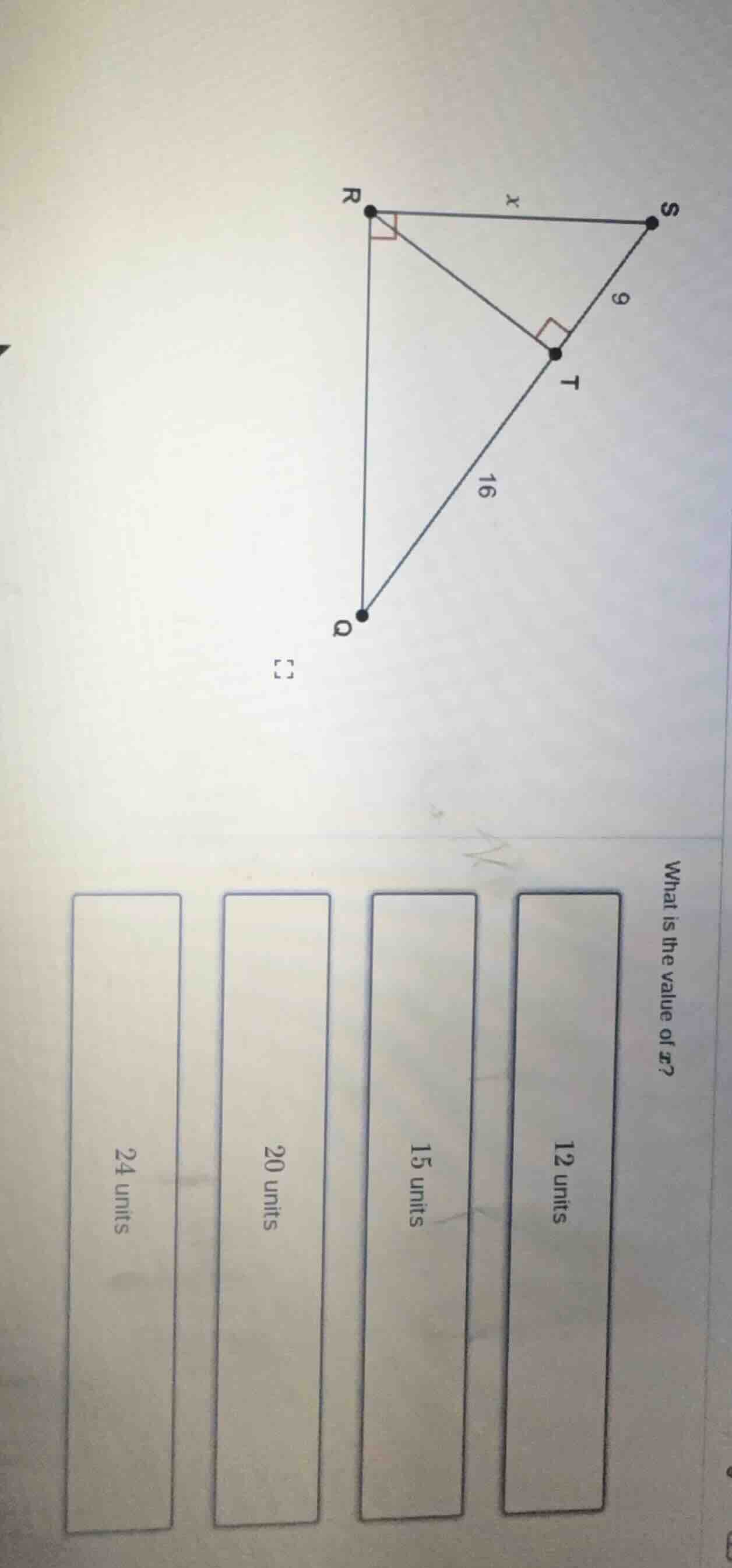
Question
what is the value of x?
12 units
15 units
20 units
24 units
Step1: Identify the geometric theorem
In a right triangle, when an altitude is drawn to the hypotenuse, the length of each leg of the right triangle is the geometric mean of the lengths of the hypotenuse and the segment of the hypotenuse adjacent to that leg. So, for right triangle \( \triangle QRS \) with right angle at \( R \) and altitude \( RT \) to hypotenuse \( QS \), we have \( \frac{RS}{QS}=\frac{ST}{RS} \), which can be rewritten as \( RS^{2}=ST\times QS \). Wait, actually, the correct geometric mean theorem (altitude-on-hypotenuse theorem) states that \( RT^{2}=ST\times TQ \) and \( RS^{2}=ST\times QS \), \( RQ^{2}=TQ\times QS \). But here we need to find \( x = RS \). We know \( ST = 9 \), \( TQ=16 \), so \( QS=ST + TQ=9 + 16 = 25 \). Then by the geometric mean theorem, \( RS^{2}=ST\times QS \)? Wait no, wait the right angle is at \( R \), so the legs are \( RS \) and \( RQ \), hypotenuse \( QS \). The altitude from \( R \) to \( QS \) is \( RT \), so the theorem is \( RS^{2}=ST\times QS \)? Wait no, let's recall: in \( \triangle QRS \), right-angled at \( R \), and \( RT\perp QS \), then \( \triangle RST \sim \triangle QRS \) (by AA similarity, since \( \angle RST=\angle QRS = 90^\circ \) and \( \angle S \) is common). So \( \frac{RS}{QS}=\frac{ST}{RS} \), so \( RS^{2}=ST\times QS \). Wait \( QS = ST + TQ=9 + 16 = 25 \), \( ST = 9 \), so \( RS^{2}=9\times25 \)? No, that can't be. Wait maybe I mixed up the triangles. Wait \( \triangle RST \) and \( \triangle QRT \)? Wait no, let's look at the angles. \( \angle RTS = 90^\circ \), \( \angle R = 90^\circ \), so \( \triangle RST \sim \triangle SRT \)? Wait no, let's label the triangle: \( R \) is right angle, \( S \) and \( Q \) are the other two vertices. \( T \) is on \( QS \), \( RT\perp QS \), \( ST = 9 \), \( TQ = 16 \), so \( QS=25 \). Then, the geometric mean theorem: for leg \( RS \), which is adjacent to segment \( ST \) on hypotenuse \( QS \), we have \( RS^{2}=ST\times QS \)? Wait no, the correct formula is that in a right triangle, the square of a leg is equal to the product of the hypotenuse and the adjacent segment. So leg \( RS \), adjacent segment \( ST \), hypotenuse \( QS \), so \( RS^{2}=ST\times QS \). Wait \( QS = 25 \), \( ST = 9 \), so \( RS^{2}=9\times25 = 225 \), so \( RS=\sqrt{225}=15 \)? Wait no, that would be if \( RS \) is adjacent to \( ST \), but wait maybe I got the segments wrong. Wait actually, the two smaller triangles \( \triangle RST \) and \( \triangle QRS \) are similar. So \( \triangle RST \sim \triangle QRS \), so corresponding sides are proportional. So \( \frac{RS}{QS}=\frac{ST}{RS} \), so \( RS^{2}=ST\times QS \). \( QS = 9 + 16 = 25 \), \( ST = 9 \), so \( RS^{2}=9\times25 = 225 \), so \( RS = 15 \). Wait but let's check with the other leg. \( RQ^{2}=TQ\times QS=16\times25 = 400 \), so \( RQ = 20 \), which is one of the options, but we need \( RS \). Wait but the options include 15 units. Wait maybe I made a mistake in the similarity. Wait \( \triangle RST \sim \triangle QRS \): \( \angle S \) is common, \( \angle RTS=\angle QRS = 90^\circ \), so yes, AA similarity. So \( \frac{RS}{QS}=\frac{ST}{RS} \), so \( RS^{2}=ST\times QS \). \( QS = 25 \), \( ST = 9 \), so \( RS^{2}=225 \), \( RS = 15 \). So \( x = 15 \).
Step1: Calculate the length of hypotenuse \( QS \)
The hypotenuse \( QS \) is the sum of segments \( ST \) and \( TQ \). Given \( ST = 9 \) and \( TQ = 16 \), we have:
\( QS=ST + TQ=9 + 16 = 25 \)
Step2: Apply the geometric mean theorem (altitude-on-hypotenuse theorem)
In right triangle \( \triangle QRS \) (right-…

Snap & solve any problem in the app
Get step-by-step solutions on Sovi AI
Photo-based solutions with guided steps
Explore more problems and detailed explanations
15 units