QUESTION IMAGE
Question
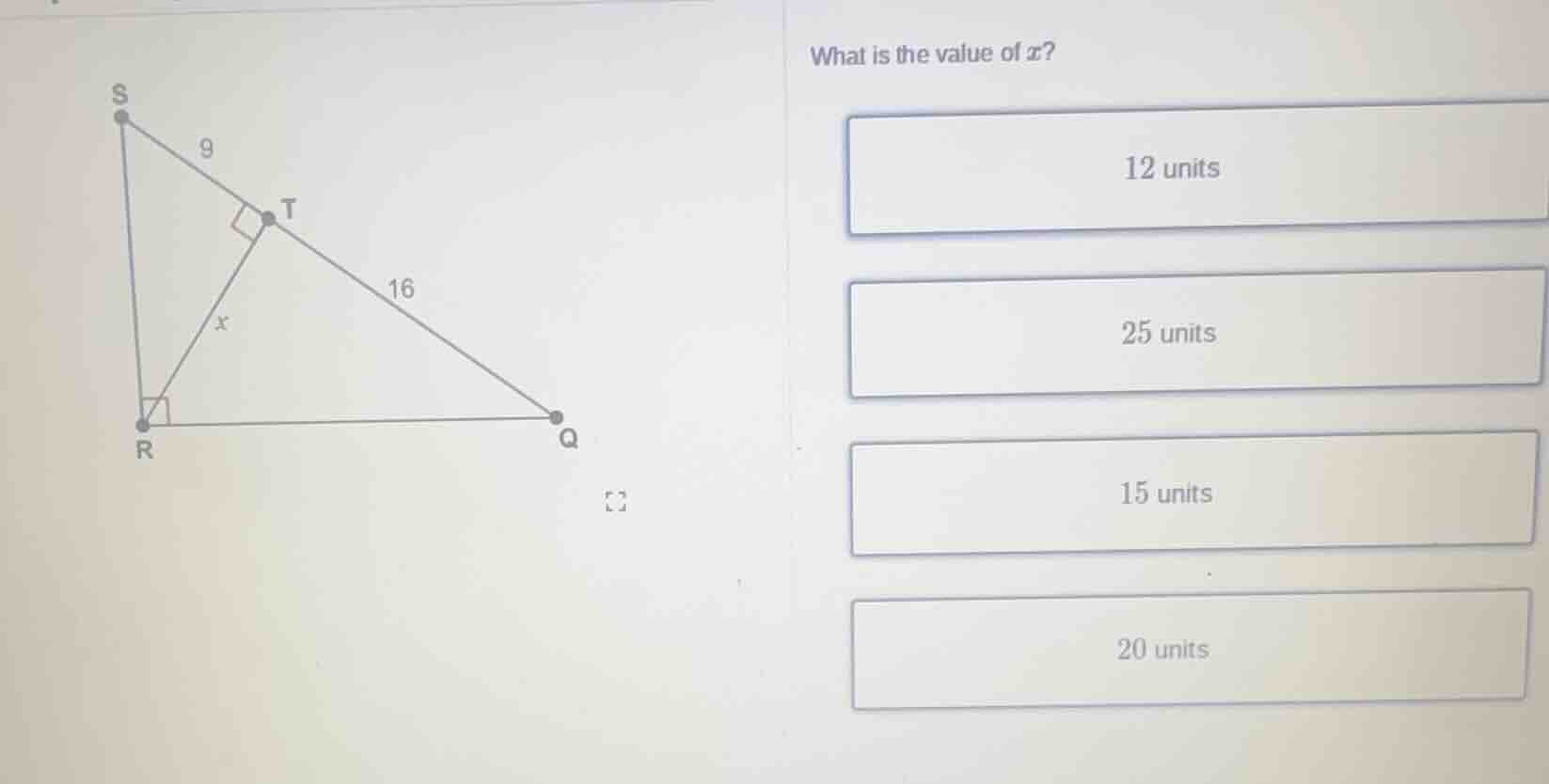
what is the value of x? 12 units 25 units 15 units 20 units
Step1: Recall the geometric mean theorem (altitude-on-hypotenuse theorem)
In a right triangle, the length of the altitude drawn to the hypotenuse is the geometric mean of the lengths of the two segments that the hypotenuse is divided into. Also, the length of each leg of the right triangle is the geometric mean of the length of the hypotenuse and the length of the adjacent segment. Here, for right triangle \( \triangle SRQ \) with right angle at \( R \) and altitude \( RT \) to hypotenuse \( SQ \), we have \( RT^2=ST\times TQ \), but wait, actually, the leg \( SR \) can be related, but more accurately, the length of the altitude \( x = RT \) can be found using the geometric mean, but also, another way: the length of the leg \( RQ \) or \( SR \)? Wait, no, the formula for the altitude to the hypotenuse is \( x=\sqrt{ST\times TQ} \)? Wait, no, let's check the segments. \( ST = 9 \), \( TQ=16 \), and the hypotenuse \( SQ=ST + TQ=9 + 16 = 25 \). Then, in a right triangle, the altitude to the hypotenuse is given by \( x=\frac{SR\times RQ}{SQ} \), but also, by the geometric mean, \( SR^2=ST\times SQ \) and \( RQ^2=TQ\times SQ \), and \( x^2=ST\times TQ \)? Wait, no, that's not correct. Wait, the correct formula is that in a right triangle, the altitude to the hypotenuse is the geometric mean of the two segments: \( x=\sqrt{ST\times TQ} \)? Wait, no, let's recast. Let's denote \( \triangle SRQ \) right-angled at \( R \), \( RT \perp SQ \) at \( T \). Then:
- \( \triangle STR \sim \triangle SRQ \sim \triangle RTQ \) (similar triangles)
- From similarity of \( \triangle STR \) and \( \triangle RTQ \), we have \( \frac{ST}{RT}=\frac{RT}{TQ} \), so \( RT^2=ST\times TQ \)
- Wait, but also, from \( \triangle SRQ \), \( SR^2 + RQ^2 = SQ^2=(9 + 16)^2=25^2=625 \)
- Also, \( SR^2=ST\times SQ=9\times25 = 225 \), so \( SR = 15 \)
- \( RQ^2=TQ\times SQ=16\times25 = 400 \), so \( RQ = 20 \)
- Then, the area of \( \triangle SRQ \) is \( \frac{1}{2}\times SR\times RQ=\frac{1}{2}\times15\times20 = 150 \)
- Also, area is \( \frac{1}{2}\times SQ\times x=\frac{1}{2}\times25\times x \)
- Setting equal: \( \frac{1}{2}\times25\times x=150 \), so \( 25x = 300 \), \( x = 12 \)? Wait, no, that contradicts the earlier thought. Wait, no, wait, maybe I mixed up the segments. Wait, the problem is asking for \( x \), which is \( RT \). Wait, let's do it step by step.
Wait, first, hypotenuse \( SQ = ST + TQ = 9 + 16 = 25 \). Then, in right triangle \( SRQ \), the altitude \( RT \) to hypotenuse \( SQ \) is given by the formula \( RT=\frac{SR\times RQ}{SQ} \). But we can find \( SR \) and \( RQ \) using the geometric mean:
- \( SR^2=ST\times SQ=9\times25 = 225 \), so \( SR = 15 \)
- \( RQ^2=TQ\times SQ=16\times25 = 400 \), so \( RQ = 20 \)
Then, area of \( \triangle SRQ \) is \( \frac{1}{2}\times SR\times RQ=\frac{1}{2}\times15\times20 = 150 \)
Also, area is \( \frac{1}{2}\times SQ\times RT=\frac{1}{2}\times25\times x \)
So, \( \frac{25x}{2}=150 \)
Multiply both sides by 2: \( 25x = 300 \)
Divide by 25: \( x = 12 \)
Wait, but let's check with the geometric mean of the segments. \( ST = 9 \), \( TQ = 16 \), so \( x^2=ST\times TQ=9\times16 = 144 \), so \( x = 12 \). Ah, there we go. I made a mistake earlier in the similarity ratio. The correct formula is that the altitude to the hypotenuse is the geometric mean of the two segments: \( x=\sqrt{ST\times TQ} \). So \( x=\sqrt{9\times16}=\sqrt{144}=12 \).
Step1: Identify the segments of the hypotenuse
The hypotenuse \( SQ \) is divided into two segments \( ST = 9 \) and \( TQ = 16 \) by the altitude \( RT…

Snap & solve any problem in the app
Get step-by-step solutions on Sovi AI
Photo-based solutions with guided steps
Explore more problems and detailed explanations
12 units