QUESTION IMAGE
Question
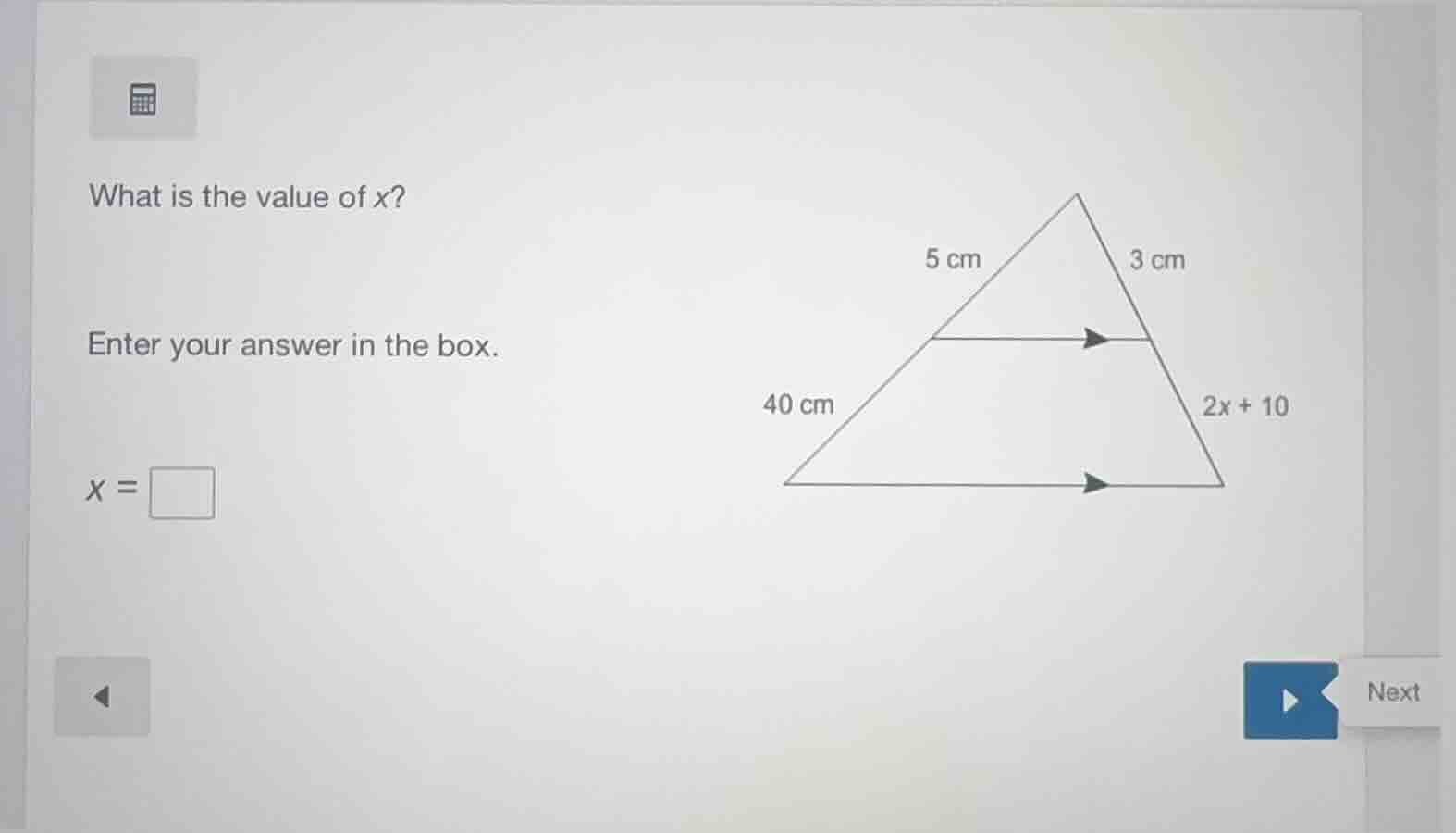
what is the value of x? enter your answer in the box. x = box (and there is a triangle with segments: 5 cm, 3 cm, 40 cm, 2x + 10)
Step1: Identify Similar Triangles
The line segment in the triangle is parallel to the base, so the two triangles are similar by the Basic Proportionality Theorem (Thales' theorem). Thus, the ratios of corresponding sides are equal.
The ratio of the sides of the smaller triangle to the larger triangle is $\frac{5}{5 + 40}=\frac{5}{45}=\frac{1}{9}$? Wait, no, actually, the corresponding sides: the side of length 5 cm in the smaller triangle corresponds to the side of length $5 + 40 = 45$ cm? No, wait, the smaller triangle has sides 5 cm and 3 cm, and the larger triangle (including the smaller one) has sides $5 + 40 = 45$ cm and $3 + (2x + 10)=2x + 13$ cm? Wait, no, actually, the correct corresponding sides: the side of length 5 cm in the smaller triangle corresponds to the side of length 40 + 5 = 45 cm? No, wait, the segment divides the sides into 5 cm and 40 cm, and 3 cm and $2x + 10$ cm. So the ratio of the smaller triangle's side to the larger triangle's side (the whole side) is $\frac{5}{5 + 40}=\frac{5}{45}=\frac{1}{9}$, and for the other side, $\frac{3}{3 + (2x + 10)}=\frac{3}{2x + 13}$. But since the triangles are similar, the ratios of corresponding sides should be equal. Wait, actually, the correct ratio is $\frac{5}{40 + 5}=\frac{3}{2x + 10 + 3}$? No, wait, no. Wait, the two triangles: the smaller one has sides 5 cm and 3 cm, and the larger one (the whole triangle) has sides $5 + 40 = 45$ cm and $3 + (2x + 10)=2x + 13$ cm? No, that's not right. Wait, the segment is parallel to the base, so the triangle above the segment is similar to the entire triangle. So the side of length 5 cm in the smaller triangle corresponds to the side of length $5 + 40 = 45$ cm in the larger triangle, and the side of length 3 cm in the smaller triangle corresponds to the side of length $3 + (2x + 10)=2x + 13$ cm? No, that's incorrect. Wait, actually, the correct corresponding sides: the side of length 5 cm (smaller triangle) corresponds to the side of length 40 cm + 5 cm = 45 cm (larger triangle's side), and the side of length 3 cm (smaller triangle) corresponds to the side of length $2x + 10$ cm + 3 cm? No, no. Wait, the segment is parallel to the base, so the triangle with sides 5 cm and 3 cm is similar to the triangle with sides $5 + 40 = 45$ cm and $3 + (2x + 10)=2x + 13$ cm? No, that's not. Wait, maybe I got the corresponding sides wrong. Let's think again. The two triangles: the smaller one has a side of 5 cm, and the larger triangle (the whole) has a side of 5 + 40 = 45 cm. The other side of the smaller triangle is 3 cm, and the other side of the larger triangle is 3 + (2x + 10) = 2x + 13 cm. But since they are similar, the ratio of corresponding sides is equal. So $\frac{5}{45}=\frac{3}{2x + 13}$. Wait, but that would be $\frac{1}{9}=\frac{3}{2x + 13}$, so $2x + 13 = 27$, $2x = 14$, $x = 7$. But that doesn't seem right. Wait, maybe the corresponding sides are 5 cm and 40 cm? No, that can't be. Wait, no, the segment is parallel to the base, so the triangle above the segment is similar to the triangle below? No, the triangle above the segment is similar to the entire triangle. So the side of length 5 cm (top triangle) corresponds to the side of length 5 + 40 = 45 cm (entire triangle's side), and the side of length 3 cm (top triangle) corresponds to the side of length 3 + (2x + 10) = 2x + 13 cm (entire triangle's side). But maybe the correct ratio is $\frac{5}{40}=\frac{3}{2x + 10}$. Ah! That's probably it. Because the segment divides the sides into 5 cm and 40 cm, and 3 cm and $2x + 10$ cm. So the ratio of the smaller triangle's side (5 cm)…

Snap & solve any problem in the app
Get step-by-step solutions on Sovi AI
Photo-based solutions with guided steps
Explore more problems and detailed explanations
7