QUESTION IMAGE
Question
what is the value of y? 6√3 units 12√3 units 3√3 units 9√3 units
Step1: Identify Similar Triangles
In the diagram, we have right triangles \( \triangle NTM \) and \( \triangle NUM \) (or using geometric mean theorem, also known as the altitude-on-hypotenuse theorem). The geometric mean theorem states that in a right triangle, the altitude to the hypotenuse is the geometric mean of the segments into which it divides the hypotenuse, and each leg is the geometric mean of the hypotenuse and the segment adjacent to that leg.
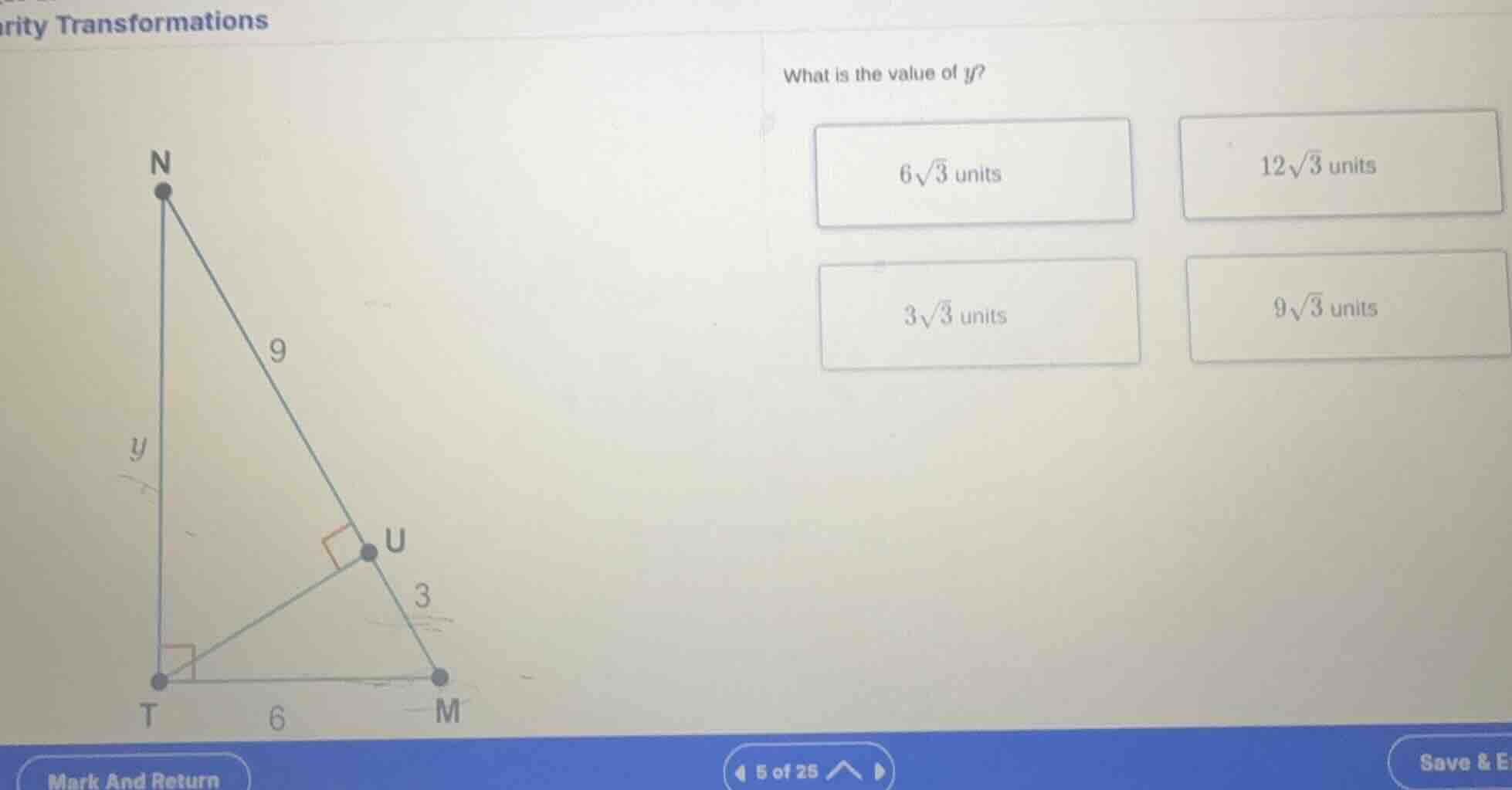
For right triangle \( \triangle NTM \) with right angle at \( T \), and \( TU \) perpendicular to \( NM \), we can use the property that \( NT^2 = NU \times NM \) and \( TM^2 = UM \times NM \), but more directly, we can use the proportion from similar triangles.
We know \( TM = 6 \), \( UM = 3 \), so \( NM = NU + UM \), but actually, looking at the lengths on \( NM \): the total length from \( N \) to \( M \) is \( 9 + 3 = 12 \)? Wait, no, the segment \( NU \) is 9? Wait, the diagram shows \( NU = 9 \)? Wait, no, the side \( NM \) is composed of \( NU = 9 \)? Wait, no, the length from \( N \) to \( U \) is 9, and from \( U \) to \( M \) is 3, so \( NM = 9 + 3 = 12 \). And \( TM = 6 \), \( NT = y \).
By the geometric mean theorem (leg - hypotenuse segment proportion), in a right triangle, the length of a leg is the geometric mean of the length of the hypotenuse and the length of the adjacent segment of the hypotenuse. So \( NT^2 = NU \times NM \)? Wait, no, the correct proportion is: if in right triangle \( \triangle ABC \) with right angle at \( C \), and altitude \( CD \) to hypotenuse \( AB \), then \( AC^2 = AD \times AB \), \( BC^2 = BD \times AB \).
In our case, right triangle \( \triangle NTM \) (right angle at \( T \)), and \( TU \) is the altitude to hypotenuse \( NM \). So \( NT^2 = NU \times NM \), \( TM^2 = UM \times NM \).
We have \( TM = 6 \), \( UM = 3 \), \( NM = NU + UM \), but \( NU \) is 9? Wait, the length from \( N \) to \( U \) is 9, so \( NU = 9 \), \( UM = 3 \), so \( NM = 9 + 3 = 12 \). Then using \( TM^2 = UM \times NM \), let's check: \( 6^2 = 3 \times 12 \)? \( 36 = 36 \), which works. Now for \( NT^2 = NU \times NM \), so \( y^2 = 9 \times 12 \).
Step2: Calculate \( y \)
\( y^2 = 9 \times 12 = 108 \)
Take the square root: \( y = \sqrt{108} = \sqrt{36 \times 3} = 6\sqrt{3} \)? Wait, no, wait: Wait, maybe I mixed up the segments. Wait, the leg \( NT = y \), the adjacent segment on hypotenuse \( NM \) is \( NU \), and hypotenuse \( NM = 12 \) (since \( NU = 9 \), \( UM = 3 \), so \( NM = 12 \)). Wait, but \( TM = 6 \), and by the geometric mean theorem, \( TM^2 = UM \times NM \), so \( 6^2 = 3 \times NM \), so \( 36 = 3 \times NM \), so \( NM = 12 \), which matches \( NU + UM = 9 + 3 = 12 \). Then for \( NT \), \( NT^2 = NU \times NM \), so \( y^2 = 9 \times 12 = 108 \), so \( y = \sqrt{108} = 6\sqrt{3} \)? Wait, no, wait, maybe I got the segments wrong. Wait, the other leg: Wait, \( NT \) is \( y \), \( TM = 6 \), \( NM = 12 \). Wait, using Pythagoras? Wait, no, \( \triangle NTM \) is right-angled at \( T \), so \( NT^2 + TM^2 = NM^2 \). Let's check: \( y^2 + 6^2 = 12^2 \), so \( y^2 + 36 = 144 \), so \( y^2 = 108 \), so \( y = \sqrt{108} = 6\sqrt{3} \). Wait, but that's one of the options. Wait, but let's re - examine the diagram.
Wait, maybe the length from \( N \) to \( U \) is 9? Wait, the side \( NU \) is 9, \( UM = 3 \), so \( NM = 12 \), \( TM = 6 \). Then by Pythagoras in \( \triangle NTM \): \( NT^2 + TM^2 = NM^2 \), so \( y^2 + 6^2 = 12^2 \), \( y^2 = 144 - 36 = 108 \), \( y = \sqrt{108} = 6\sqrt{3} \). Wait, but let's check the geo…

Snap & solve any problem in the app
Get step-by-step solutions on Sovi AI
Photo-based solutions with guided steps
Explore more problems and detailed explanations
\( 6\sqrt{3} \) units