QUESTION IMAGE
Question
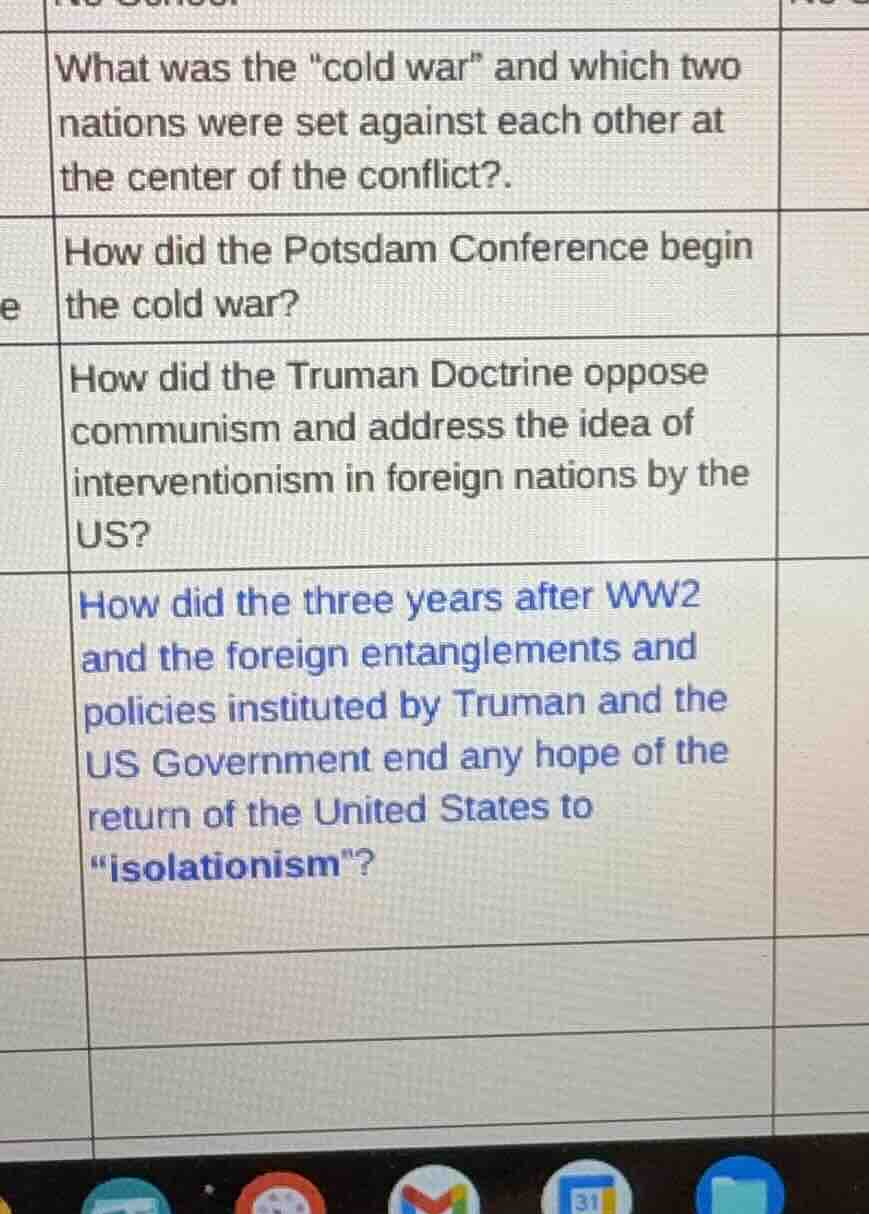
what was the \cold war\ and which two nations were set against each other at the center of the conflict?.
how did the potsdam conference begin the cold war?
how did the truman doctrine oppose communism and address the idea of interventionism in foreign nations by the us?
how did the three years after ww2 and the foreign entanglements and policies instituted by truman and the us government end any hope of the return of the united states to \isolationism\?
Brief Explanations
- For the Cold War question: The Cold War was a prolonged geopolitical rivalry (1947–1991) marked by political tension, proxy wars, and ideological conflict, without direct large-scale fighting between the two main powers. The core opposing nations were the U.S. (capitalist, democratic bloc) and the Soviet Union (communist, authoritarian bloc).
- For the Potsdam Conference question: The conference (1945) deepened mistrust between the U.S./UK and the USSR. Disagreements over post-WW2 German reconstruction, reparations, and Soviet influence in Eastern Europe created unresolved tensions that laid the groundwork for the Cold War's division of Europe.
- For the Truman Doctrine question: The 1947 Truman Doctrine pledged U.S. economic and military aid to nations threatened by communist takeovers (starting with Greece and Turkey). It formalized U.S. interventionism, framing the conflict as a global struggle against communism justifying active foreign involvement.
- For the isolationism question: Post-WW2, Truman's policies (Truman Doctrine, Marshall Plan, NATO membership) tied the U.S. to global alliances and economic commitments. Foreign entanglements like supporting anti-communist regimes, participating in collective security, and rebuilding Europe meant the U.S. abandoned its pre-WW2 policy of staying out of distant foreign conflicts permanently.

Snap & solve any problem in the app
Get step-by-step solutions on Sovi AI
Photo-based solutions with guided steps
Explore more problems and detailed explanations
- The "Cold War" was a decades-long, non-directly violent geopolitical and ideological rivalry between capitalist and communist blocs after WWII. The two opposing core nations were the United States and the Soviet Union.
- The 1945 Potsdam Conference created unresolved tensions over German governance, reparations, and Soviet control of Eastern Europe, deepening mistrust between the U.S./UK and USSR that initiated Cold War divisions.
- The Truman Doctrine (1947) provided U.S. economic/military aid to nations threatened by communism (e.g., Greece, Turkey), formalizing U.S. interventionism as a core foreign policy to counter global communist expansion.
- Post-WW2 U.S. policies (Truman Doctrine, Marshall Plan, NATO) and commitments to global anti-communist efforts, collective security, and European rebuilding tied the U.S. to permanent foreign entanglements, ending any return to pre-war isolationism.