QUESTION IMAGE
Question
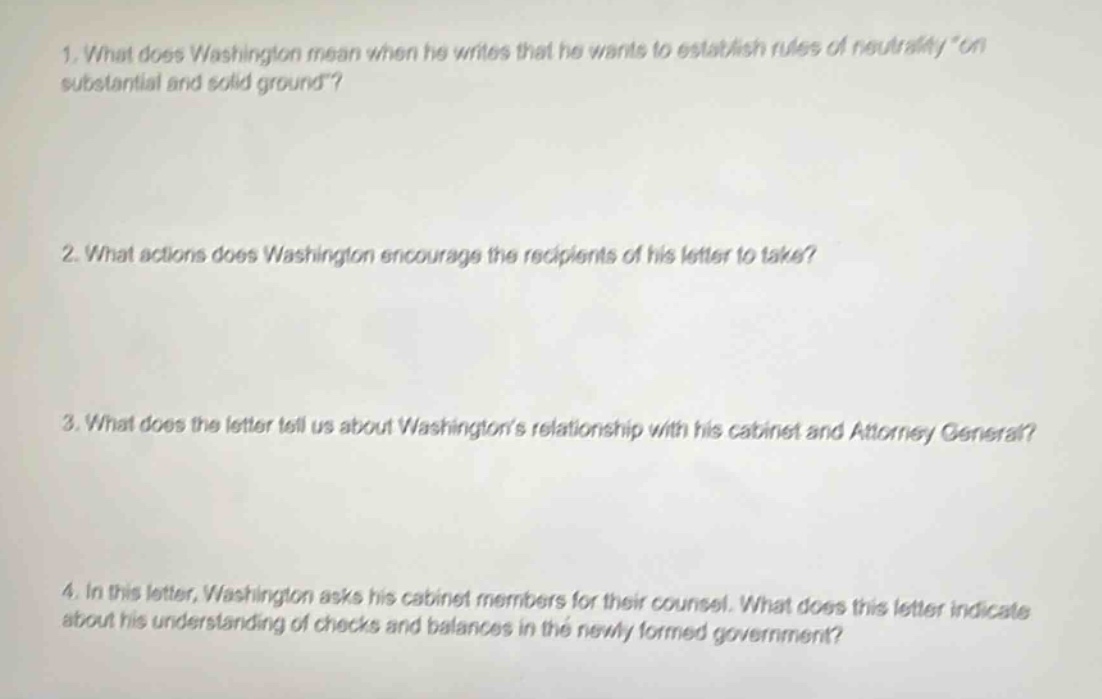
- what does washington mean when he writes that he wants to establish rules of neutrality \on substantial and solid ground\?
- what actions does washington encourage the recipients of his letter to take?
- what does the letter tell us about washington’s relationship with his cabinet and attorney general?
- in this letter, washington asks his cabinet members for their counsel. what does this letter indicate about his understanding of checks and balances in the newly formed government?
To answer these questions, we would typically analyze the relevant letter from George Washington (likely related to his policy of neutrality, such as the Neutrality Proclamation or correspondence with his cabinet). Here's a general approach for each:
Question 1:
"On substantial and solid ground" suggests Washington wants neutrality rules based on clear, defensible principles (e.g., legal, moral, or practical justifications) to withstand scrutiny. He likely aims for a neutrality policy rooted in the nation’s interests (e.g., avoiding European conflicts to protect U.S. stability) and grounded in law or precedent.
Washington likely encourages recipients (e.g., cabinet, officials) to support neutrality, follow the policy, or provide counsel (if the letter is to the cabinet). For example, in his neutrality correspondence, he might urge adherence to neutrality, avoid aiding European powers, or advise on implementing the policy.
The letter likely shows a collaborative relationship: Washington values cabinet/Attorney General input (e.g., seeking their advice on neutrality), indicating trust in their counsel. It suggests he respects their roles in governance, working with them to shape policy (e.g., consultative leadership, shared decision-making).

Snap & solve any problem in the app
Get step-by-step solutions on Sovi AI
Photo-based solutions with guided steps
Explore more problems and detailed explanations
Washington means he wants neutrality rules based on clear, defensible principles (e.g., national interest, legal/moral justifications) to be stable and justifiable.