QUESTION IMAGE
Question
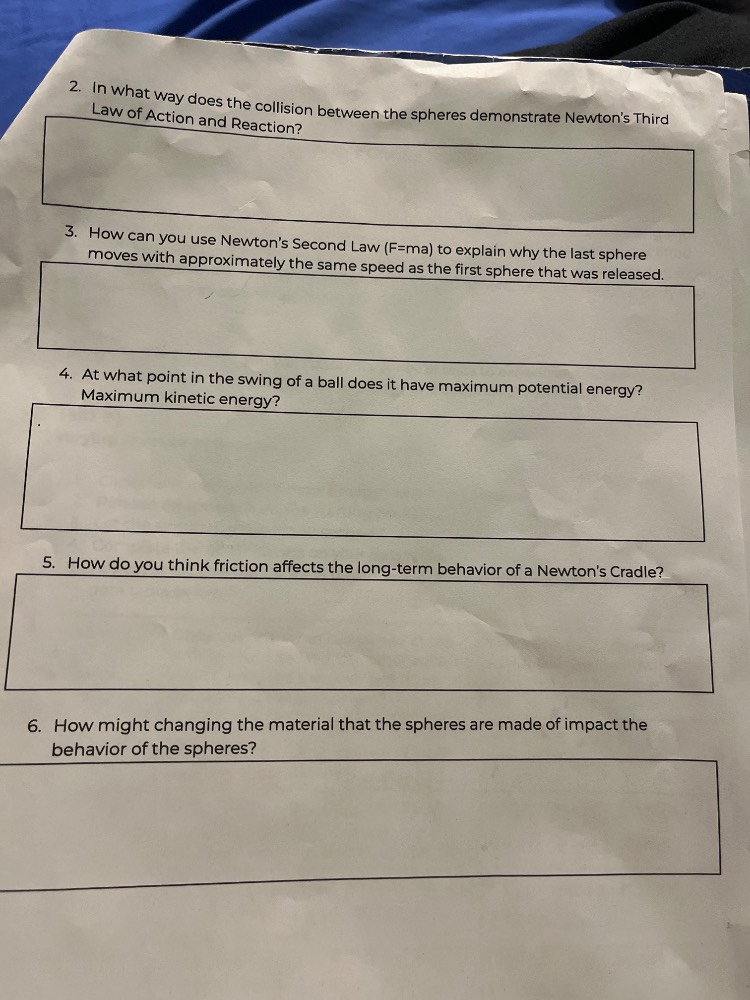
- in what way does the collision between the spheres demonstrate newtons third law of action and reaction?
- how can you use newtons second law (f=ma) to explain why the last sphere moves with approximately the same speed as the first sphere that was released.
- at what point in the swing of a ball does it have maximum potential energy? maximum kinetic energy?
- how do you think friction affects the long-term behavior of a newtons cradle?
- how might changing the material that the spheres are made of impact the behavior of the spheres?
Brief Explanations
- When one sphere hits the stationary spheres, it exerts a force on the first stationary sphere (action). That sphere immediately exerts an equal and opposite force back on the incoming sphere (reaction). This paired force transfer through the spheres causes the last sphere to move, as each interaction follows the equal and opposite action-reaction rule.
- Newton's Second Law ($F=ma$) links force, mass, and acceleration. All spheres have equal mass ($m_1=m_2=...=m_n$). The force from the first sphere's collision is transferred through the identical spheres; each sphere's acceleration is proportional to the force applied. Since mass is constant, the acceleration from the transferred force results in the last sphere gaining the same speed as the first, as the force and mass relationship preserves the velocity through the collisions.
- Potential energy depends on height ($PE=mgh$). A ball has maximum potential energy at the highest point of its swing (farthest from the lowest position), as height $h$ is greatest. Kinetic energy depends on speed ($KE=\frac{1}{2}mv^2$); maximum kinetic energy occurs at the lowest point of the swing, where the ball's speed is highest (all potential energy converts to kinetic energy).
- Friction (air resistance, friction at the pivot points) acts as a non-conservative force, removing mechanical energy (potential + kinetic) from the system over time. This means the spheres will gradually swing with smaller and smaller amplitudes, until eventually they come to a complete stop.
- The material affects mass, elasticity, and density. Denser materials (like steel) have higher mass, so collisions transfer more energy. More elastic materials (like hardened steel) have nearly perfectly elastic collisions, preserving more kinetic energy and keeping the cradle moving longer. Less elastic materials (like wood) will lose more energy to deformation during collisions, making the swings die down faster, and may not transfer speed as efficiently between spheres.

Snap & solve any problem in the app
Get step-by-step solutions on Sovi AI
Photo-based solutions with guided steps
Explore more problems and detailed explanations
- When a sphere collides with the others, it exerts an action force on a stationary sphere, which exerts an equal, opposite reaction force back. This paired force transfer through identical spheres causes the last sphere to move, directly showing equal and opposite action-reaction.
- Since all spheres have equal mass, the force from the first sphere's collision is transferred through the spheres. By $F=ma$, equal force on equal mass creates equal acceleration, so the last sphere gains the same speed as the first released sphere.
- Maximum potential energy: At the highest point of the ball's swing.
Maximum kinetic energy: At the lowest point of the ball's swing.
- Friction removes mechanical energy from the system over time, causing the spheres' swing amplitude to decrease gradually until they eventually stop moving.
- Denser, more elastic materials (e.g., steel) preserve more kinetic energy during collisions, keeping the cradle moving longer and transferring speed efficiently. Less elastic, less dense materials (e.g., wood) lose more energy to deformation, making swings die down faster and reducing speed transfer efficiency.