QUESTION IMAGE
Question
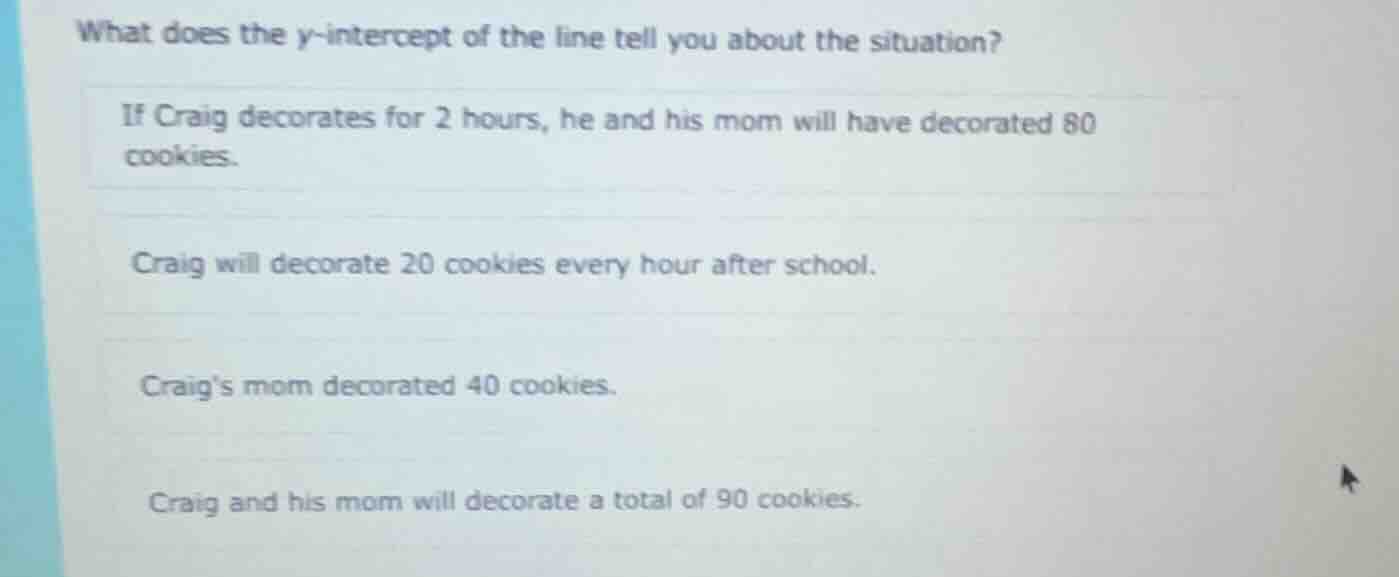
what does the y-intercept of the line tell you about the situation?
if craig decorates for 2 hours, he and his mom will have decorated 80 cookies.
craig will decorate 20 cookies every hour after school.
craigs mom decorated 40 cookies.
craig and his mom will decorate a total of 90 cookies.
To determine what the \( y \)-intercept tells us, we recall that in a linear model (e.g., \( y = mx + b \)), the \( y \)-intercept (\( b \)) represents the value of \( y \) when \( x = 0 \). Here, \( x \) is likely the time (hours Craig decorates), and \( y \) is the number of decorated cookies. When \( x = 0 \) (Craig has decorated for 0 hours), the \( y \)-intercept would show the number of cookies already decorated (by his mom, since Craig hasn't started yet).
- The first option refers to \( x = 2 \) (2 hours), not \( x = 0 \), so it’s not the \( y \)-intercept.
- The second option describes the rate (slope, \( m \)), not the \( y \)-intercept.
- The third option: If \( x = 0 \) (Craig decorates for 0 hours), the \( y \)-intercept would be the cookies his mom decorated (since Craig hasn’t contributed yet). This matches the definition of a \( y \)-intercept (value at \( x = 0 \)).
- The fourth option refers to a total, not necessarily the value at \( x = 0 \).

Snap & solve any problem in the app
Get step-by-step solutions on Sovi AI
Photo-based solutions with guided steps
Explore more problems and detailed explanations
Craig's mom decorated 40 cookies.