QUESTION IMAGE
Question
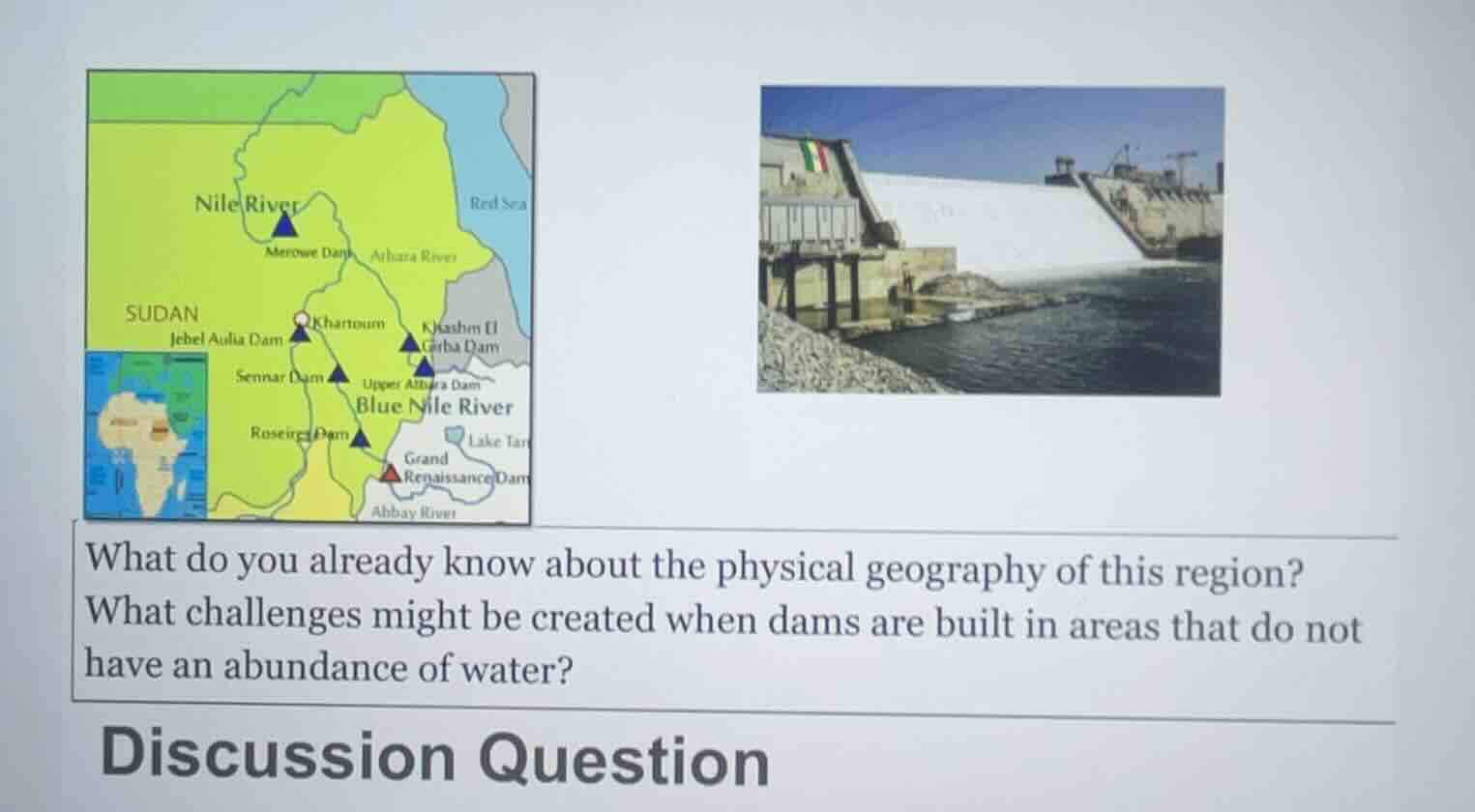
what do you already know about the physical geography of this region?what challenges might be created when dams are built in areas that do not have an abundance of water?discussion question
Brief Explanations
- For the physical geography of the Nile region: This is an arid/semi-arid area centered on the Nile River, which is the primary freshwater source. The region has low rainfall, relies on Nile runoff from upstream tropical regions, and features flat floodplains along the river that support agriculture, surrounded by desert landscapes.
- For dam challenges in water-scarce areas:
- Upstream/downstream water conflict: Dams reduce downstream flow, limiting water access for communities and ecosystems.
- Reservoir evaporation loss: High aridity leads to massive water loss via evaporation, reducing usable water storage.
- Ecological collapse: Reduced river flow harms riparian habitats, fish populations, and natural floodplain fertility cycles.
- Agricultural disruption: Less downstream water limits irrigation, threatening food security for local populations.

Snap & solve any problem in the app
Get step-by-step solutions on Sovi AI
Photo-based solutions with guided steps
Explore more problems and detailed explanations
- Physical geography of the region:
- It is an arid/semi-arid region dominated by the Nile River, the critical freshwater source for the area.
- Most surrounding land is desert, with fertile narrow floodplains along the Nile supporting human settlement and agriculture.
- The river's flow is sustained by upstream rainfall in wetter tropical regions, not local precipitation.
- Challenges of dams in water-scarce areas:
- Heightened transboundary water disputes over reduced downstream flows.
- Significant water loss from reservoir evaporation in dry, hot conditions.
- Degradation of riparian ecosystems and loss of aquatic biodiversity due to reduced natural flow.
- Reduced sediment deposition on floodplains, lowering soil fertility for agriculture.
- Risk of water scarcity for downstream communities and livestock if reservoir levels drop too low.