QUESTION IMAGE
Question
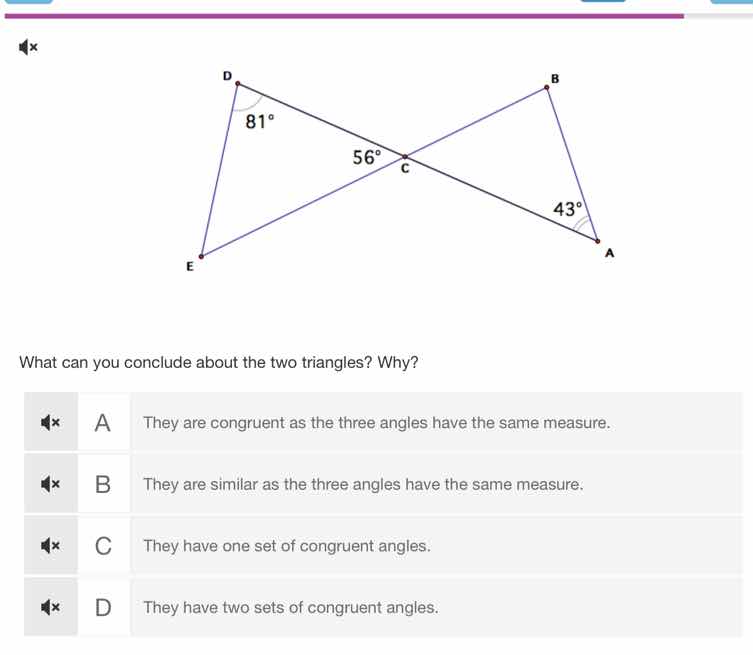
what can you conclude about the two triangles? why? a they are congruent as the three angles have the same measure. b they are similar as the three angles have the same measure. c they have one set of congruent angles. d they have two sets of congruent angles.
Brief Explanations
- First, find the third angle in triangle \( DEC \): The sum of angles in a triangle is \( 180^\circ \). So, the third angle \( \angle E = 180^\circ - 81^\circ - 56^\circ = 43^\circ \).
- In triangle \( ABC \), \( \angle A = 43^\circ \), and \( \angle ACB = 56^\circ \) (vertical angles with \( \angle DCE \)). Then the third angle \( \angle B = 180^\circ - 43^\circ - 56^\circ = 81^\circ \).
- Now, compare the angles: \( \angle D = 81^\circ = \angle B \), \( \angle E = 43^\circ = \angle A \), \( \angle DCE = 56^\circ = \angle ACB \). So all three angles are congruent.
- For similar triangles, the AA (Angle - Angle) criterion states that if two angles of one triangle are congruent to two angles of another triangle, the triangles are similar. Since all three angles are congruent, the triangles are similar (similarity is about angle correspondence and proportional sides, while congruence requires sides to be equal too). Option A is wrong because congruence needs side equality, not just angle equality. Option C and D are wrong as there are three sets of congruent angles.

Snap & solve any problem in the app
Get step-by-step solutions on Sovi AI
Photo-based solutions with guided steps
Explore more problems and detailed explanations
B. They are similar as the three angles have the same measure.