QUESTION IMAGE
Question
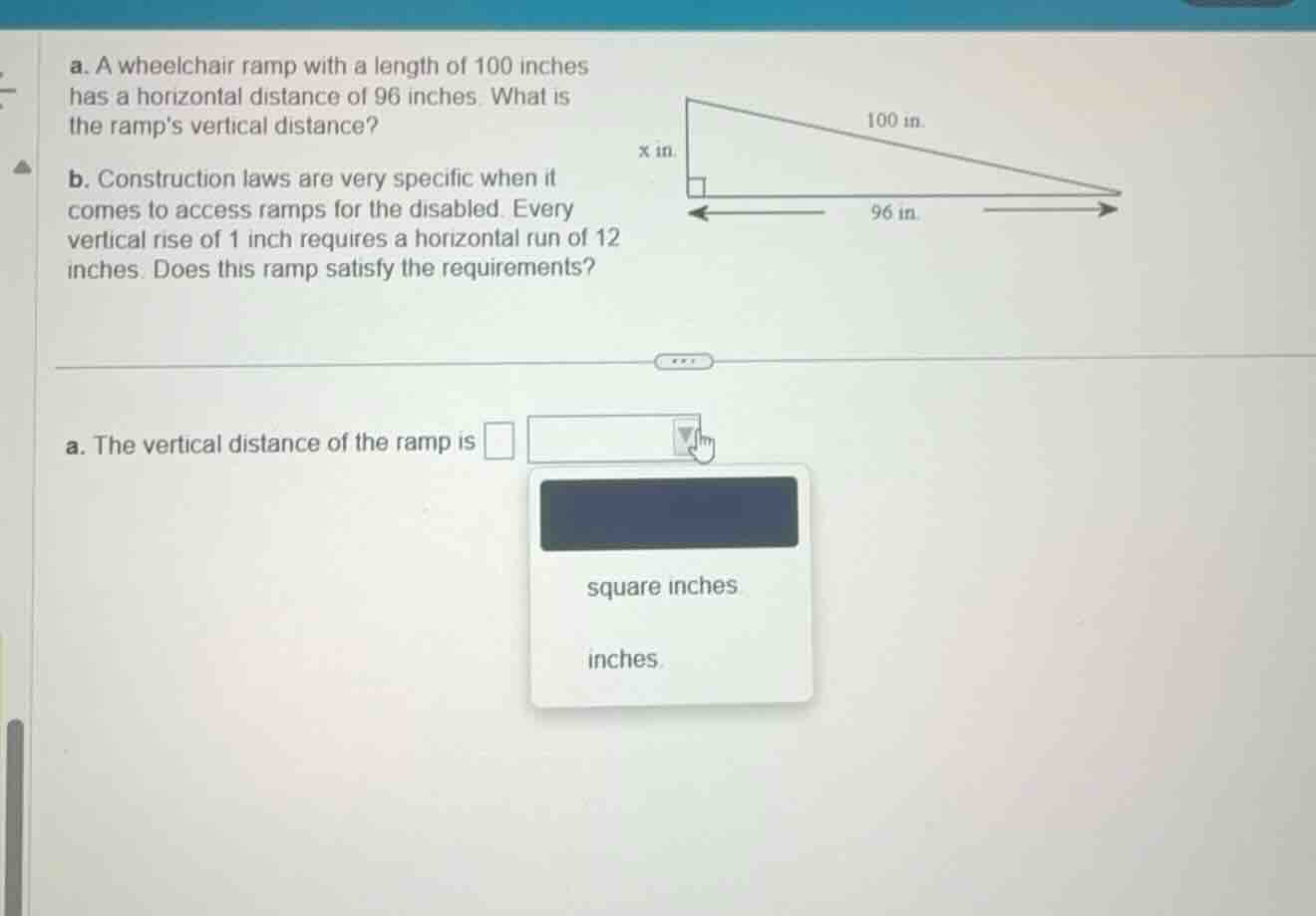
a. a wheelchair ramp with a length of 100 inches has a horizontal distance of 96 inches. what is the ramp’s vertical distance?
b. construction laws are very specific when it comes to access ramps for the disabled. every vertical rise of 1 inch requires a horizontal run of 12 inches. does this ramp satisfy the requirements?
a. the vertical distance of the ramp is dropdown with square inches, inches
Step1: Apply Pythagorean theorem
Let vertical distance = $x$. The theorem states $a^2 + b^2 = c^2$, so:
$$x^2 + 96^2 = 100^2$$
Step2: Calculate squared values
$$x^2 + 9216 = 10000$$
Step3: Isolate $x^2$
$$x^2 = 10000 - 9216 = 784$$
Step4: Solve for $x$
$$x = \sqrt{784} = 28$$
Step5: Check ramp requirement
For 28-inch rise, required horizontal run is $28 \times 12 = 336$ inches. Compare to actual 96 inches.

Snap & solve any problem in the app
Get step-by-step solutions on Sovi AI
Photo-based solutions with guided steps
Explore more problems and detailed explanations
a. The vertical distance of the ramp is 28 inches
b. No, this ramp does not satisfy the requirements. The required horizontal run for a 28-inch rise is 336 inches, but the ramp only has a 96-inch horizontal run.