QUESTION IMAGE
Question
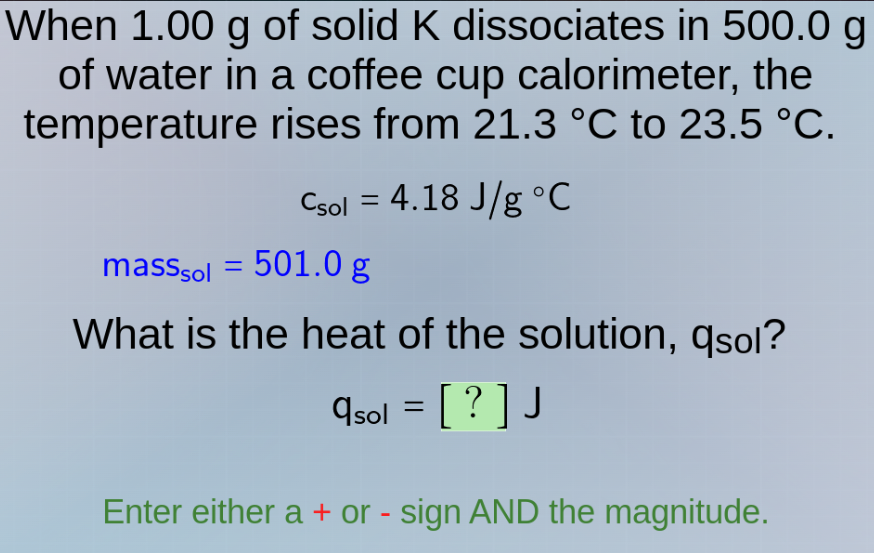
when 1.00 g of solid k dissociates in 500.0 g of water in a coffee cup calorimeter, the temperature rises from 21.3 °c to 23.5 °c.
$c_{sol} = 4.18 \\, \text{j/g °c}$
$\text{mass}_{sol} = 501.0 \\, \text{g}$
what is the heat of the solution, $q_{sol}$?
$q_{sol} = ? \\, \text{j}$
enter either a + or - sign and the magnitude.
Step1: Recall the formula for heat
The formula to calculate heat is \( q = mc\Delta T \), where \( m \) is mass, \( c \) is specific heat capacity, and \( \Delta T \) is the change in temperature.
Step2: Calculate the change in temperature
\( \Delta T = T_{final} - T_{initial} = 23.5^\circ C - 21.3^\circ C = 2.2^\circ C \)
Step3: Substitute values into the formula
We know \( m = 501.0 \, g \), \( c = 4.18 \, J/g^\circ C \), and \( \Delta T = 2.2^\circ C \). Plugging these into the formula:
\( q_{sol} = 501.0 \, g \times 4.18 \, J/g^\circ C \times 2.2^\circ C \)
First, calculate \( 501.0 \times 4.18 = 2094.18 \)
Then, \( 2094.18 \times 2.2 = 4607.196 \)
Since the temperature of the solution rises, the heat is absorbed by the solution, so \( q_{sol} \) is positive.

Snap & solve any problem in the app
Get step-by-step solutions on Sovi AI
Photo-based solutions with guided steps
Explore more problems and detailed explanations
+4607.2 (or approximately +4607, depending on rounding preferences)